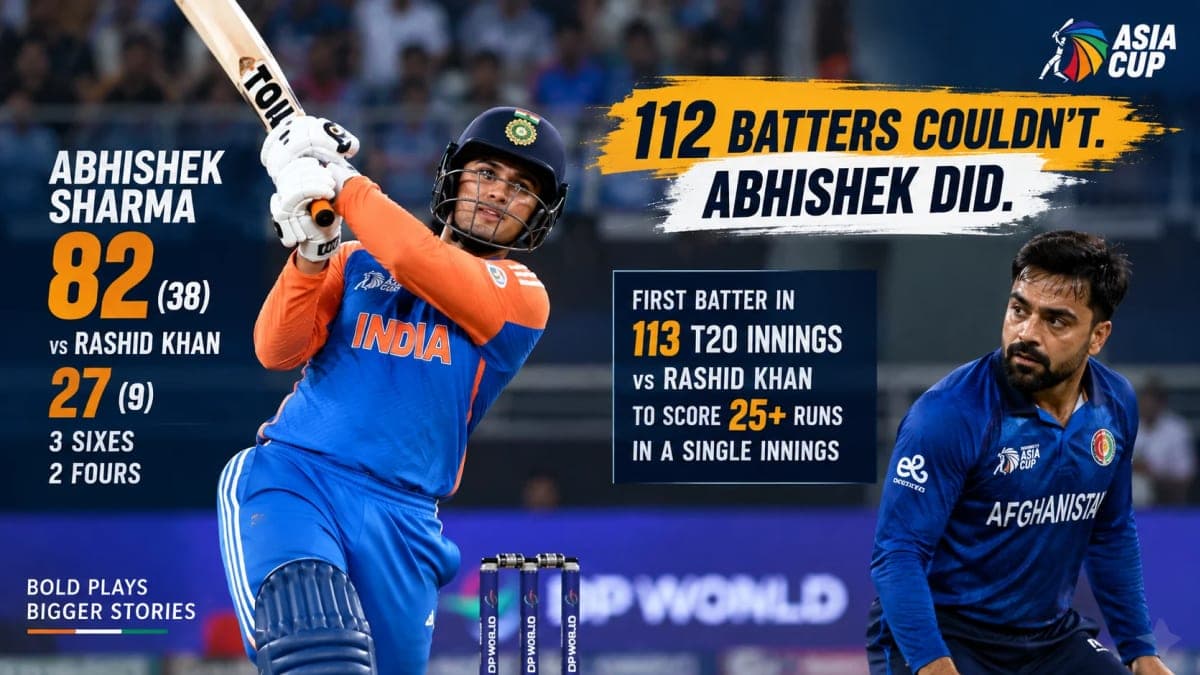
Abhishek Sharma Breaks New Ground Against Rashid Khan With 27 Runs Off Just 9 Balls
Abhishek Sharma’s 82 off 38 balls against Afghanistan already looked imposing on the scorecard. Hidden inside it was an even more unusual achievement.
The Indian opener scored 27 runs from only nine deliveries bowled by Rashid Khan, hitting the Afghanistan leg-spinner for two fours and three sixes. According to statistical data published after the match, no batter in the previous 112 T20 innings in which Rashid had bowled had managed to take 25 or more runs from him in a single innings.
Abhishek became the first.
The assault helped India chase Afghanistan’s 172-run target with 11 balls remaining, winning by seven wickets and strengthening its position in the Asia Cup Super Four stage. (indianexpress.com)
Abhishek vs Rashid: Nine Balls That Changed the Numbers
Rashid Khan has spent much of his T20 career forcing batters to choose between caution and risk.
Abhishek chose neither.
He attacked.
Across nine deliveries from Rashid, the left-hander accumulated:
27 runs
3 sixes
2 fours
That works out to a strike rate of 300 against Rashid alone.
The significance becomes clearer when compared with the leg-spinner’s long record in T20 cricket.
Before this match, 112 different batting innings against Rashid had passed without a batter reaching the 25-run mark against him in a single T20 innings, according to the statistical reporting cited after India’s victory.
Abhishek crossed it in nine balls.
Why Scoring 27 Off Rashid Khan Is Different
There is a reason the statistic attracted attention beyond Abhishek’s overall score.
Rashid is not simply Afghanistan’s leading spinner. He has been one of the defining bowlers of the modern franchise-T20 era, playing in competitions including the IPL and other major leagues around the world.
His combination of pace through the air, a difficult-to-read googly and the ability to attack the stumps has traditionally made sustained hitting against him risky.
Many batters therefore approach his four-over spell as something to survive rather than dominate.
Abhishek’s approach was the opposite.
Instead of allowing Rashid to settle into a defensive spell, he repeatedly looked for boundaries.
That aggression was particularly valuable because Afghanistan needed its captain and premier spinner to slow India after a rapid start.
He could not.
82 Runs in 38 Balls Set Up India's Chase
The Rashid matchup was only one part of Abhishek’s innings.
He struck 82 from 38 deliveries, finishing with a strike rate above 215.
India was chasing 172 after Afghanistan posted 171/7.
Abhishek’s powerplay aggression immediately changed the required-rate equation and prevented Afghanistan from creating sustained scoreboard pressure.
By the time he was dismissed, India had already gained control of the chase.
The visitors eventually reached the target with 11 balls remaining, sealing a seven-wicket victory. (timesofindia.indiatimes.com)
Afghanistan Had 171 to Defend
Afghanistan's total was competitive enough to give its bowling attack something to work with.
They finished at 171/7, leaving India a required rate of 8.6 runs per over.
Against a bowling attack containing Rashid, that was not a trivial chase.
But Abhishek's early acceleration changed its shape.
Every boundary above the required rate created breathing room for the batters who followed. More importantly, attacking Rashid meant Afghanistan could not rely on its strongest bowler to compensate for expensive overs elsewhere.
That is what made the matchup strategically important, not merely statistically unusual.
The Record Needs One Important Qualification
“Abhishek did what 112 batters couldn't” makes for a striking headline, but the underlying statistic needs to be stated precisely.
It does not mean Abhishek is the first batter ever to hit Rashid Khan aggressively.
Nor does it mean nobody has previously hit him for multiple sixes.
The record reported after the match is more specific:
Abhishek became the first batter across 113 T20 batting innings against Rashid Khan to score at least 25 runs off Rashid within one innings.
His final tally against the spinner was 27 from nine balls.
That distinction matters because cricket statistics can become misleading when the qualification behind a record disappears from the headline.
Abhishek's Method Makes the Matchup Interesting
Abhishek has built his reputation around attacking bowling rather than waiting for weaker matchups.
That approach becomes particularly valuable in modern T20 cricket because teams often use their best bowlers to control specific phases of an innings.
If an opener can attack the opposition's premier spinner rather than simply seeing him off, the bowling side loses one of its most reliable ways of slowing a chase.
There is also a trade-off.
This style naturally carries dismissal risk. An aggressive batter taking on Rashid can lose his wicket just as quickly as he can change a match.
Against Afghanistan, the risk paid off decisively.
A Growing Reputation as India's Powerplay Aggressor
Abhishek's innings also fits the role India has increasingly asked him to perform at the top of the order.
His value is not built around conventional accumulation followed by late acceleration. He tries to push the scoring rate early enough that the rest of the batting order inherits a more manageable equation.
That can be particularly disruptive against teams whose plans depend on introducing their strongest bowlers after the powerplay to regain control.
Against Afghanistan, Rashid represented exactly that opportunity.
Instead, Abhishek turned the matchup into another source of runs.
What the 27 Runs Really Tell Us
The most useful way to read the record is not that Rashid suddenly became ineffective.
One innings does not erase a career built on sustained T20 success.
The statistic tells us something more specific about Abhishek.
He was prepared to attack an elite bowler in a matchup where most batters historically have not been able to sustain that level of scoring.
Nine balls are a small sample. But in a 20-over chase, nine balls can matter enormously.
Abhishek extracted 27 runs from them.
India needed 172.
That burst accounted for almost 16% of the entire target, against Afghanistan's best-known bowler alone.
India Found More Than Just Two Points
The seven-wicket win mattered in the Asia Cup Super Four standings, but Abhishek's performance offered India something strategically useful beyond the result.
T20 knockout matches often turn on how teams handle the opposition's strongest four-over spell.
India now has an opener demonstrating that his instinct is not necessarily to protect his wicket when that spell arrives.
Against Rashid Khan, one of the toughest tests of that approach, Abhishek did not merely survive.
He scored at three runs per ball.
And after 112 previous batting innings had failed to reach 25 against Rashid in a single T20 innings, Abhishek pushed the number to 27 in just nine deliveries.