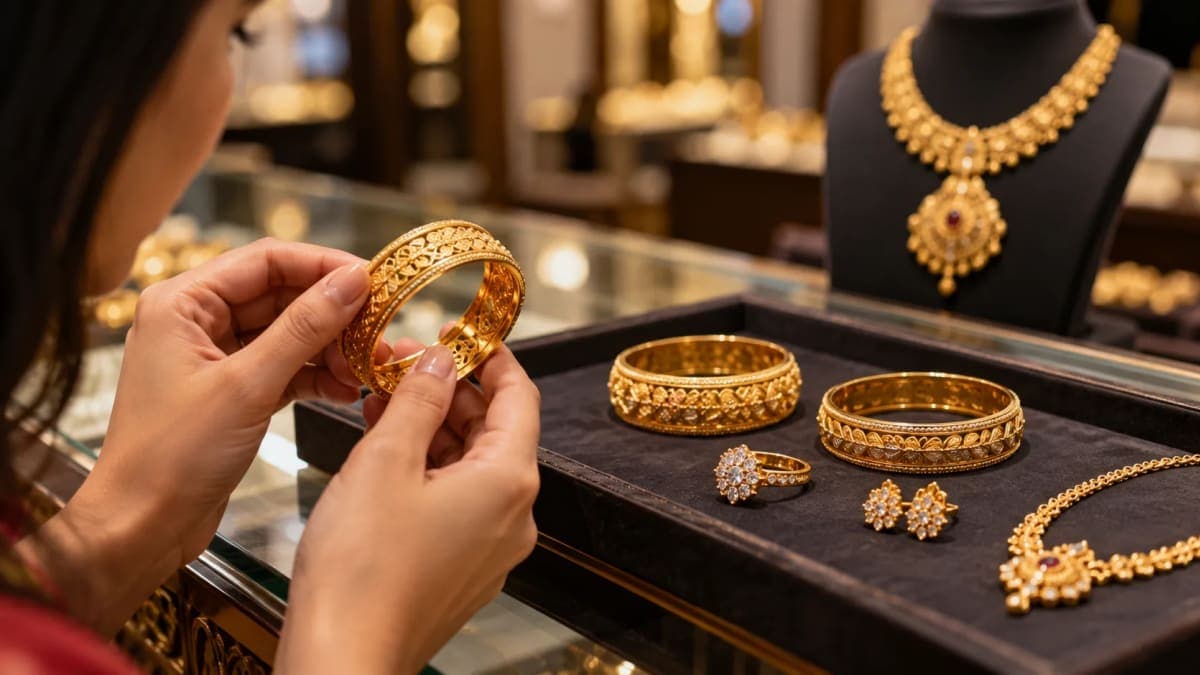
Buying gold jewellery always starts with a choice between 18K, 22K and 24K. The numbers is about how pure the gold is, but choosing the high karat does not necessarily mean you are getting the most suitable jewellery.
Any piece meant for occasional wear has different requirements. That maybe everyday ring, jewellery holding diamonds and other gemstones. Purity always matters, but with purity strength, design, colour, price and how the jewellery will be used is also a concern.
Under BIS-(Bureau of Indian Standards) specifications, common fineness markings include 18K750 and 22K916. BIS standards also recognise fine and standard gold at 999 and 995 parts per 1000 respectively.
What 24K, 22K and 18K mean ?
Purity of gold is always measured using the karat system, which divides purity into 24 parts.
At the highest end, 24K means gold that is pure or very close to pure. BIS specifies 24KF as fine gold with at least 999 parts per 1000 and 24KS as standard gold with at least 995 parts per 1000.
For 22K gold, the minimum fineness is 916, meaning 916 parts out of every 1,000 are gold. That works out to 91.6%.
With 18K gold, the fineness drops to 750, or 75% gold. The remaining 25% is made up of other metals in the alloy.
The World Gold Council also explains 18K as 75% gold and 25% other metals, which may include copper or silver that depends on the alloy and the colour being produced.
Put simply:
24K ≈ 99.9% gold
22K = 91.6% gold
18K = 75% gold
This percentages become more meaningful when the metal needs to be shaped into jewellery that can withstand for regular use.
Why more gold does not always mean better jewellery ? Lets see
Pure gold that is 24K is naturally soft and malleable,that makes it easy to work with, but softness is not always desirable in jewellery. BIS-(Bureau of Indian Standards) notes that gold in its pure form is more soft and is alloyed and mixed with metals such as copper to increase its very strength for jewellery. The World Gold Council similarly explains that to mix 24K gold with other metals can improve durability while also changing the metal's colour. That's why two pieces cannot be judged simply by always asking which contains more gold.
A 24K piece has considerably more gold than an 18K piece of same weight. An 18K alloy, however, gives jewellers a larger proportion of other metals to work with, which can be useful for pieces designed for everyday wear.
Someone buying mainly for gold content or investment may value higher purity. Someone choosing a ring to wear every day may have different priorities or reasons.
Why 22K remains a familiar choice ?
At 916 fineness, 22K contains a high proportion of gold while, leaving a relatively small share for other metals in the alloy. The rich yellow appearance is also known for its traditional Indian gold jewellery. It is widely seen in necklaces, bangles, chains and many traditional pieces.
How the jewellery will be worn always matters, everytime.
A necklace purchased for weddings and special occasions can't be used as a ring worn every day. Rings regularly come into contact with hard surfaces. Clasps are often opened and closed. Jewellery with diffrent stones also needs settings capable of keeping those stones securely in place and also safe.
So 22K is suitable for many kinds of jewellery without necessarily being the right choice for every design.
Where 18K gold makes sense ?
Moving from 22K to 18K reduces the gold content from 91.6% to 75%. That contains a larger proportion of the finished alloy made up of other metals. The resulting alloy can be useful for jewellery where endurance and structural strength are particularly very much important. It is also common in pieces containing diamonds and other gemstones, where prongs and detailed settings needs to remain secure. 18K also helps jewellery makers considerable flexibility with colour.
The World Gold Council explains that gold can be alloyed with white metals for example, palladium or silver to produce white gold, while copper helps create the pink colour associated with rose gold.
18K yellow-gold ring and 18K white-gold ring can therefore look very different even though they have same nominal fineness of 750. Their gold content is the same proportionally, even though the composition of the remaining alloy and the finished appearance may differ.
Can jewellery be made from 24K gold?
Yes. The idea that 24K gold cannot be used for jewellery is too broad.
BIS standards recognise 24KS995 for gold jewellery and artefacts, while 24KF999 is specified as fine gold. BIS laboratory information also lists 995 and 999 grades alongside jewellery and alloy testing capabilities.
The more useful consideration is what the jewellery is designed to do.
Because very high-purity gold is softer, it may not be a good idea for pieces that regularly face knocks, pressure or other forces that could change their shape. The demands placed on a delicate everyday ring, for example, are very much different from those placed on a high-purity ornament intended for occasional or ceremonial use.
A buyer seeking higher gold content may prefer very high purity. For something that will be used frequently, durability may carry more weight in the decision.
Gold content is only part of the final price
The difference in purity also means how much actual gold is present in a piece.
Take two 10-gram items as an example. Ignoring manufacturing tolerances, stones and other components, a 10-gram item with 916 fineness corresponds to about 9.16 grams of gold content and at 750 fineness, the corresponding gold content is about 7.5 grams.
That calculation should not be confused with the final retail price.
Jewellery also include making charges, design costs, gemstones, taxes and other charges. Two pieces containing a similar amount of gold may therefore have noticeably different price tags.
The same point applies when jewellery is compared with bullion. Jewellery is a finished product, so that is the reasons its retail price cannot be treated simply as the market value of the gold it contains.
What buyers should check ?
Only colour alone is not a trusted way to determine purity of gold. Buyers should also look at the documented fineness of the jewellery.
BIS says hallmarking provides third-party assurance of the fineness of precious-metal articles. Its consumer guidance says an invoice for hallmarked jewellery should include the description of the jewellery, the net weight of the precious metal, purity in karat and fineness, and hallmarking charges as well.
A marking of 22K916, identifies 22-karat gold with 916 fineness. Similarly, 18K750 identifies 18-karat gold with 750 fineness. The BIS hallmarking system also uses identification information that allows hallmarked articles to be traced and their purity credentials checked.
For a buyer, every details provide far more useful information than trying to judge a piece by its colour, shine or weight.
Which purity suits which type of jewellery?
There is no single karat that works best for every piece.
24K has the highest gold content of the three. That can appeal to buyers who place maximum emphasis on purity, although the softness of high-purity gold needs to be considered for wearable designs.
22K combines high gold content with some alloying metals and is commonly used in traditional jewellery such as necklaces, chains and bangles.
18K contains less gold but a larger proportion of other metals, which can make it useful for everyday pieces, detailed designs and gemstone settings. It also lends itself to yellow, white and rose-gold variations which looks good on strength basis.
These are practical information rather than rigid rules while making a purchase of gold jewellery. The suitability of a piece also depends on its construction, thickness, alloy composition, design, gemstone setting and how frequently it will be worn.
A wedding necklace, a diamond ring and a high-purity gold ornament are built for different purposes. Their karat choices do not have to be the same.
For every buyers, the more useful question in mind is not simply which gold has the highest purity, but which purity suits the jewellery they will actually choose to wear. Whatever the choice, the stated fineness needs to be checked rather than assumed.