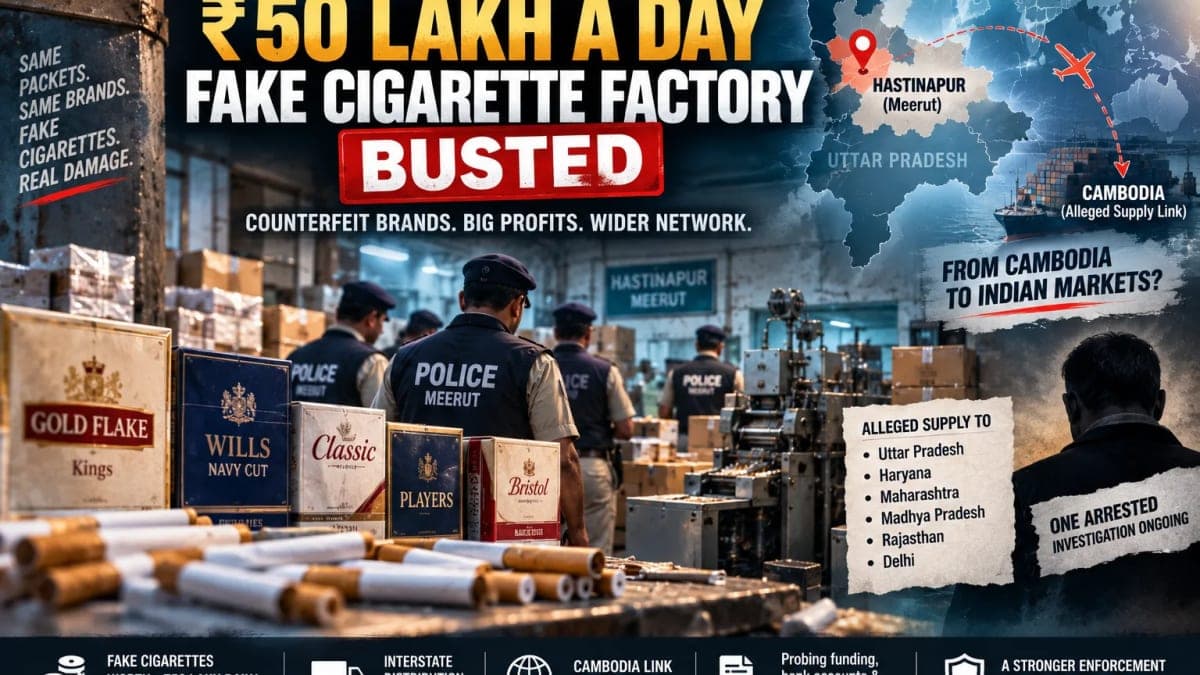
Meerut Police Bust Counterfeit Cigarette Factory; ₹50 Lakh Daily Supply, Interstate Network Alleged
Introduction
A large counterfeit cigarette operation allegedly capable of supplying products worth around ₹50 lakh a day has been uncovered in Meerut, widening into an investigation of an interstate distribution network and possible international links.
The factory was operating from an old school building near a government gaushala in Dudhli Khadar village under Hastinapur police station, according to police accounts cited by multiple local and national news organisations.
Police and representatives of cigarette manufacturer ITC raided the premises after a private investigation into counterfeit products allegedly being sold under established brand names.
Investigators recovered large quantities of finished and semi-finished cigarettes, filters, wrappers, packaging material and automatic cigarette-manufacturing machinery. Police arrested Ravi Kishore, while investigators are searching for other people suspected of involvement.
The case has since expanded beyond the factory itself. Police and the Special Operations Group are examining bank accounts and call-detail records, while a person identified as Harshad, who is reported to be based in Cambodia, has emerged as a suspect in the alleged financing and supply chain.
Those Cambodia-related claims remain part of an ongoing police investigation and have not been established in court.
How the Fake Cigarette Factory Was Discovered
The investigation reportedly began after ITC became concerned about counterfeit products affecting sales in the market.
Company representatives carried out a private inquiry and, according to reporting, traced suspected counterfeit activity to the Hastinapur area after roughly a month of surveillance.
One account says investigators first intercepted or examined a container in Delhi's Sadar Bazaar and followed evidence from there to Dudhli Khadar in Meerut.
After the information was shared with police, a team was formed and the premises were raided on Thursday night.
Aaj Tak reported that police found large quantities of ready and partially manufactured cigarettes, packing material, raw material and cigarette-making machinery inside the building. Initial police statements said the precise value of the recovered stock was still being calculated.
Fake Versions of Major Cigarette Brands Allegedly Produced
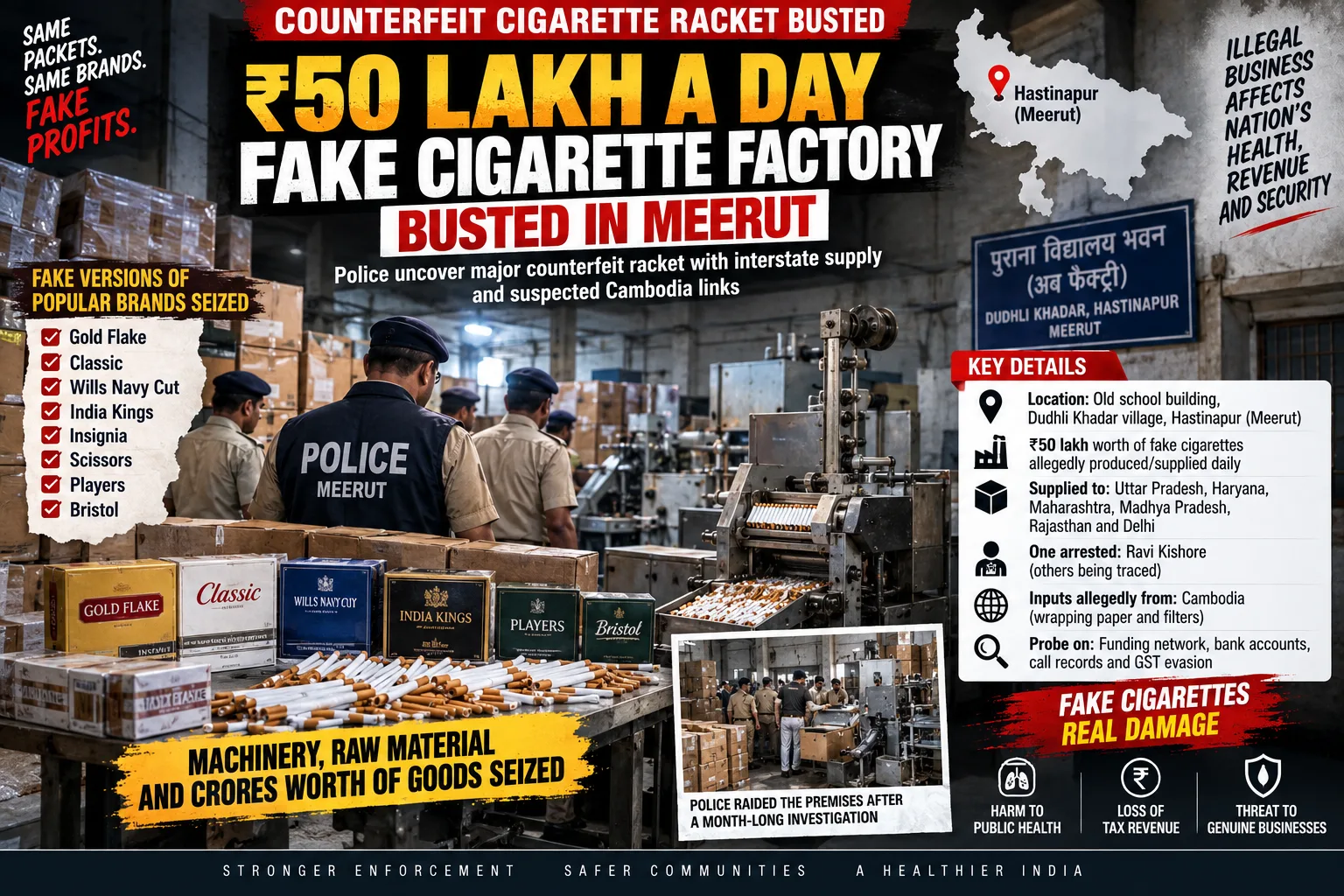
Reporting from the site says the factory was allegedly manufacturing cigarettes bearing the names and packaging of several well-known brands.
The reported brands included:
Gold Flake
Classic
Wills Navy Cut
India Kings
Insignia
Scissors
Players
Bristol
Police have described the products as counterfeit cigarettes made to resemble established brands.
The presence of packaging, filters, branded rolls and automated manufacturing equipment suggests the suspected operation extended beyond simple repackaging and involved an organised production setup.
Police Estimate Around ₹50 Lakh of Cigarettes a Day
One of the most widely circulated claims surrounding the case is that the unit handled counterfeit cigarettes worth approximately ₹50 lakh every day.
That figure was also used in the Instagram post.
Later local reporting attributed the figure to police, saying counterfeit cigarettes worth around ₹50 lakh were being manufactured and dispatched to markets in different states every day.
Dainik Jagran separately reported that approximately ₹50 lakh worth of material was being supplied each day.
The figure should therefore be described as a police or investigative estimate, rather than a independently audited daily turnover.
Cigarettes Allegedly Supplied Across Six States and Delhi
Investigators say the suspected network was considerably larger than a local Meerut operation.
The counterfeit cigarettes were allegedly distributed across:
Uttar Pradesh, Haryana, Maharashtra, Madhya Pradesh, Rajasthan and Delhi.
This geographic spread is one of the most consequential aspects of the investigation because it suggests the factory may have functioned as a production hub feeding wholesalers or distributors outside western Uttar Pradesh.
Police are now investigating who handled transportation, distribution and financing and whether additional production or storage facilities were connected to the network.
Cambodia-Sourced Paper and Filters Under Investigation
Police say some of the inputs used to manufacture the cigarettes came from outside India.
According to the investigation described by Amar Ujala, specialised wrapping paper and filter material were allegedly sourced from Cambodia, while lower-quality tobacco was obtained from Rajasthan.
The materials were then allegedly brought together at the Hastinapur unit for production and packaging before the finished cigarettes were distributed to markets elsewhere in the country.
The international element has become more significant as the investigation has progressed.
A later Hindustan report said police and SOG investigators had identified a person named Harshad, believed to be in Cambodia, and were investigating whether he financed the factory and supplied cigarette paper.
Police are examining bank transactions and call records as they attempt to establish the nature of those connections.
At this stage, Harshad's alleged role is a police suspicion under investigation, not a proven finding.
Ravi Kishore Arrested; Other Suspects Sought
Police arrested Ravi Kishore in connection with the operation.
Later reporting said he was produced before a court and sent to judicial custody.
Investigators have subsequently identified additional people whose roles are being examined.
Hindustan reported on September 6 that police had named Tarun, Deepak, Ravi and Harshad while pursuing suspects linked to the wider operation.
Police and SOG teams were conducting searches for the remaining suspects as the investigation expanded.
Earlier reports contained some differences over Ravi Kishore's exact position in the alleged network, with some describing him as the factory operator or businessman running the premises and later reports examining whether other people exercised greater control.
For that reason, it is safer at this stage to describe Ravi Kishore as an arrested accused in the alleged counterfeit operation rather than to definitively identify him as its sole mastermind.
How Much Material Was Seized?
The value of the seizure has been reported differently as police continued assessing the stock.
Early reporting said the exact valuation was still being calculated.
Dainik Jagran subsequently reported the seizure of approximately ₹1.5 crore worth of cigarettes, along with machinery and raw material it valued at roughly ₹50 lakh.
Amar Ujala later reported a broader estimate of about ₹3 crore, comprising roughly ₹1.5 crore in finished counterfeit cigarettes and a similar amount in machinery and raw material.
Because those figures differ, the most accurate description is that goods, raw material and machinery worth crores of rupees were seized, while the final official valuation should be treated as subject to investigation.
94 Cartons of Finished Cigarettes Reportedly Found
Amar Ujala provided additional detail about what investigators said was found at the premises.
According to the report, police recovered:
94 cartons of finished cigarettes,
13 cartons of loose cigarettes,
19 cartons containing cigarette-brand rolls, and
124 cartons of cigarettes carrying another name.
Automatic cigarette-making machines, filters, wrappers and other manufacturing material were also recovered.
These quantities indicate an operation structured for commercial-scale production rather than small-scale counterfeiting.
Factory Was Hidden Inside an Old School Building
The location appears to have helped keep the operation away from immediate public scrutiny.
Police say the unit operated from an old building beside the government gaushala at Dudhli. The building had earlier housed a school before educational activities shifted elsewhere.
From outside, the premises reportedly appeared ordinary. Inside, however, investigators found cigarette production and packaging equipment.
Police are now examining the building's ownership, lease arrangements and whether anyone connected to the premises knew how it was being used.
Reports Differ on How Long the Factory Was Operating
There is one factual point on which published reports are not completely consistent.
Some coverage said the factory had been operating for approximately six months, while Amar Ujala reported that police believed production had been taking place for about eight months.
The same report said a lease for the property ran from January 1, 2026 to December 31, 2028, with rent reportedly fixed at ₹50,000 a month.
Because the investigation is continuing, the precise date on which illegal cigarette production began has not been conclusively established in the available reporting.
Investigation Expands to Funding and GST
The raid is now developing into a financial investigation.
Police and SOG teams are examining bank accounts and call records to determine who provided capital for machinery, raw materials and distribution.
GST officials have also visited the premises amid suspicions of large-scale tax evasion linked to the alleged operation.
Hindustan reported that investigators were examining possible GST losses running into crores of rupees, although no final tax-evasion figure has yet been publicly established.
This part of the probe could become particularly important because an organised counterfeit cigarette operation potentially involves several separate offences: trademark infringement, illicit manufacturing and distribution, taxation issues and potentially customs or import questions if materials were brought from overseas improperly.
Why Counterfeit Cigarettes Are More Than a Branding Problem
Counterfeit cigarette cases are often described primarily as intellectual-property violations, but they raise wider concerns.
Legitimate cigarette products operate within a regulated system involving taxation, statutory health warnings, packaging requirements and product-control rules.
An illicit factory can potentially circumvent those controls.
At the same time, counterfeit products deprive governments of tax revenue and make it harder for authorities to determine where products were manufactured, what they contain and how they reached consumers.
The Meerut case is therefore potentially significant not simply because familiar brand names were allegedly copied, but because investigators suspect a supply chain stretching across states and possibly beyond India's borders.
What Is Confirmed and What Remains Alleged
Several core facts are supported across multiple reports: authorities raided an alleged counterfeit cigarette manufacturing unit in Dudhli Khadar, cigarette-making machinery and large quantities of material were found, and Ravi Kishore was arrested.
Police have also said the products were being distributed to several states.
However, some of the most dramatic elements remain under investigation.
The ₹50 lakh daily figure is an investigative estimate.
The Cambodia financing connection is a police allegation.
The exact seizure valuation is disputed across reports.
The roles of several people named by investigators have not been established in court.
Those distinctions matter because the investigation is still expanding and criminal liability will ultimately have to be established through evidence and judicial proceedings.
The Bigger Story Behind the Viral Post
The Instagram post captures the striking headline — a fake cigarette factory allegedly producing or supplying goods worth ₹50 lakh a day.
But the deeper story is the network behind the manufacturing unit.
Police are no longer investigating only who operated machines inside an old building in Meerut. They are examining where the capital came from, how overseas material allegedly reached the factory, how cigarettes were transported across multiple states and who benefited financially.
If investigators substantiate those links, the Hastinapur raid could expose a much wider counterfeit tobacco supply chain than the original viral video suggested.
For now, however, those wider connections remain the subject of an active investigation.