AAP Has Finally Found a Rajasthan Foothold. It Is Concentrated in One City.
For years, the Aam Aadmi Party (AAP) has tried to establish itself in Rajasthan without seriously disturbing the state's BJP-Congress political structure.
Baran has now produced something different.
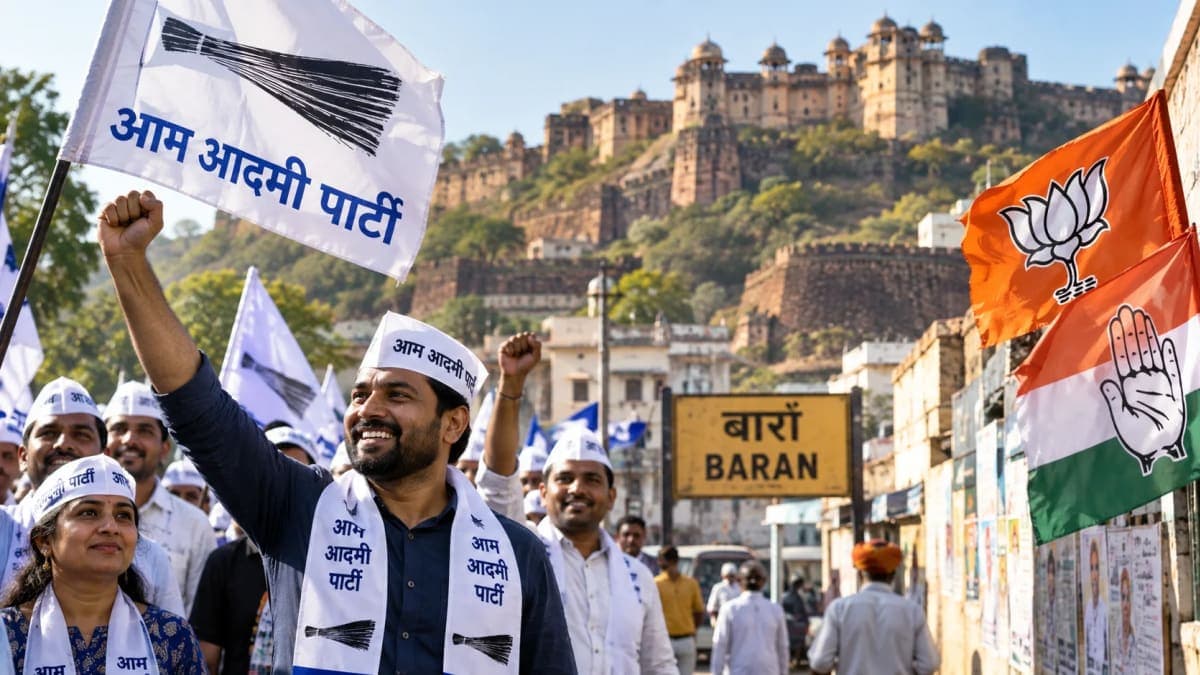
In the 2026 Rajasthan urban local-body elections, AAP won 31 of the 60 wards in Baran Municipal Council, giving it the bare majority required in the council.
Congress finished with 18 wards, BJP won nine, and Independents took the remaining two.
For AAP, it is unquestionably a significant result.
But its significance needs to be measured carefully.
Across Rajasthan's 309 urban local bodies, BJP won 4,179 of 10,244 wards for which results were declared, Congress 3,613 and Independents 2,273. AAP won only 42 wards statewide.
That means almost 74% of all AAP's winning wards—31 of 42—came from Baran alone.
The real question, therefore, is not simply how AAP won Baran.
It is whether the conditions that produced Baran can be replicated elsewhere.
First, the Numbers: What Happened in Baran?
The result was unusually decisive for a party that has historically occupied the margins of Rajasthan politics.
In the 60-member Baran Municipal Council, AAP won 31 wards, Congress secured 18, BJP won nine and Independent candidates took the remaining two seats. With 31 seats required for a majority in the 60-member council, AAP reached that threshold on its own.
The contrast with the statewide picture is striking.
AAP's Rajasthan election in-charge Devendra Shastri told The Indian Express that the party fielded 299 candidates across the civic elections and 42 won.
On those figures, only around 14% of its candidates won statewide.
But in Baran, it captured just over 51% of all council wards.
That gap is the first clue to understanding the result: Baran was not simply the product of a uniform statewide AAP surge.
Something distinctly local happened.
The Kamal Rathore Factor
At the centre of AAP's Baran campaign was Kamal Rathore, who was both an elected candidate and the person overseeing the party's campaign in the municipality.
Multiple reports identify Rathore's local organisation and political network as central to AAP's performance.
His political history also matters.
Before joining AAP, Rathore had been associated with the ABVP and later entered Congress politics. Reporting from Baran says he had previously served in municipal leadership, including as acting chairperson.
This means AAP was not building its Baran operation entirely from scratch.
It had a locally established political organiser with experience inside the city's existing political ecosystem.
That distinction matters when considering whether the result can be exported elsewhere.
A national party brand can provide the symbol and broader message. But local elections are often heavily dependent on candidate networks, neighbourhood relationships and reputations built through municipal politics.
In Baran, AAP appears to have combined both.
AAP Made Youth Part of the Candidate Strategy
Candidate selection was another identifiable feature of the campaign.
According to Shastri and reporting based on party officials, AAP deliberately sought to field younger candidates in Baran.
The party's Baran nominees were under 45 years old, with Rathore playing a central role in that selection strategy.
The objective was political differentiation.
Rather than attempting to compete with BJP and Congress using candidates drawn from exactly the same established political profile, AAP sought to present a younger local team as an alternative.
Whether age itself persuaded voters cannot be independently established from election results.
But it is clear that youth was part of the party's deliberate candidate strategy.
And in municipal politics, where voters may know candidates personally, candidate selection can matter considerably more than national messaging alone.
The Campaign Was Built Around Local Contact
Another striking element was the campaign's emphasis on direct voter contact.
Reporting from Baran describes AAP candidates conducting door-to-door campaigning, in some instances carrying the party's broom symbol rather than relying heavily on conventional flags and banners.
AAP's leadership says it campaigned on development and the governance principles associated with Arvind Kejriwal.
Shastri said:
“Our strategy in the civic polls has worked. We focused on development on the principles of Arvind Kejriwal.”
He also said voters were looking for change and described AAP as attempting to fill the space of a third alternative.
Those are the party's explanations for its victory, rather than independently proven reasons for how individual voters made their choices.
Election results tell us who won.
They do not, by themselves, tell us why every voter voted the way they did.
That distinction is particularly important when analysing a surprising result.
Congress's 15-Year Hold Was Broken
AAP was not merely taking wards from an open field.
Reporting on the result says the outcome ended approximately 15 years of Congress control of the Baran civic body.
Congress still finished second with 18 wards, substantially ahead of BJP's nine.
That makes the result interesting in another way.
AAP's breakthrough occurred in a municipality where Congress had a substantial established presence.
It therefore cannot simply be described as AAP defeating BJP.
The more useful interpretation is that AAP disrupted an existing local BJP-Congress competition and, in this particular municipality, displaced both.
But Rajasthan Did Not Suddenly Turn Into a Three-Party State
This is where the statewide numbers provide essential perspective.
The Rajasthan civic elections covered 10,244 wards across 309 urban local bodies in the results cited by PTI.
Statewide, BJP won 4,179 wards, Congress secured 3,613, Independent candidates won 2,273, the Rashtriya Loktantrik Party took 63, AAP won 42, CPI(M) secured 38, BSP won 19 and the Bharat Adivasi Party took eight wards.
AAP therefore accounted for roughly 0.4% of the wards won statewide.
Its 31 Baran victories represented nearly three-quarters of its entire Rajasthan tally.
That produces a very different conclusion from simply saying AAP has “arrived in Rajasthan”.
A more defensible conclusion is:
AAP has established a meaningful local foothold in Baran while remaining a small player across Rajasthan as a whole.
The 2023 Assembly Election Shows How Big the Gap Still Is
The longer-term comparison makes the challenge clearer.
In the 2023 Rajasthan Assembly election, AAP contested dozens of constituencies but failed to win a seat. Its statewide vote share was approximately 0.38%.
Three years later, controlling—or being positioned to control—a municipal council represents tangible organisational progress.
But municipal and Assembly elections are fundamentally different tests.
Local elections can be shaped heavily by individual candidates, ward-level networks and municipal issues.
An Assembly election requires much larger organisational machinery, constituency-wide recognition, financing, booth-level management and a message capable of surviving a much more intense BJP-Congress contest.
Baran demonstrates that AAP can win under favourable local conditions.
It does not yet demonstrate that AAP has solved its Rajasthan-wide organisational problem.
The Most Important Number May Actually Be 11
AAP won 42 wards across Rajasthan.
Thirty-one were in Baran.
That leaves only 11 victories everywhere else combined.
Shastri said those included five in Pidawa, five in Jhalrapatan and one in Jhalawar.
This geographical pattern deserves attention.
Baran, Jhalawar, Jhalrapatan and Pidawa are all located in the broader Hadoti/southeastern Rajasthan political region.
So AAP's result may be showing the early formation of a regional cluster, rather than disconnected victories spread uniformly across the state.
That could actually be strategically useful.
A smaller party trying to expand often has a choice between spreading resources thinly across an entire state or building concentrated pockets where organisation, candidates and recognition reinforce one another.
The results suggest AAP now has a potentially testable cluster in southeastern Rajasthan.
Whether that was deliberately designed as a regional expansion strategy has not been independently established.
But geographically, the pattern is visible in the results.
What Comes Next: AAP Is Looking Toward Rural Rajasthan
AAP is already signalling its next electoral target.
Shastri said:
“The next target is to do well in the panchayat polls.”
He said AAP intends to contest Zilla Parishad elections, which are fought on party symbols, while also participating in sarpanch contests.
That is an important strategic shift.
Baran proved that AAP can build a competitive municipal organisation in at least one Rajasthan city.
Panchayat politics asks a different question:
Can the party move from an urban local breakthrough into Rajasthan's rural political networks?
That is potentially much harder.
Rural elections involve different social coalitions, candidate networks and local power structures.
The Rajasthan State Election Commission was already issuing election-related directions for the state's 2026 Panchayati Raj institution elections as of September 14.
So AAP will not have years to convert the Baran result into organisation.
The next test is approaching.
Baran Gives AAP a Model — But Not Yet a Formula
The temptation after an unexpected election result is to turn it into a universal political formula.
Baran does not support that conclusion yet.
Several ingredients appear to have converged:
A locally established organiser in Kamal Rathore.
A deliberate emphasis on younger candidates.
Intensive ward-level campaigning.
A development-oriented message.
An electorate willing, at least in this municipality, to move beyond the BJP-Congress binary.
But some of these conditions may be unique to Baran.
AAP cannot simply reproduce Kamal Rathore in every Rajasthan municipality.
And the statewide tally—42 wards from 299 candidates—shows how sharply its results fell outside its strongest pockets.
That makes candidate recruitment arguably as important as branding for the party's next phase.
The Bigger Rajasthan Result Also Offers a Warning Against Overreading Baran
There was another important feature of the 2026 civic elections: Independents performed far more strongly statewide than AAP or any other smaller party.
Independent candidates won 2,273 wards.
In Bharatpur Municipal Corporation alone, Independents won 36 of 65 wards, compared with BJP's 20 and Congress's seven.
This suggests dissatisfaction with the two largest parties does not automatically flow to AAP.
Depending on the locality, it can flow to Independents or other parties.
CPI(M), for example, also produced a major local result in Nokha.
So the political opening AAP sees is real in some places—but it is contested.
What Would Show That Baran Is Becoming More Than a One-Off?
The next elections provide measurable tests.
Rather than judging AAP's Rajasthan prospects from political claims, three indicators will be more useful.
First is geographical spread.
If AAP begins winning significant numbers of seats beyond the Baran-Jhalawar belt, that would suggest its organisation is broadening.
Second is candidate recruitment.
If the party can attract locally credible candidates without relying primarily on one established organiser, the Baran model becomes more transferable.
Third is vote conversion at larger elections.
AAP's 0.38% Rajasthan vote share in 2023 provides a low statewide baseline. A sustained increase in subsequent party-symbol elections would provide stronger evidence of expansion than one municipal majority.
Until those tests are met, Baran should be understood for what it demonstrably is:
AAP's strongest Rajasthan local-body breakthrough so far—not proof that Rajasthan has already become a three-party state.
Why Baran Still Matters
Caution should not obscure what AAP actually achieved.
Winning 31 of 60 wards is not merely symbolic representation. It gives the party a majority in an important municipal council and an opportunity to demonstrate local governance.
That creates something AAP previously lacked in Rajasthan: a place where voters elsewhere in the state can eventually judge the party not only by its promises or governments outside Rajasthan, but by a Rajasthan governing record.
That may be the most important consequence of Baran.
The party's next campaign can point to the victory.
But after it assumes responsibility, opponents can also point to Baran's roads, sanitation, drainage, finances and municipal services.
Winning the council therefore changes AAP's challenge from:
“Can you win in Rajasthan?”
to:
“Can you govern well enough in Rajasthan to make voters elsewhere want the same?”
The answer to the second question will matter much more for the party's longer-term ambitions.