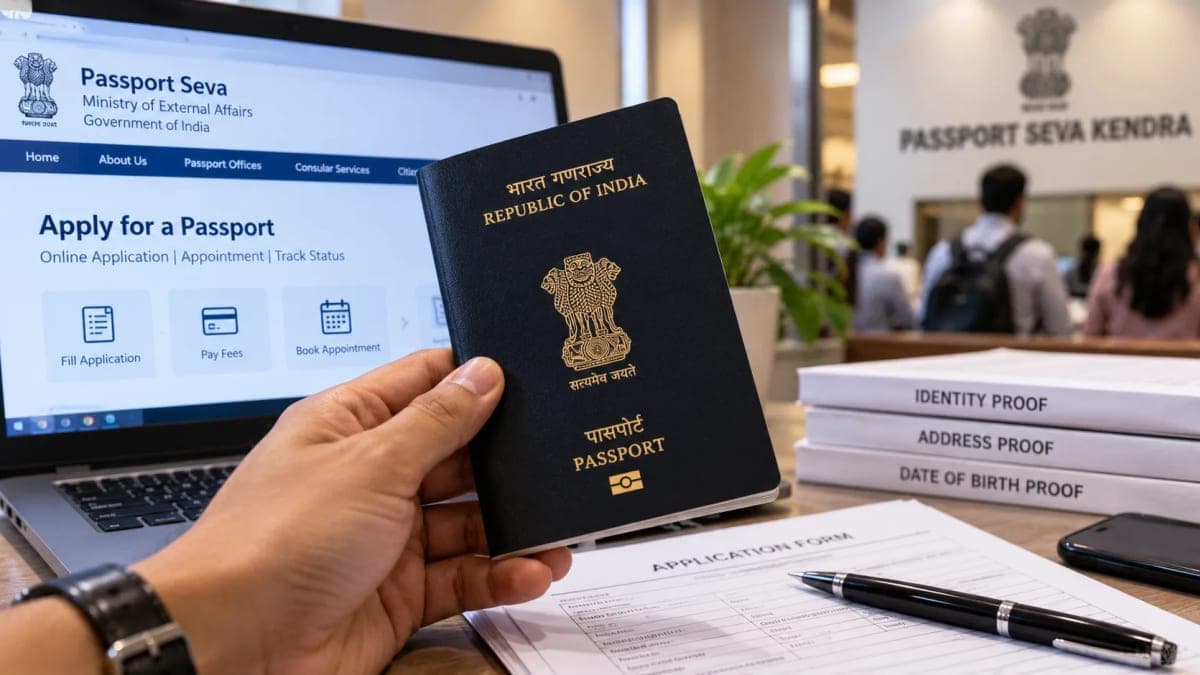
Applying for an Indian passport in 2026 begins online, but the process is not entirely digital. Applicants still need to visit a Passport Seva Kendra (PSK) or Post Office Passport Seva Kendra (POPSK) with their original documents before the application can be processed.
Applications are handled through the Ministry of External Affairs' Passport Seva system. Applicants register on the portal, complete the relevant form, pay the applicable fee and schedule an appointment. One change applicants should be aware of is the revision of passport application fees from July 1, 2026. Since the amount depends on the service requested, applicants should check the current Fee Calculator instead of relying on older fee tables.
The official portal has also warned about fraudulent passport websites and mobile apps that collect personal information or charge excessive fees. Passport applications and payments should be made through the government-designated Passport Seva service.
Indian Passport Application Process: Step by Step
Step 1: Register on the Passport Seva Portal
First-time applicants need to create an account on Passport Seva using basic personal details and an email address. The registered email must be confirmed before the account can be used.
After logging in, go to Services and select Apply for Fresh Passport/Re-issue of Passport.
A fresh passport application is intended for someone applying for the first time in that category. Re-issue applies when an existing passport needs to be replaced because it has expired or is nearing expiry, its pages have been exhausted, it has been lost or damaged, or the holder needs to change personal particulars.
The portal also advises users to keep track of their login ID. Passwords expire every three months and must then be reset.
Step 2: Choose the Appropriate Passport Office
Applicants select a Regional Passport Office (RPO) based on their current place of residence. Relevant PSKs are then shown when they proceed to schedule an appointment.
Passport Seva offers some flexibility here. According to the official service, applicants may apply for passport services at a PSK/RPO across India based on their preference. Special account requirements can apply when an applicant seeks re-issue through an RPO different from the one associated with the existing passport.
Applicants should also make sure they choose the correct service. Someone who has never held an ordinary passport should generally apply for a fresh passport rather than select re-issue.
Step 3: Complete the Online Passport Application
The fresh passport form asks for information including the type of passport required, personal and family details, address, emergency contact information, previous passport details where relevant, and other declarations.
Before final submission, the portal provides a passport preview and verification stage. Applicants should carefully check names, spellings, dates and other personal information at this point.
Passport Seva specifically warns that an online application cannot be changed after it has been submitted. Once the form is submitted, an Application Reference Number (ARN) is generated. Until then, an incomplete application can be saved and resumed later.
Particular care should be taken with the applicant's name and surname, date and place of birth, parents' details and address. Errors in these fields can create additional work later in the application process.
Step 4: Check the Documents Required for Your Application
There is no single passport document checklist that applies to everyone.
For a fresh passport, requirements can vary according to age, applicant category, address, date of birth, ECR/Non-ECR status and whether special circumstances apply.
Passport Seva's instructions say a fresh passport applicant is normally required to provide proof of address and proof of date of birth, along with documentary evidence for Non-ECR eligibility where applicable. Additional documents may be required for cases involving a name change, Tatkaal application or other special circumstances.
Applicants have to take their original documents to the PSK or POPSK along with self-attested photocopies. The originals are checked during verification and returned.
The official Document Advisor on Passport Seva is useful because it provides requirements according to the applicant's category rather than relying on a generic checklist.
Rules can differ for minors, government employees, people applying after a passport has been lost or damaged, and applicants seeking changes to personal particulars.
For a minor, for example, present-address proof in a parent's name can be submitted and the parents can attest the child's documents. Passport Seva also advises parents who hold passports to carry their original passports and self-attested copies.
Step 5: Pay the Passport Fee
Submitting the application does not automatically book an appointment.
After submission, applicants need to select Pay and Schedule Appointment. Advance payment of the applicable passport service fee is mandatory for booking an appointment at a Passport Seva Kendra.
Passport Seva says passport application fees were revised from July 1, 2026. The exact amount varies according to the service selected, so applicants should use the official Fee Calculator rather than an older article, screenshot or fee table.
The portal also provides a 10% passport-fee discount for fresh applications from minors up to eight years of age and senior citizens above 60.
Step 6: Book a PSK or POPSK Appointment
After proceeding to appointment scheduling, applicants select the relevant quota, such as Normal or Tatkaal where eligible, and choose a preferred PSK or POPSK.
The system displays the next available appointment date for the selected centre. Once payment and booking are completed, a confirmation is generated. Appointment information is also sent to the registered mobile number.
Under the current system, normal appointments can be rescheduled three times, while Tatkaal appointments can be rescheduled once.
Step 7: Visit the PSK or POPSK
Applicants must attend the selected centre on their appointment date with all documents required for their application.
Original documents are checked during processing, while self-attested photocopies are submitted where required.
There is also a deadline after submitting the online form. If an applicant does not visit a Passport Seva Kendra within 90 days of online form submission, the application has to be resubmitted.
For children below four years of age, official guidance requires a recent 4.5 cm × 3.5 cm photograph with a white background to be carried.
Step 8: Complete Police Verification Where Required
Police verification continues to be part of passport processing, although its timing can differ depending on the case.
Passport Seva lists two modes: verification before passport issuance and verification after issuance. The Passport Office decides which applies according to the application and the applicant's circumstances. In most cases where police verification is required, it takes place before the passport is issued.
Applicants need address proof only for their present address, irrespective of how long they have lived there. They must, however, provide details of all places where they lived during the previous year so that police verification can be conducted where required.
Different provisions apply to government, PSU and statutory-body employees depending on whether they submit an Identity Certificate, No Objection Certificate or Prior Intimation Letter.
Step 9: Track the Passport Application
After completing the required stages, applicants can use the Passport Seva system to track their application.
The status will reflect how the case is progressing through passport processing, police verification where applicable, granting and subsequent stages.
Applicants should rely on the official tracking system rather than unofficial websites or third-party services.
How the Tatkaal Passport Process Differs
Tatkaal is available to eligible applicants who need faster processing, although certain categories cannot use the scheme.
Applicants may still encounter outdated advice saying a Verification Certificate from a Gazetted Officer is required for Tatkaal. Passport Seva states that such a certificate is not required under the current scheme.
Applicants above 18 may submit any three documents from the prescribed list of acceptable Tatkaal documents. Those below 18 may submit any two. Eligibility should still be checked before applying because Tatkaal is not available in every case.
Police verification in Tatkaal cases is generally carried out after the passport has been issued rather than before.
Passport Seva says that when an application has been successfully submitted and receives the final status "Granted," the passport can be expected to be dispatched on the third working day, excluding the date of submission, without waiting for the police verification report.
That timeline does not guarantee approval of every Tatkaal application. The Passport Office remains the final authority on whether a passport is issued under the scheme.
Avoid Unofficial Passport Websites
The Ministry of External Affairs has warned applicants about fraudulent websites and mobile apps that collect personal information and charge substantial additional fees for passport applications and appointments.
The official Passport Seva service provides the application system as well as the Document Advisor, Fee Calculator, appointment availability and application tracking.
For applicants, using the official system is particularly important now that passport fees have changed. Old fee tables, third-party document checklists and unofficial appointment services can create unnecessary confusion.
For most applicants, the process follows nine main stages: register on Passport Seva, choose the correct service and Passport Office, complete the application, check the required documents, pay the fee, book an appointment, attend the PSK or POPSK, complete police verification where required and track the application.
Careful attention to the application details matters. Selecting the wrong category, entering incorrect personal information or arriving without the required documents can complicate an otherwise structured process.