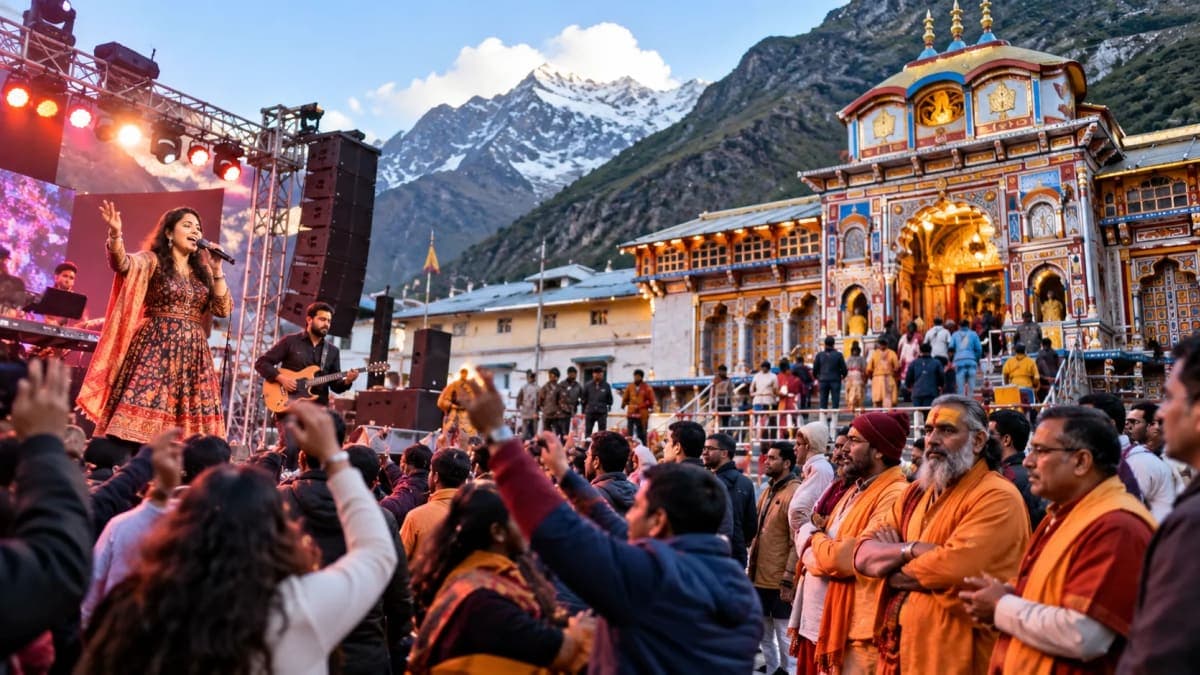
BADRINATH, Uttarakhand — A cultural festival held near the Badrinath shrine has sparked a debate over how public entertainment and cultural programmes should be conducted around one of India’s most revered Hindu pilgrimage destinations.
The controversy emerged after videos from the Devbhoomi Cultural Festival 2026, held on September 19 and 20 at the Tourist Arrival Plaza adjoining the Badrinath temple, circulated widely online.
The footage showed Uttarakhand folk singer Priyanka Meher performing on stage as members of the audience danced to amplified music. While the programme was intended to showcase Uttarakhand’s culture, critics questioned whether the volume and concert-style presentation were appropriate so close to the shrine.
What Was the Devbhoomi Cultural Festival?
The two-day programme was organised under the Indian Army’s Operation Sadbhavana, in collaboration with the Chamoli district administration and Uttarakhand Tourism.
Held under the theme “Our Heritage, Our Future,” the festival was designed to showcase Uttarakhand’s traditions and local communities through folk music, dance, handicrafts, traditional cuisine and locally produced goods.
Women’s self-help groups, artisans, farmers and young entrepreneurs were also involved in the programme.
Chief Minister Pushkar Singh Dhami attended the concluding day on September 20 after offering prayers at the Badrinath shrine and honoured winners of competitions associated with the programme.
Why Did Priests Object?
The criticism intensified after photographs and videos of the musical performance spread on social media.
Brijesh Sati, general secretary of the Char Dham Teerth Purohit Mahapanchayat, objected to the use of loud music near the shrine.
“Lord Vishnu is in a meditative posture here and, therefore, loud noise is not allowed,” Sati said, adding that conch shells are not blown at Badrinath because of local beliefs and environmental considerations.
He described playing loud DJ music at the entrance plaza as “completely unacceptable.”
The objection therefore extends beyond the presence of a cultural programme itself. The central question raised by priests and other critics is whether its volume, style and proximity to the shrine were compatible with Badrinath’s religious traditions.
Why the Conch-Shell Tradition Is Part of the Debate
A recurring argument in the online discussion concerns the tradition of not blowing a shankh, or conch shell, at Badrinath.
Religious and local traditions offer different explanations for the practice, and reports caution against treating one explanation as universally established.
Nevertheless, critics invoked the custom to argue that amplified music was inconsistent with the quiet and devotional atmosphere traditionally associated with the shrine.
Viral Videos Fuel Social Media Backlash
The debate expanded after clips of Priyanka Meher’s performance circulated across social platforms.
One widely shared X post argued that “club style music has a time & place” and that a sacred pilgrimage destination was not an appropriate venue.
Importantly, the user later clarified that the objection was directed at the location and format of the event rather than the singer herself, praising Meher as an artist while questioning why such a performance had been organised near the Dham.
Other users similarly questioned the role of organisers and authorities in approving the event.
Not all reactions rejected cultural programmes near pilgrimage centres outright. Some argued that Uttarakhand’s folk traditions are themselves an important part of the region’s cultural identity, while maintaining that the scale and presentation of events should be adapted to the spiritual character of the venue.
Uttarakhand Tourism Responds
Following the controversy, Uttarakhand Tourism Secretary Dhiraaj Singh Garbyal said the programme had primarily been organised by the Army under the Vibrant Village initiative.
“It will be ensured in future that loud music is not played. We will make a request to the Army in this regard,” Garbyal told The Times of India.
He added that the tourism department would work to ensure that traditional rituals and local norms are respected during the pilgrimage.
A Wider Question Over Tourism and Sanctity
The episode has developed into a broader discussion about balancing tourism promotion, local cultural expression and religious traditions at major pilgrimage destinations.
Badrinath is situated at an altitude of approximately 10,279 feet in Uttarakhand’s Chamoli district. The shrine opened for the 2026 pilgrimage season on April 23 and had received about 17.79 lakh pilgrims during the first 153 days of the yatra through September 22, according to figures reported by The Times of India.
The festival itself had a stated cultural and community-oriented purpose. The criticism, however, has centred on a narrower question: how should such events be staged when the venue immediately adjoins a religious site where silence, prayer and longstanding traditions carry particular significance?
The authorities’ response indicates that this distinction may shape the planning of future programmes around the Dham.