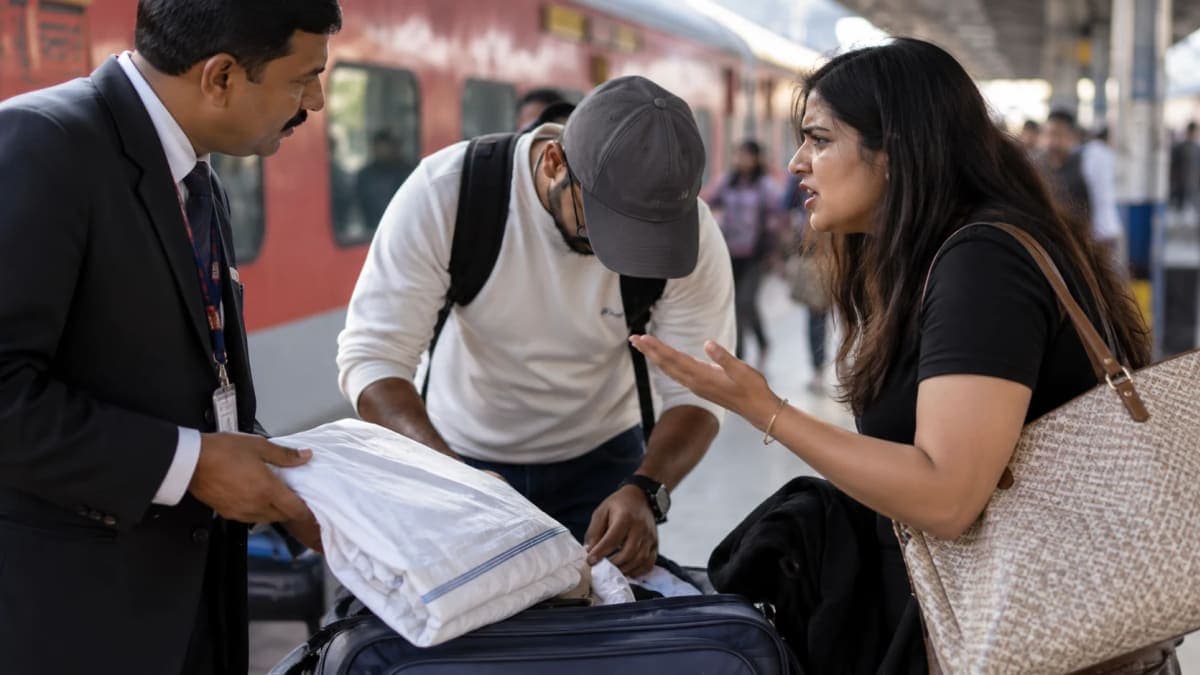
Couple Confronted Over Railway Bedsheet; Woman Claims TTE Took Extra Money
A video of a couple being confronted after a railway bedsheet was allegedly found in their luggage has gone viral, triggering criticism online and drawing fresh attention to a problem Indian Railways has been dealing with for years: linen disappearing from AC coaches.
In the clip, a coach attendant questions the passengers about a railway bedsheet kept inside their bag. The woman argues with him and claims that a Travelling Ticket Examiner (TTE) had taken extra money from them. She is also heard asking whether the bedsheet belongs to the TTE personally. As the exchange continues, the man accompanying her opens the luggage and returns the sheet, according to reports describing the video.
The video was shared by the Instagram account “yatrawalavishal” and had crossed 1.1 million views by September 17, according to Maharashtra Times. Some social media users reacted with the Hindi phrase “chori aur seena zori” — broadly used for someone who remains defiant after being accused of wrongdoing.
There are still gaps in what can be independently established about the incident. The exact train, station and date, as well as the identities of the passengers, have not been verified through an official railway statement. There is also no independent evidence confirming the woman's claim that a TTE had collected extra money from them.
What the viral video shows
Reports based on the footage say the confrontation happened after the passengers had left, or were in the process of leaving, the train.
The coach attendant asks why the railway bedsheet had been put inside their luggage. The woman responds by arguing with him and alleging that the TTE had charged them extra money, according to Maharashtra Times.
Another report says a packed railway bedsheet is then taken out of the bag. The woman continues arguing after the item is produced, while the man travelling with her eventually hands it back.
The argument helped push the video across social media, but the rule surrounding regular railway linen is fairly simple. Bedrolls supplied to eligible passengers in AC coaches are meant to be used during the journey. They are not complimentary items passengers can take home.
Official railway passenger information says a standard bedroll includes a blanket, pillow, two bedsheets and a face towel for eligible AC passengers. The facility is provided without a separate charge, and passengers are instructed to return the bedroll to the coach attendant before reaching their destination.
That also provides context for the woman's reported argument about having paid for the journey. The linen service may be included in the fare of an eligible passenger, but the reusable items themselves remain railway property.
Why does Indian Railways provide two bedsheets?
Indian Railways recently explained why passengers receive two bedsheets as part of a standard bedroll.
In a Rajya Sabha reply on July 24, 2026, Railway Minister Ashwini Vaishnaw said Indian Railways provides clean linen to passengers travelling in AC classes for each trip.
A standard packet contains two bedsheets, one pillow cover and a hand towel. One sheet is spread on the berth. The second goes between the passenger and the blanket, preventing the blanket from coming into direct contact with the body.
The government said that second sheet is washed after a single use.
That clarification is useful because an extra sheet can easily be mistaken for a spare or disposable item. It isn't. Both sheets are part of the reusable linen supplied for the journey.
Railway linen also has a prescribed service life. According to the same parliamentary reply, handloom bedsheets have a life of 12 months, while Polyvastra sheets supplied by KVIC have a 24-month life. Pillow covers and face towels have a nine-month prescribed life, while pillows and woollen blankets have a 24-month life.
These items are reused, moving between trains, passengers and railway laundries over the course of their service life.
One bedsheet is part of a much larger problem
A single missing bedsheet may not sound particularly serious. Railway records, however, show how quickly those losses add up across India's vast train network.
An Indian Express investigation published in July used Right to Information applications to examine missing railway linen between January 2022 and May 2026.
The newspaper received information from 54 of Indian Railways' 69 divisions, covering 16 of the 18 railway zones. Some divisions provided only partial information.
Even with those gaps, the records showed that at least 1.27 crore bedroll items went missing during the period. Officials said passengers were primarily responsible.
The number of missing items rose 56% between 2022 and 2025.
Face towels were the most frequently reported missing item, at 46.54 lakh. They were followed by 41.13 lakh bedsheets, 23.59 lakh pillow covers, 12.95 lakh blankets and 2.76 lakh pillows.
The estimated cost of the missing linen was ₹104.51 crore over the period covered by the data.
Those figures also need some perspective. Indian Railways operates on an enormous scale. The Indian Express estimated that around eight lakh AC passengers use railway bedrolls every night, with its investigation calculating that roughly one in every 1,000 passengers takes away at least one bedroll item.
So this is not something most railway passengers do. But when even a small proportion of travellers take linen, millions of items can disappear over time.
Why attendants care about every missing bedsheet
For coach attendants, missing linen isn't necessarily just an inconvenience.
According to RTI responses obtained by The Indian Express, the cost of missing linen is recovered from contractors' bills. Contractors, in turn, recover those amounts from the coach attendants working on trains.
That gives attendants a direct financial reason to make sure bedsheets, pillows and blankets are collected before passengers leave.
The Railway Board issued instructions in 2015 asking linen distribution staff to advise passengers to return used linen at least 30 minutes before getting off the train. Railway divisions have also tried measures including counselling attendants, monitoring linen through CCTV and using the Coach Mitra app to track linen issuance and passenger boarding.
A Railway Ministry spokesperson told The Indian Express that linen theft was a matter of “serious concern” and said efforts were being made to prevent it and act against offenders. The ministry also said it could not establish evidence of staff collusion in the thefts examined.
Can passengers ever take railway bedding home?
There is one possible source of confusion.
Indian Railways launched a separate personalised take-away bedroll scheme in 2016. Under that programme, passengers could buy disposable bedroll kits specifically designed to be taken home after the journey.
The government announcement at the time listed a ₹140 kit containing two cotton bedsheets and a pillow, along with a separate ₹110 blanket kit.
That was a paid take-away product. It was not the same as the regular reusable linen provided to passengers in AC coaches.
The rule is straightforward: a bedroll specifically sold as a take-away product can be kept. Regular reusable railway linen issued for an AC journey must be returned.
What we still don't know about the viral incident
The footage shows a confrontation, and reports consistently describe a railway bedsheet being returned from the passengers' luggage. But several details being circulated with the video have not been independently established.
JantaScope could not verify through an official railway source who the passengers were, which train they were travelling on, the station where the incident occurred, when it happened, whether authorities registered a formal case, or whether any penalty or legal action followed.
The woman's claim that a TTE had taken extra money also remains unsubstantiated. Without independent evidence, it should be treated only as a claim made during the confrontation — not as an established case of misconduct by a railway employee.
The RTI figures help explain why railway staff are concerned even when the item involved is just one bedsheet. At least 1.27 crore linen items were reported missing across the railway divisions covered by the data between January 2022 and May 2026. Repeated across a network as large as Indian Railways, what looks like a small loss on a single journey can become an expensive operational problem.