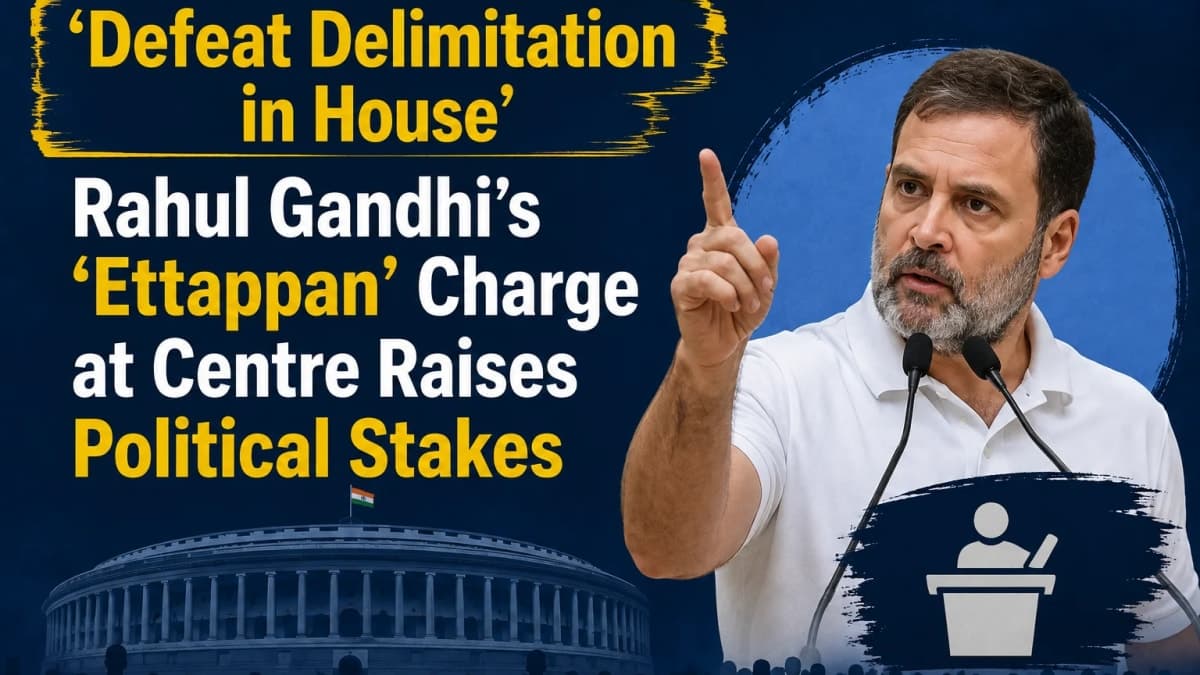
‘Defeat Delimitation in House’: Rahul Gandhi’s ‘Ettappan’ Charge Puts Political Battle in Focus
Rahul Gandhi has intensified the political debate surrounding delimitation, appealing to political parties to defeat it in the House while directing an “Ettappan” charge at the Centre.
The intervention brings the issue firmly into the arena of parliamentary politics, where numbers, alliances and the positions adopted by individual parties could become increasingly important.
Beyond the immediate political confrontation, Gandhi’s appeal suggests an attempt to turn delimitation into a broader issue around which parties could coordinate their positions.
Rahul Gandhi Calls for Battle in the House
The central element of Gandhi’s intervention is his call to “defeat delimitation in the House.”
That framing is politically significant because it places Parliament at the centre of the confrontation.
Rather than treating delimitation only as a technical or administrative subject, the appeal positions it as an issue requiring political scrutiny and parliamentary resistance.
The headline information does not specify the particular delimitation proposal or parliamentary mechanism being referred to. It therefore would be premature to assume how or when such a confrontation could take place.
Nevertheless, Gandhi’s message clearly attempts to raise the political stakes around the subject.
‘Ettappan’ Charge Sharpens Attack on Centre
Gandhi’s use of the term “Ettappan” adds a sharper rhetorical dimension to his attack on the Centre.
“Ettappan” is a historically and culturally loaded reference associated in popular Tamil discourse with betrayal. Its use in a contemporary political argument therefore carries significance beyond ordinary criticism.
By employing such terminology in connection with the delimitation debate, Gandhi appears to be framing the issue in emotionally powerful political language.
However, because only the headline facts are available, the exact context in which Gandhi used the term should not be inferred beyond the fact that the charge was directed at the Centre.
Why Delimitation Can Become a Major Political Issue
Delimitation concerns the drawing or readjustment of electoral constituency boundaries and is therefore closely connected with political representation.
Any debate surrounding it can quickly become politically sensitive because representation in elected institutions influences how different regions and populations participate in democratic decision-making.
That makes delimitation more than an electoral-map issue.
Political parties may examine its implications through questions of representation, regional balance and parliamentary influence.
Gandhi’s intervention indicates that the political dimension of the issue could become increasingly prominent.
Appeal to Parties Could Test Opposition Coordination
One of the most important elements of Gandhi’s position is his appeal to political parties.
Such an appeal potentially shifts the conversation from a confrontation between an individual opposition leader and the Centre to a broader question of political coordination.
If multiple parties adopt similar positions, delimitation could emerge as an issue capable of encouraging cooperation across political formations.
But agreement cannot be assumed.
Different parties may assess delimitation through their own regional interests, electoral calculations and political priorities. The response of individual parties would therefore be crucial in determining whether Gandhi’s appeal develops into a wider parliamentary strategy.
Regional Politics Could Gain Greater Importance
Delimitation can carry particular political significance because its consequences may be viewed differently across regions.
Parties with strong regional bases may evaluate any debate over representation according to how their states and constituencies could be affected.
This potentially creates a political landscape in which national and regional considerations intersect.
For Gandhi, appealing directly to parties may therefore be an attempt to broaden the issue beyond the traditional government-versus-opposition divide.
Whether that strategy succeeds would depend on how other political formations interpret both the issue and their own interests.
Parliament Could Become the Key Battleground
The phrase “defeat delimitation in the House” deliberately places legislative institutions at the centre of the political strategy.
Parliamentary contests require more than political rhetoric. They depend on procedure, numbers and the positions ultimately taken by parties and lawmakers.
That means any effort to build resistance inside the House would require political coordination rather than statements alone.
If delimitation becomes a major parliamentary issue, negotiations between parties could become as important as public campaigning.
Political Implications for the Centre
For the Centre, Gandhi’s intervention potentially creates another front of political criticism.
If opposition parties successfully build a shared narrative around delimitation, the government could face increased pressure to explain and defend its position in political and parliamentary terms.
On the other hand, opposition unity around any complex political issue cannot be taken for granted.
The Centre’s political position would therefore depend partly on whether Gandhi’s appeal gains support beyond his immediate political camp.
Without additional facts about the specific proposal under discussion, it would be speculative to predict how the government or individual parties will ultimately respond.
Balanced Analysis: Strong Rhetoric Does Not Guarantee Political Unity
Gandhi’s “Ettappan” charge gives the debate a sharper political edge, while his appeal to defeat delimitation in the House provides a clear parliamentary message.
But turning rhetoric into an effective political coalition is a different challenge.
Political parties often approach questions of representation according to their individual electoral and regional interests. Even parties that share concerns about one aspect of an issue may disagree about strategy or possible alternatives.
The real political significance of Gandhi’s appeal will therefore depend on whether it generates broader coordination.
If it does, delimitation could develop into a significant point of opposition mobilisation. If parties remain divided, the political impact of the appeal may be more limited.
Delimitation Debate Could Become a Wider Political Flashpoint
Rahul Gandhi’s intervention has placed three elements at the centre of the debate: his “Ettappan” charge against the Centre, his call to defeat delimitation in the House and his appeal to political parties.
Together, these elements indicate an effort to transform the issue into a wider political and parliamentary confrontation.
The next important question is how other parties respond.
If Gandhi’s appeal gains wider political backing, delimitation could become an important test of opposition coordination and parliamentary strategy.
For now, his remarks have ensured that the debate is not merely about electoral boundaries. It is increasingly about representation, political alliances and who can build sufficient support when the issue reaches the political battlefield.


