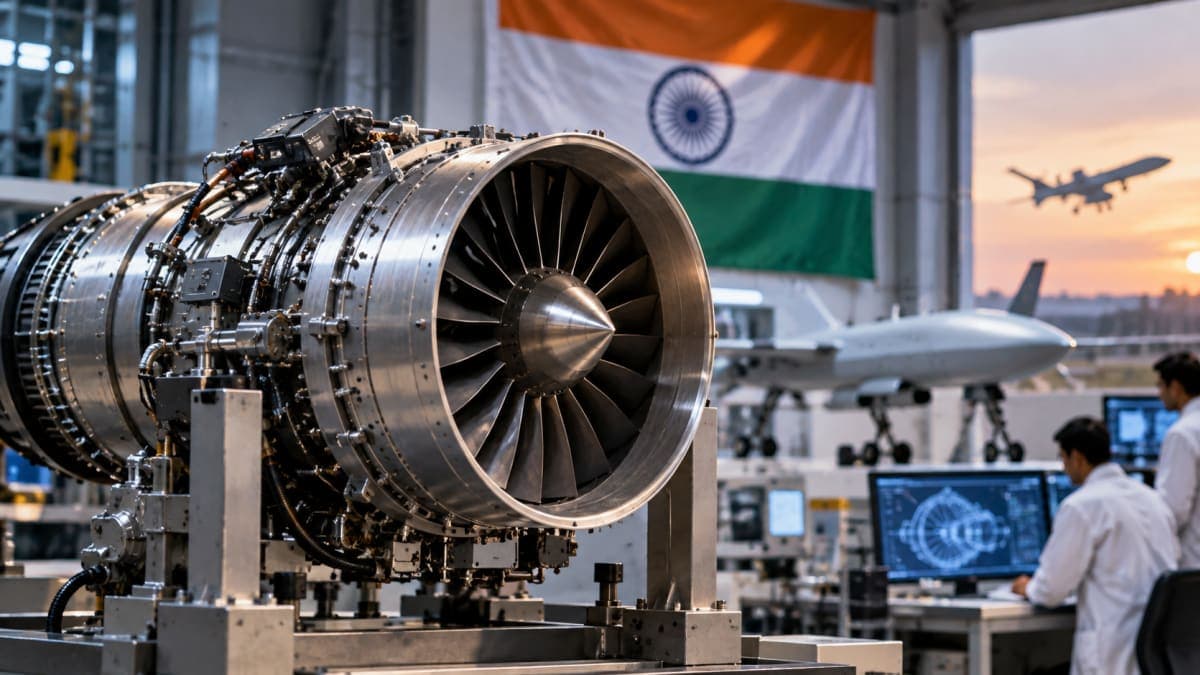
DheyaTech Raises ₹43 Crore to Take Made-in-India Gas Turbine Engines From Lab to Flight
Bengaluru-based deep-tech company DheyaTech has raised ₹43 crore as it prepares for a crucial phase in its journey: taking its homegrown small gas turbine engines beyond development and into production, flight testing and commercial use.
The round was led by Avaana Capital, with existing investor and strategic manufacturing partner Unimech Aerospace and Manufacturing also participating. DheyaTech plans to use the fresh capital to expand production, build an integrated gas turbine testing facility and work more closely with customers in India and overseas.
What makes the story interesting isn't simply the size of the funding round. Gas turbine engines are complex pieces of engineering that sit at the heart of several aerospace, defence and energy systems. Building one that is compact, efficient and reliable — while also being able to withstand extreme temperatures and operating conditions — is difficult.
DheyaTech is attempting to build more of that capability in India.
DheyaTech Isn't Building Just One Engine
Dheya Engineering Technologies develops small gas turbine engines for aerospace, defence and energy applications.
Its current engine programme covers a fairly wide range, from roughly 20 kilogram-force (kgf) to 400 kgf of thrust. According to a September regulatory disclosure by Unimech, Dheya's military-grade engines are mainly intended for unmanned aerial vehicles, while its 20 kgf, 40 kgf and 50 kgf engines have already undergone testing.
Instead of concentrating on a single engine, the company is building a family of turbines across different thrust categories.
CEO and co-founder Gurushankara K C has said the company's focus is on creating an engine platform that can scale while improving its testing capabilities and moving the technology into real-world applications. The longer-term ambition is to reduce India's dependence on imported propulsion and energy technologies.
DheyaTech has also developed an adaptive engine control unit, or ECU, for managing its turbine systems.
The bigger challenge now is moving from prototypes that work in development environments to engines that customers can use reliably and repeatedly.
The company is targeting flight trials in the fourth quarter of 2026. It also says it has confirmed orders from Indian and international original equipment manufacturers.
There is an important limitation here: the names of those customers, the number of engines ordered and the financial value of the orders have not been publicly disclosed in the sources reviewed by JantaScope.
Why Small Gas Turbine Engines Are So Difficult to Build
A smaller turbine engine might appear simpler than the huge engines powering commercial aircraft. In practice, making an engine smaller doesn't make the underlying engineering challenges disappear.
Air still has to be compressed efficiently. Fuel has to be introduced and burned in a stable combustion process. The turbine has to extract energy while components operate at extremely high rotational speeds and temperatures.
All of this brings together several specialised fields — aerodynamics, combustion, materials engineering, electronics, precision machining, thermal management and software controls.
And getting an engine to run once is only the beginning.
A commercial engine has to perform consistently. Components need to be manufactured within extremely tight tolerances, and performance has to remain predictable from one unit to another. Aerospace applications add another layer because engines must eventually meet demanding reliability and airworthiness requirements.
That helps explain why DheyaTech is putting part of the ₹43 crore into testing infrastructure rather than simply increasing manufacturing capacity.
The Unimech Connection Could Be Important
A key part of DheyaTech's strategy is its relationship with listed aerospace manufacturer Unimech.
A manufacturing agreement signed in November 2024 and disclosed in Unimech's IPO documentation appointed Unimech as the exclusive manufacturer of Dheya's current and future micro gas turbine models covered by the agreement.
The arrangement spans defence and energy applications in global markets and extends from prototypes to full-scale manufacturing and assembly.
The two companies have since become even more closely linked.
Unimech's annual reporting shows that it held a 29.99% stake in Dheya Engineering Technologies as of March 31, 2026, up from 16.94% a year earlier. Following another transaction completed on September 7, its shareholding increased to 35.07%, according to a regulatory disclosure.
For DheyaTech, that relationship could solve one of the hardest problems facing aerospace startups.
Designing an engine and manufacturing it repeatedly at commercial scale are very different challenges.
Prototype components can be carefully produced in small quantities, sometimes with considerable manual attention. Commercial manufacturing requires the same components to be produced again and again while maintaining tight control over quality, precision, cost and delivery schedules.
A specialised manufacturing partner could allow DheyaTech's engineers to spend more time on engine design, testing, controls and customer integration while Unimech handles much of the precision manufacturing work.
₹43 Crore Is Significant Compared With DheyaTech's Current Business
DheyaTech is still a relatively small company in revenue terms.
Unimech's September disclosure shows that Dheya Engineering Technologies generated turnover of about ₹2.06 crore in FY2025-26. That compares with ₹1.73 crore in FY2024-25 and ₹98.94 lakh in FY2023-24.
Those numbers put the latest ₹43 crore funding round into perspective.
Investors aren't putting money into an established engine manufacturer already generating large sales. They are backing a company trying to make the difficult jump from technology development to industrial production and commercial deployment.
That transition comes with plenty of execution risk.
The engines need to perform as expected during flight trials. Production has to increase without sacrificing reliability. Relevant certification requirements have to be cleared. Most importantly, customers evaluating the engines need to eventually turn into repeat buyers.
The next stage, then, isn't simply about proving that an Indian company can make a functioning small gas turbine. It is about proving that those engines can become reliable products that can be manufactured and delivered at scale.
Certification Could Be a Bigger Milestone Than Funding
DheyaTech says it is pursuing independent airworthiness certification for its gas turbine engines under the guidance of the Centre for Military Airworthiness and Certification, or CEMILAC, which operates within the DRDO ecosystem.
The company has described itself as the first Indian private company to pursue independent airworthiness certification for gas turbine engines through this route.
That particular "first" claim needs to be treated carefully. It is a company assertion and could not be independently confirmed from publicly available CEMILAC information reviewed for this story.
The importance of certification itself, however, is much clearer.
Customers buying mission-critical aerospace equipment need more than evidence that an engine successfully ran in a laboratory. Its performance, durability, control systems, materials and behaviour under different operating conditions all need to be evaluated against the applicable requirements.
Clearing that process would tell the market considerably more about DheyaTech's technology than the size of its latest funding round.
The Technology Isn't Limited to UAV Engines
DheyaTech is also exploring applications beyond aircraft propulsion.
The company is developing gas-turbine-based systems for distributed power generation and has been working with hydrogen technologies.
According to Unimech's regulatory disclosure, Dheya has completed the combustor design for a 60 kW hydrogen-based flexible-fuel turbogenerator in collaboration with the Indian Institute of Science in Bengaluru.
It has also demonstrated a hydrogen-based high-speed anode blower for an Indian Navy submarine programme.
The same disclosure says the blower has received ATEX certification, which applies to equipment intended for use in potentially explosive environments.
These projects could give DheyaTech more than one route to commercialisation rather than leaving the business dependent entirely on UAV propulsion.
There is some technological overlap. Expertise in high-speed turbomachinery, combustion and engine controls can potentially be applied to both propulsion and stationary energy systems.
But that shouldn't be taken to mean success in one market automatically guarantees success in another. Each application comes with its own engineering, certification and commercial requirements.
Can India Turn Turbine R&D Into Large-Scale Production?
India's aerospace ambitions have grown rapidly, but developing indigenous technology is only part of the challenge.
The harder step is often turning that technology into something that can be manufactured reliably, certified and deployed in meaningful numbers.
That is the context in which DheyaTech's ₹43 crore funding round becomes more interesting.
There are some tangible signs of progress. Multiple engine classes have been tested. The company has a specialised manufacturing partner. It is investing in dedicated testing infrastructure and preparing for flight trials. Importantly, its manufacturing relationship with Unimech is documented through regulatory filings rather than being based solely on a startup announcement.
But there are still major commercial questions that cannot yet be answered.
DheyaTech hasn't disclosed the size or value of its confirmed OEM orders. Publicly available information also doesn't tell us how many engines the company expects to produce each year once the expansion is completed, how much revenue those orders might generate, or when the engine business could reach meaningful commercial scale.
Cost is another area where caution is needed.
Gurushankara has reportedly said that manufacturing locally could give customers a 50%-55% cost advantage over imported engines. That could be significant if achieved, particularly for customers currently dependent on overseas suppliers.
For now, though, it remains a company claim. There isn't enough independent and comparable pricing information publicly available to verify that percentage.
What the ₹43 crore does give DheyaTech is something hardware companies need badly: capital and time to cross the difficult gap between building technology that works and producing something customers can repeatedly test, buy and deploy.
From here, the more meaningful updates are likely to come from the engineering side rather than another funding announcement.
The planned flight trials will be one of those tests. Customer adoption will be another.
If DheyaTech can move successfully through flight testing, certification and repeat production, it could provide an important example of sophisticated small gas turbine technology being developed and industrialised by India's private aerospace sector.
For now, that's the progress worth watching.


