Varaha Wins ET Startup Award After Turning Carbon Credits Into Income for Small Farmers
Indian climate-tech startup Varaha has won the Social Enterprise category at the ET Startup Awards 2026, recognising a business model designed to connect smallholder farmers with the growing market for verified carbon removal.
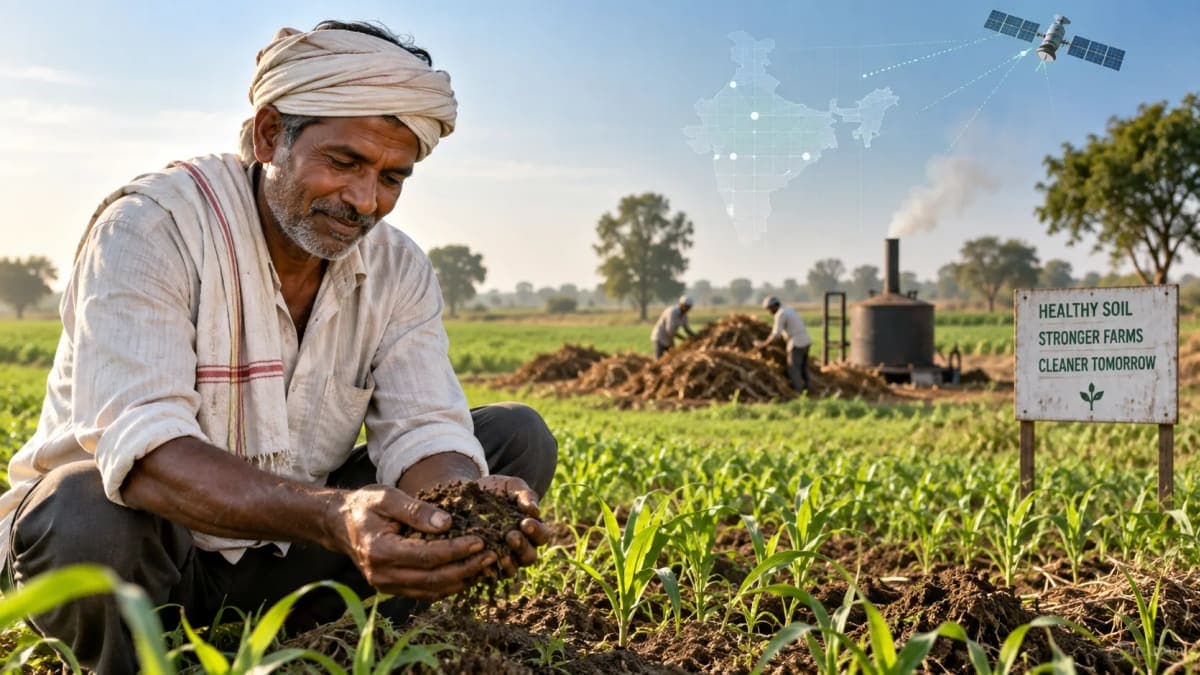
Founded in 2022 by Madhur Jain, Ankita Garg and Vishal Kuchanur, Varaha works on regenerative agriculture, biochar, afforestation and enhanced rock weathering projects. It uses technology including satellite-based monitoring to measure environmental outcomes before selling verified carbon credits to corporate buyers. ET reported that its clients include Google, Microsoft, Lufthansa, Swiss Re and JPMorgan.
The award comes at an important moment for the sector. India is putting the institutional and regulatory pieces of its own Carbon Credit Trading Scheme into place, while international companies are simultaneously spending more on high-quality carbon removal projects.
Why Varaha won the Social Enterprise award
The central idea behind Varaha is relatively straightforward: farmers adopt practices intended to reduce emissions or remove additional carbon from the atmosphere, the climate impact is measured and verified, and eligible reductions or removals can ultimately be converted into carbon credits sold to buyers.
That model is considerably harder to execute than the summary suggests.
Agricultural activity is fragmented across large numbers of small plots, meaning developers need systems capable of collecting and verifying data at scale. Varaha says it uses proprietary technology, including AI and satellite-based measurement, to monitor projects distributed across farms.
Its interventions include regenerative agricultural practices, planting trees, producing biochar and enhanced rock weathering.
ET reported that the company had worked with more than 200,000 smallholder farmers across more than two million acres in India, Nepal, Bangladesh, Kenya and Côte d'Ivoire and had sequestered more than two million tonnes of CO₂ equivalent. Those figures should be understood as company-reported impact data cited by ET, rather than independently measured figures from JantaScope.
Varaha's own website currently lists more than 199,000 farms onboarded, over 399,000 hectares covered and nearly two million tonnes of CO₂e sequestered.
Carbon credits can create another source of farm income
The social-enterprise component of Varaha's model comes from attempting to direct part of carbon-market revenue back to farmers.
ET reported that Varaha's artisanal biochar projects have distributed more than $4 million to farmers and generated more than 2,600 ancillary jobs.
For farmers, that potentially creates an income stream linked to climate-friendly practices rather than crop production alone.
But carbon-credit income is not automatic.
Projects must meet the requirements of the carbon-credit methodology or standard being used, including rules around quantification, verification and whether an emissions reduction or removal is genuinely additional. Nature-based and agricultural carbon credits can be particularly complicated because outcomes need to be measured across changing soils, crops and farming practices.
That makes verification quality one of the most important issues for companies such as Varaha as they scale.
Varaha's business is growing quickly
The award is also notable because Varaha is no longer operating only as an experimental climate project.
According to financial figures reported by ET, revenue increased from ₹51.7 crore in FY25 to ₹105.2 crore in FY26, an increase of roughly 103%.
Net profit rose from ₹1.1 crore to ₹1.8 crore during the same period. ET also reported that the company had raised more than ₹700 crore and was last valued at ₹2,085 crore.
Varaha expects revenue to reach ₹224 crore in FY27. That target is a company expectation and should not be treated as achieved revenue.
The growth indicates that carbon removal is becoming more than a sustainability experiment for some buyers: long-term purchase agreements can provide developers with predictable demand that helps finance new projects.
Google has already signed a major biochar deal with Varaha
One of the clearest examples came in January 2025.
Google agreed to purchase 100,000 tonnes of carbon-dioxide removal credits from Varaha, with delivery scheduled through 2030. TechCrunch reported that it was Google's first carbon-removal deal involving a project in India and, at the time, the largest deal involving biochar produced from biomass.
The project converts agricultural biomass into biochar.
Instead of allowing carbon contained in plant matter to return relatively quickly to the atmosphere through decomposition or burning, certain biochar systems thermally convert biomass into a carbon-rich material that can keep a portion of that carbon stored for much longer periods.
Varaha's website describes projects using cotton stalks and other agricultural waste as feedstock for biochar production.
For farmers and project developers, the economics therefore involve more than selling an abstract environmental certificate. Carbon buyers can provide financing that helps make the underlying collection, processing and monitoring infrastructure viable.
Investors are also betting on the model
Varaha's access to capital has expanded alongside its carbon-credit agreements.
In February 2026, TechCrunch reported that Varaha had secured $20 million as the first portion of a planned $45 million Series B, led by WestBridge Capital. At that stage, the publication reported about $33 million in equity raised, alongside approximately $35 million in project financing and $500,000 in grants.
Varaha's own website subsequently described the Series B as a $45 million round led by WestBridge Capital.
Separately, French climate-focused investment manager Mirova committed $30.5 million to Varaha's regenerative farming programme in 2025 under a structure where the investment was linked to carbon credits generated by projects rather than a conventional equity investment.
These transactions illustrate an important trend: carbon projects can attract both venture capital and project-level climate finance.
What India's expanding carbon market actually means
Varaha's award arrives while India is building a much broader domestic carbon-market system, but the two markets should not be treated as identical.
The Government of India notified the Carbon Credit Trading Scheme, or CCTS, in June 2023. Under the framework, one carbon credit represents one tonne of carbon-dioxide equivalent reduced, removed or avoided.
The Indian Carbon Market has two major tracks.
The compliance mechanism targets emissions-intensive industrial entities. Companies that perform better than their prescribed greenhouse-gas emissions-intensity targets can qualify for Carbon Credit Certificates, while companies missing their targets may need to obtain certificates to cover the shortfall.
The offset mechanism allows non-obligated entities to register eligible projects that reduce, avoid or remove greenhouse-gas emissions.
Agriculture is among the sectors eligible under the offset framework.
490 industrial entities are now covered by India's compliance framework
The clearest evidence of expansion is regulatory rather than simply higher carbon-credit trading volumes.
The government initially notified emissions-intensity targets in October 2025 covering 282 entities in aluminium, cement, chlor-alkali and pulp-and-paper sectors.
In January 2026, another 208 entities from petroleum refineries, petrochemicals, textiles and secondary aluminium were brought under notified targets, taking total coverage to 490 obligated entities.
India's system therefore has increasingly concrete rules, targets and verification infrastructure.
However, describing India as having a fully developed domestic carbon-trading market would go too far.
In a Lok Sabha reply dated March 12, 2026, the Ministry of Power said that no Carbon Credit Certificates had yet been issued to obligated entities under CCTS.
The more precise description is that India's regulated carbon market is being operationalised and expanded in coverage, while voluntary and international carbon markets are already enabling companies such as Varaha to conduct commercial transactions.
Why global buyers are interested in carbon removal
Companies pursuing climate targets generally have two broad tasks: reducing their own emissions and addressing emissions that remain difficult to eliminate.
Carbon removal is increasingly being considered for the latter category, particularly when companies seek credits representing CO₂ physically removed from the atmosphere rather than credits generated only by avoiding future emissions.
Demand does not eliminate the need for scrutiny.
The usefulness of any carbon credit depends heavily on questions such as additionality, measurement accuracy, permanence, leakage, verification and whether an underlying project would have happened without carbon finance.
Those issues become particularly important as carbon markets move from relatively small voluntary schemes toward larger financial markets.
What does this mean for farmers?
For an individual farmer, Varaha's award does not mean that every farm can immediately start selling carbon credits.
A credible carbon project requires a methodology, baseline data, monitoring, verification and an organisation capable of aggregating large numbers of farms. The economics must also justify the cost of measurement and certification.
What could change is access.
If developers can spread monitoring and verification costs across hundreds of thousands of farms, smallholders who would be too small to participate individually can potentially enter the carbon economy collectively.
That is arguably the more significant part of the Varaha story.
The company is not merely selling carbon certificates. It is attempting to build the infrastructure connecting small farms, carbon accounting and large global buyers.
What to watch next
Varaha's next challenge will be proving that rapid expansion does not weaken verification quality or farmer economics.
Investors and carbon buyers will also watch whether its projected FY27 growth materialises and whether long-term corporate purchase agreements continue to support new carbon-removal capacity.
For India, the larger question concerns the domestic CCTS: how quickly certificates are issued, how effectively emissions targets are enforced, how transparent price discovery becomes and how voluntary offset projects interact with India's wider climate policy.
If those mechanisms develop successfully, India's combination of large agricultural supply chains, industrial decarbonisation needs and climate-tech expertise could make carbon markets an increasingly important part of the country's climate economy.
Varaha's ET Startup Award is therefore best viewed not simply as a trophy for one startup, but as an early commercial test of whether climate finance can move from corporate balance sheets all the way to small farms.