Marmalade Secures ₹6 Crore Seed Round as Brightside Whiskey Prepares for Mumbai Expansion
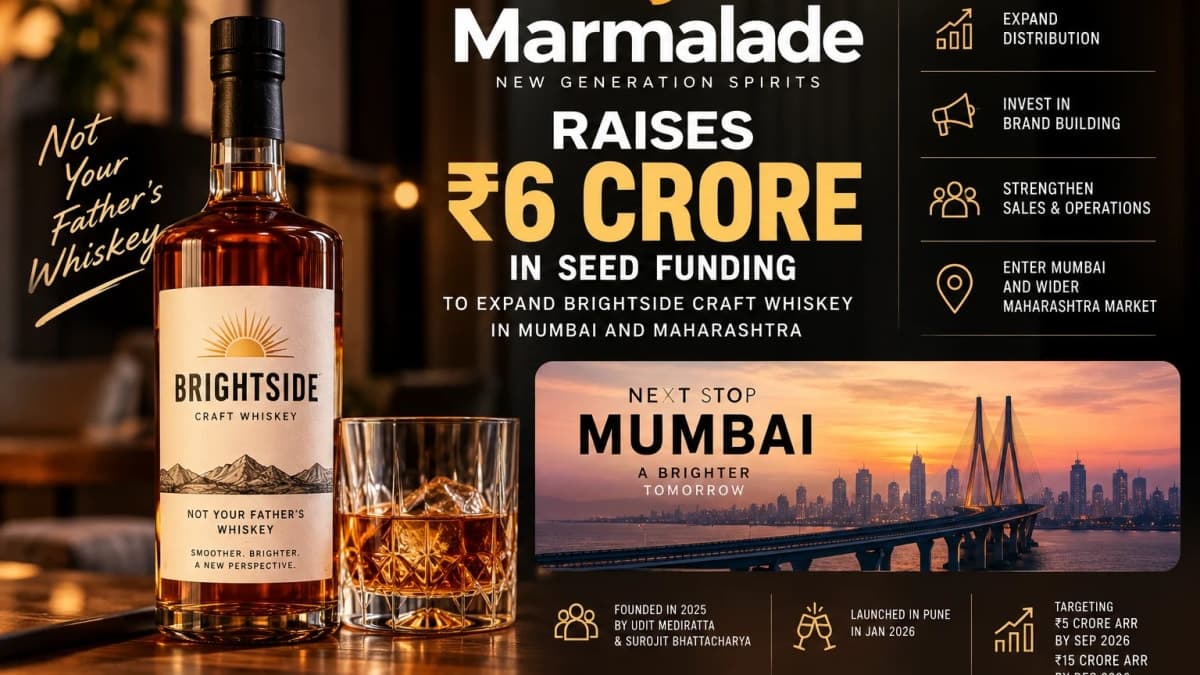
Marmalade has raised ₹6 crore in seed funding, giving the young alcoholic-beverage company fresh capital to take Brightside Craft Whiskey beyond the market where it made its debut earlier this year.
The round includes investors with backgrounds in spirits and consumer businesses, among them Amrut Distilleries chief operating officer Ashok Chokalingam, Robert Sellares, Ishank Gupta and HomeLane founders Srikanth Iyer and Tanuj Choudhry.
Marmalade plans to put the money towards distribution, brand building and stronger sales and operational capabilities. Mumbai and the wider Maharashtra market are central to the next phase.
The expansion comes soon after Brightside's January 2026 launch in Pune. That makes the funding less about developing an idea and more about answering the harder question facing a new consumer brand: whether early interest can translate into repeat sales at a larger scale.
Brightside Is Marmalade's First Bet
Udit Mediratta and Surojit Bhattacharya founded Marmalade in 2025, entering an Indian spirits market dominated by companies with established brands, extensive distribution and considerable marketing resources.
Their first product, Brightside Craft Whiskey, was developed in partnership with Amrut Distilleries and master blender Ashok Chokalingam.
Rather than leaning heavily on the heritage-led imagery traditionally associated with whiskey, Marmalade has positioned Brightside for a younger generation of legal-drinking-age consumers. Its marketing line, “Not Your Father’s Whiskey,” makes that strategy explicit.
The proposition rests on more than packaging. Marmalade describes Brightside as a smoother, more approachable whiskey designed for consumers whose expectations may differ from those addressed by conventional whiskey brands.
Whether that positioning is distinctive enough to build a lasting customer base will become clearer as the company leaves the relative confines of its initial Pune launch.
Investors Bring Spirits and Consumer Experience
The ₹6 crore round is notable for the backgrounds of several participants.
Chokalingam already has a direct connection with Brightside through the product's development and his role at Amrut Distilleries. Robert Sellares comes from the founding family behind Don Q Rum, while Ishank Gupta previously worked as a director at AB InBev and later founded Humyn Labs.
The founders of Malt Society Arabia also participated, alongside HomeLane founders Srikanth Iyer and Tanuj Choudhry.
For Marmalade, that mix offers access to people familiar with both the mechanics of the alcoholic-beverage industry and the challenges of building consumer businesses.
The company has not disclosed its valuation or the amount invested by each participant.
Moving Into Mumbai Raises the Stakes
A spirits startup cannot scale in India simply by shipping more bottles to more stores.
Alcohol is regulated at the state level, creating a fragmented market in which taxes, licensing requirements and distribution structures can vary significantly. As a result, expanding a brand involves regulatory and operational work alongside conventional marketing and sales.
Marmalade's next step remains within Maharashtra, but moving from Pune into Mumbai substantially increases the commercial opportunity as well as the competition.
Brightside will need sufficient retail availability for consumers to discover it, while Marmalade will have to spend carefully enough on marketing to establish the brand without allowing customer-acquisition costs to run ahead of sales.
The seed capital gives the company more room to build that infrastructure. It does not remove the execution risk.
Marmalade Is Setting a Fast Revenue Pace
The founders are aiming for rapid growth.
Marmalade says it expects to reach an annualised revenue run rate of ₹5 crore in September 2026 and is targeting ₹15 crore by December.
Those numbers should be read as company projections expressed as annualised run rates, not as ₹5 crore and ₹15 crore of revenue already recorded during those periods. An annualised run rate extrapolates the pace of sales at a given point over a full year.
Even on that basis, the December target is ambitious. It would represent a threefold increase from the September run-rate figure within a matter of months.
Expansion into Mumbai and the rest of Maharashtra will therefore have to contribute quickly if Marmalade is to deliver the growth it expects.
Founders See an Opening Among Younger Drinkers
Mediratta and Bhattacharya believe demographic change is creating room for a different kind of Indian spirits company.
“Gen Z is expected to account for nearly 40% of India’s drinking population by 2030. Yet, much of the category still speaks to an earlier generation, with products and brands that have not kept pace with changing tastes,” the founders said while discussing the funding.
“We created Marmalade to close this gap, with Brightside as our first expression of what a new-gen Indian spirits brand can be.”
The 40% figure forms part of the company's stated assessment of the market opportunity. Marmalade's broader strategy is clear: it wants to build brands around the tastes and visual language of younger adult consumers rather than reproduce the conventions of established whiskey labels.
That approach is increasingly familiar across consumer categories, where younger companies often use design and a tightly defined identity to secure attention before they have the distribution strength of incumbents.
Spirits present an additional challenge. A successful launch can generate curiosity, but longevity depends heavily on taste, price, availability and whether consumers return to the bottle after trying it once.
From Brand Launch to Distribution Business
Brightside's first months gave Marmalade an opportunity to establish what the whiskey stands for. The ₹6 crore round moves the company into a different phase.
As the brand expands, operational questions will become more important. Marmalade needs to secure distribution, maintain supply, build retail relationships and support the product with enough marketing to remain visible in a crowded category.
The participation of experienced alcohol-industry investors may help as those challenges become more complicated.
There is also a broader strategic question. Brightside is Marmalade's first product, but the founders have described the company in terms that suggest ambitions beyond a single whiskey label. How quickly it expands that portfolio will likely depend on what happens with Brightside first.
For now, Maharashtra provides the test.
Marmalade has established its positioning, attracted investors and secured capital for expansion. The next measure of progress will be less about the story surrounding the brand and more about what happens when substantially more consumers encounter it on shelves.