Rybakina Beats Sabalenka in Three Sets to Claim First US Open Title
Elena Rybakina’s route to the top of women’s tennis was mathematically settled before she walked onto Arthur Ashe Stadium for the US Open final. What remained was the opportunity to leave New York with the trophy as well.
She took it.
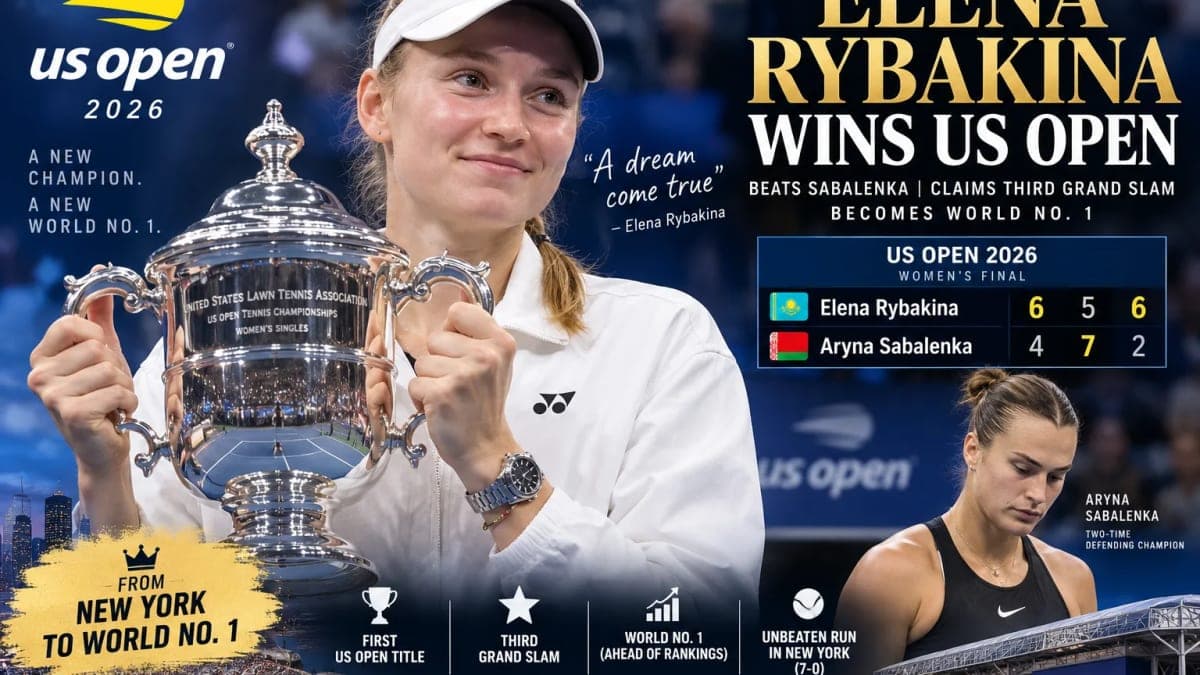
Rybakina defeated Aryna Sabalenka 6-4, 5-7, 6-2 on September 12, ending the Belarusian’s two-year reign as US Open champion and securing her own first title at Flushing Meadows.
The championship is Rybakina’s third Grand Slam singles title, following Wimbledon in 2022 and the Australian Open earlier this year. It also gives her two majors in a 2026 season that will now include her debut at No. 1 in the WTA rankings.
That ranking milestone had already been secured three days earlier. Rybakina accumulated enough points by reaching the semifinals in New York to guarantee she would replace Sabalenka at the top after the tournament.
The final therefore carried an unusual symmetry: the outgoing No. 1 was defending the title she had won in each of the previous two years against the player who had already done enough to replace her.
Rybakina Finds Her Way Through a Tight Final
Neither player entered the match with much room for passive tennis.
Sabalenka’s first-strike power has made her one of the tour’s most difficult players to contain on hard courts. Rybakina brings similar weapons, particularly behind her serve, but her progress from the baseline has made her increasingly comfortable when points extend beyond the opening exchanges.
She established the early advantage by taking the first set 6-4.
Sabalenka did not allow the match to run away from her. She recovered in a more closely contested second set and took it 7-5, pushing the championship into a decider.
The third set was considerably less balanced.
Rybakina regained control and denied Sabalenka the sustained momentum she needed to impose herself from the baseline. She pulled clear for a 6-2 finish, closing out a title that had required her to survive increasingly difficult matches as the tournament progressed.
Sabalenka’s New York Streak Ends
The defeat stopped Sabalenka one victory short of an achievement not seen in the women’s event for more than a decade.
Having won the US Open in 2024 and 2025, she was attempting to become the first woman since Serena Williams to win three consecutive singles championships in New York. Williams completed her three-peat between 2012 and 2014.
Sabalenka also carried a 19-match US Open winning streak into Saturday’s final.
Rybakina ended both runs.
The result adds another significant match to a rivalry that has increasingly followed the two players onto the sport’s biggest stages.
Their Grand Slam Rivalry Has Turned
Sabalenka once held one of the most important victories in their head-to-head history.
At the 2023 Australian Open, she came from a set down to defeat Rybakina and capture her first Grand Slam singles championship.
Three years later, they returned to Melbourne for another final. This time Rybakina won, defeating Sabalenka 6-4, 4-6, 6-4 to claim the 2026 Australian Open.
Their next Grand Slam final came in New York.
Again, three sets were required. Again, Rybakina won.
That makes the pattern particularly striking this season. Rybakina has beaten Sabalenka in the finals of both hard-court majors, taking the Australian Open at the beginning of the Grand Slam calendar and the US Open at its end.
Those results have helped reshape both their rivalry and the hierarchy at the top of the WTA rankings.
The Hardest Part of Rybakina’s Run Came Late
The final was not an isolated display of resilience.
Rybakina’s path through the second week repeatedly required her to recover after losing the opening set.
In the quarterfinals, Qinwen Zheng took the first set before Rybakina changed the direction of the match and won 3-6, 6-1, 6-4.
That victory carried significance beyond qualification for the semifinals. The ranking points guaranteed that Rybakina would become world No. 1 for the first time once the post-US Open rankings were published.
Her semifinal against Coco Gauff followed a similar pattern. Gauff won the opening set, but Rybakina responded to take the next two and advance 3-6, 6-4, 6-4.
By the time she faced Sabalenka, Rybakina had already spent consecutive rounds solving difficult matches from behind.
The final presented a different test. She won the opening set, lost the second and then had to rebuild her advantage rather than chase one.
Her 6-2 deciding set completed an unbeaten 7-0 campaign in New York.
Three Majors Across Three Different Grand Slam Venues
Rybakina now owns major titles on grass and hard courts at three different Grand Slam tournaments.
Her breakthrough came at Wimbledon in 2022, when she won her first major championship.
The wait for a second lasted more than three years. She finally added the 2026 Australian Open, beating Sabalenka in the final.
Seven months later, the US Open has become major No. 3.
That leaves Roland Garros as the only Grand Slam tournament missing from her collection.
The sequence also shows how Rybakina’s career has developed beyond the grass-court success that first made her a major champion. Winning Melbourne and New York in the same season requires sustained effectiveness across two very different periods of the hard-court calendar.
No. 1 Was Secured Before the Trophy
The ranking story needs an important distinction.
Rybakina did not become No. 1 because she defeated Sabalenka in the final.
She had already accumulated enough ranking points during her US Open run to guarantee the position. Her quarterfinal victory over Zheng mathematically secured the change at the top, regardless of what happened in the remaining rounds.
The rankings will formally reflect that change after the tournament.
Rybakina will become the 30th woman to reach No. 1 in the WTA rankings, ending Sabalenka’s 99-week stay at the summit.
Winning the US Open changed none of that arithmetic. It changed the context.
Instead of arriving at No. 1 after falling short late in the tournament, Rybakina will begin her first stint at the top with the US Open trophy in her hands and victories over Zheng, Gauff and Sabalenka behind her.
The rankings measure performance over time. New York supplied something less mathematical: a direct meeting between the player leaving No. 1 and the woman replacing her.
Rybakina won that match too.