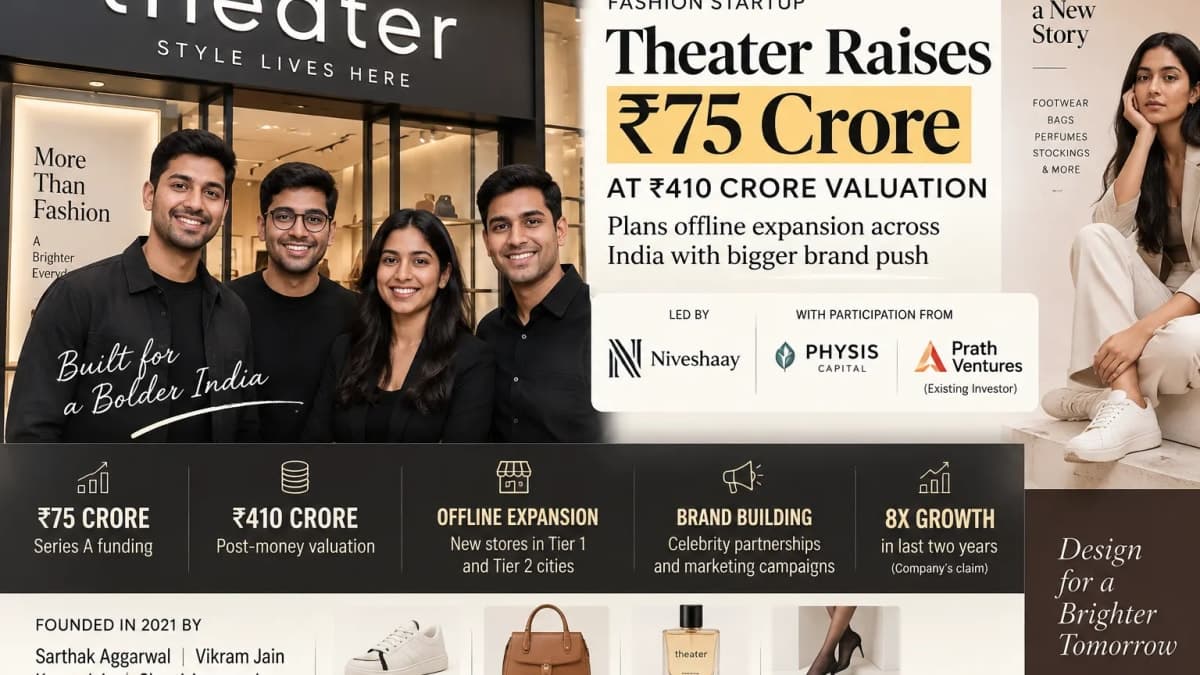
Theater, a fashion startup built around design-led footwear and accessories, has raised ₹75 crore in Series A funding as it prepares to expand beyond its largely digital roots and establish a wider physical retail presence in India.
The round was led by Niveshaay, with Physis Capital joining as a new investor and existing backer Prath Ventures participating. The financing values Theater at ₹410 crore on a post-money basis.
The capital gives the four-year-old company room to pursue a more expensive phase of growth. Rather than relying primarily on online sales and digital discovery, Theater now intends to open stores across Tier 1 and Tier 2 cities, while investing in marketing and celebrity partnerships to build broader recognition.
That shift will test whether a brand developed around a distinct online identity can carry the same appeal into physical retail.
From Digital Brand to Physical Stores
Offline expansion is one of Theater's main priorities after the Series A round.
For fashion companies, stores offer something online channels cannot fully replicate. Customers can try footwear, examine materials and compare products before making a purchase. Physical locations can also give younger brands visibility outside the audiences they already reach through digital advertising and marketplaces.
The opportunity comes with higher costs. Leases, store staff, inventory and operations can place considerably more pressure on a business than a digital-first model.
Theater is therefore pairing its retail plans with greater spending on brand building. Celebrity partnerships and larger marketing campaigns are among the initiatives planned as it moves into new markets.
The strategy suggests the company does not view stores simply as additional sales points. They are intended to become part of a broader effort to turn Theater into a more recognisable consumer brand.
Theater's Bet on India's Mass-Premium Shopper
Founded in 2021, Theater was started by Sarthak Aggarwal, Vikram Jain, Karan Jain and Shruti Aggarwal.
Its product range spans footwear, stockings, perfumes and bags. The company positions itself in the mass-premium segment, targeting customers looking for stronger design and product differentiation without moving into international luxury-brand pricing.
That gap was central to the founders' original idea.
Sarthak Aggarwal, Theater's co-founder and CEO, said:
“We started Theater because we couldn’t find beautiful, well-made accessories in India that weren’t either a luxury import or a compromise.”
The challenge now is to preserve that proposition as the company grows.
A niche fashion label can build loyalty through a recognisable aesthetic. A national retail business has to retain that identity while producing at greater scale, managing more inventory and appealing to customers across markets with different spending patterns.
Company Says It Has Grown Eightfold in Two Years
The Series A follows what Theater describes as a period of rapid expansion.
The company says its business has grown eightfold over the past two years while maintaining a focus on profitability.
The growth figure is a company claim, and detailed financial data supporting it was not disclosed alongside the funding announcement. Even so, the participation of both new and returning investors suggests the business has reached a stage where its backers see an opportunity to fund a larger expansion.
Theater previously raised $1.5 million in a pre-Series A round in September 2024, led by Prath Ventures.
Prath's participation in the new round gives the company continuity among its existing investors, while Niveshaay and Physis Capital add fresh capital for the next stage.
Can Design Scale Beyond a Niche Audience?
Theater's founders are building the company around a proposition that has historically been difficult for many consumer brands: convincing a broad market to pay more for differentiation rather than competing mainly on price and discounts.
Co-founder Vikram Jain addressed that tension directly.
“We’ve heard for years that design doesn’t scale, and that Indian consumers will always choose discounts over differentiation.”
Theater believes its recent growth challenges that assumption.
For the company, the mass-premium category offers room between inexpensive mass-market fashion and high-priced luxury products. Customers in that middle segment may be willing to pay more for design and quality, but price remains an important consideration.
That makes brand perception particularly important. Theater needs consumers to see enough difference in its products to justify a premium without pushing the label beyond the audience it wants to reach.
Its planned marketing investment is closely connected to that calculation.
Investors See a Larger Mass-Premium Opportunity
Lead investor Niveshaay is also looking beyond Theater's individual performance to changes in Indian consumer spending.
Niveshaay founder Arvind Kothari has pointed to rising female workforce participation as one factor supporting demand in fashion and lifestyle categories.
India's female Labour Force Participation Rate increased from 23.3% in 2017-18 to 41.7% in 2023-24, according to figures cited by Kothari while discussing the investment.
He also sees mass-premium fashion growing faster than the broader market.
The connection is commercially relevant for Theater. Greater workforce participation can expand the population of consumers with independent purchasing power, while rising incomes and changing fashion preferences can create more room for brands positioned above the conventional mass market.
Those broader trends, however, do not guarantee success for individual labels. Fashion businesses remain exposed to changing tastes, customer-acquisition costs and the operational demands of managing inventory across multiple categories.
Why the Offline Push Matters
Theater's decision to put Series A capital into stores reflects a wider evolution among digital-first consumer brands.
Online distribution makes it possible to launch without committing large amounts of money to physical infrastructure. It also allows companies to test products and build audiences relatively quickly.
But digital growth has its limits.
Customer acquisition can become expensive, competition for attention is intense, and consumers increasingly encounter the same brands across social platforms and marketplaces. For some companies, physical retail becomes a way to broaden discovery and deepen the relationship with existing customers.
The economics are different, however.
A successful store can increase visibility and sales in a local market. A poorly performing location creates fixed costs that cannot be adjusted as quickly as an online advertising budget.
Theater's ₹75 crore round therefore finances more than expansion. It gives the company the resources to test whether the demand it has built online can support a substantially larger offline network.
₹410 Crore Valuation Sets a New Benchmark
The ₹410 crore post-money valuation establishes a new reference point for Theater as it enters this phase.
The company will now have to show that additional marketing, celebrity partnerships and physical stores can produce growth without weakening the economics of the business.
Sarthak Aggarwal said the scale of the opportunity has changed since the company was founded.
“Four years in, the ambition remains the same, but the opportunity is much bigger.”
The ambition may be familiar, but the operating challenge is not.
Theater began by trying to fill a gap between luxury imports and products that its founders felt compromised on design or quality. After four years, it is attempting something larger: converting that proposition into a retail brand capable of reaching consumers across multiple Indian cities.
The Series A provides the capital for that transition. What follows will depend on whether Theater can make its design-led identity work at a scale far beyond the digital audience that helped establish it.