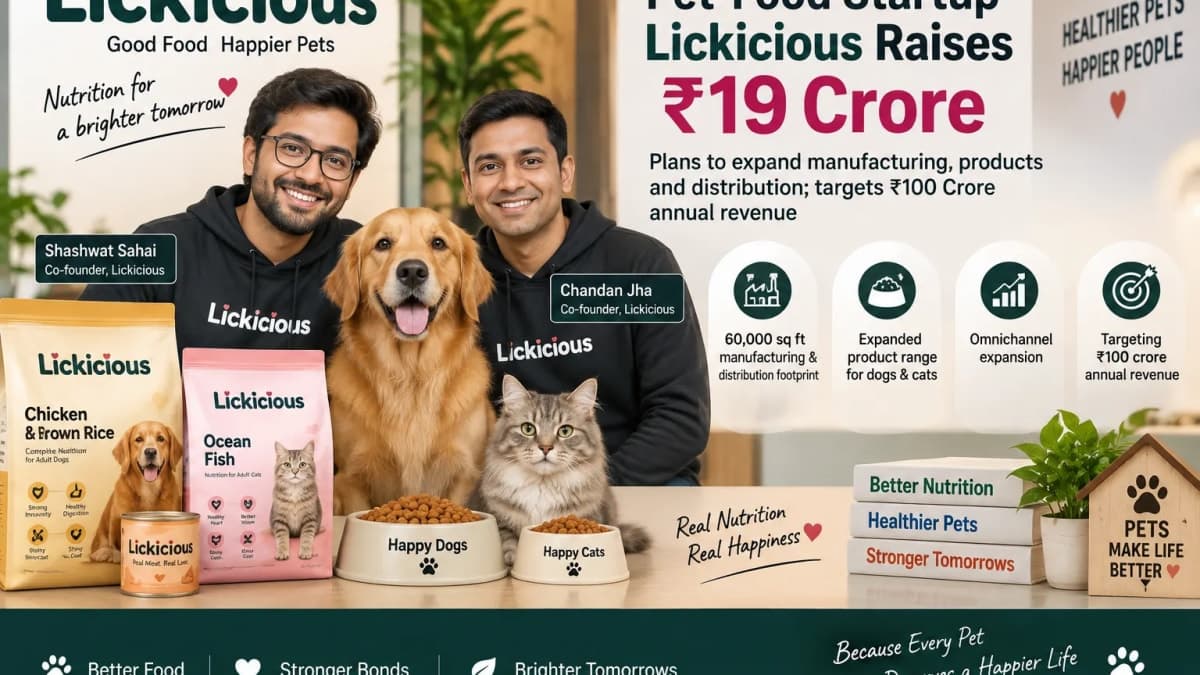
Lickicious is moving beyond the playbook that helped it establish itself as a digital-first pet-food brand.
The Mumbai-based company has secured ₹19 crore in growth capital and plans to direct the money towards manufacturing, product development, distribution and a wider range of food and nutrition products for dogs and cats.
The financing combines equity with institutional debt. Prath Ventures is the lead institutional investor, while the company's early backers include the founders of Atomberg and senior industry executives.
For Lickicious, the funding comes at a point when growth increasingly depends on what happens behind the storefront: production capacity, quality control, supply reliability and the ability to develop products that customers continue buying.
Manufacturing Becomes a Bigger Part of the Business
A substantial part of the expansion will take place away from the consumer-facing side of the brand.
Lickicious is developing a 60,000-square-foot manufacturing and distribution footprint as it prepares for higher volumes and a broader product range. The investment is intended to give the company greater control over production while strengthening its ability to keep products consistently available as distribution expands.
The company also plans to build its research and development, quality, supply-chain, brand and commercial capabilities.
Those investments mark a different phase for a business that began with a digital-first approach. Selling online can help a young consumer brand establish demand without building a conventional retail network from the outset. Once volumes rise, however, manufacturing capacity and dependable distribution become harder to separate from the customer experience.
Lickicious Plans a Wider Pet-Food Portfolio
Founded in 2024 by Shashwat Sahai and Chandan Jha, Lickicious makes food and nutrition products for dogs and cats.
The company now wants to expand across categories and formats rather than rely on a limited set of products. It also intends to reach customers through more sales channels as it develops into an omnichannel business.
That expansion puts additional weight on product consistency. A larger catalogue may create more opportunities to sell to existing customers, but it also increases the operational demands associated with sourcing, production, inventory and quality assurance.
Sahai has framed repeat purchases as the more meaningful test of whether the company's products are working.
“A good-looking bag can win the first order. Only good food wins the next ten,” he said.
The comment captures a central challenge in pet food. Marketing can encourage trial, but sustained growth depends heavily on whether pet owners trust the product enough to buy it repeatedly.
₹100 Crore Is the Next Revenue Milestone
Lickicious has set its sights on reaching ₹100 crore in annual revenue.
The company regards that figure as an intermediate milestone rather than its final destination. Its longer-term ambition is to become one of India's three largest pet-food companies over the next decade.
Those are company targets rather than forecasts. Reaching them will depend on whether Lickicious can turn its new capacity and expanded portfolio into sustained sales while managing the costs that accompany a larger manufacturing and distribution operation.
The ₹19 crore round gives it additional resources for that effort, but scaling a food business creates pressures that are different from those faced during its initial digital growth.
More products mean more inventory. Wider distribution requires stronger logistics. Greater production volumes make quality systems increasingly important.
The company's spending priorities reflect those realities.
Prath Ventures Backs the Expansion
Prath Ventures is leading the institutional investment in Lickicious. Founder disclosures also identify ISV Capital as a participant, alongside Atomberg founders and executives from other industries.
Harmanpreet Singh, managing partner at Prath Ventures, has argued that India's pet-food market is evolving beyond a business where distribution alone determines success.
“Lickicious has demonstrated a strong understanding of Indian pet parents, a differentiated product proposition and disciplined execution across digital channels,” Singh said.
That assessment points to the investment case behind the round. Lickicious has already tested its proposition with online consumers; the next task is to build the physical and organisational infrastructure needed to operate at a substantially larger scale.
The Harder Stage of Building a Consumer Brand
India's digital commerce ecosystem has lowered some of the barriers that once made it difficult for young consumer companies to challenge established brands.
Pet food is part of that shift. Online distribution allows newer businesses to reach customers directly, introduce specialised products and gather feedback without first securing shelf space across a large physical retail network.
But digital access solves only part of the problem.
Food companies ultimately have to manufacture reliably, maintain quality, manage supply chains and persuade customers to reorder. Those requirements become more demanding as the business expands.
Lickicious' decision to invest in manufacturing and R&D suggests that it sees product and production capability, rather than advertising alone, as central to its next stage.
From Digital-First Startup to Larger Pet-Nutrition Business
The ₹19 crore financing is therefore less about a single expansion project than a change in the company's operating model.
Lickicious is trying to move from an emerging digital brand towards a pet-nutrition business with its own larger manufacturing base, a wider product portfolio and distribution across multiple channels.
That transition carries opportunity as well as execution risk. Manufacturing capacity is useful only if demand grows with it, while rapid product expansion can become costly if inventory moves slowly.
The company's focus on repeat purchases offers one measure of whether the strategy is working. If customers return because their pets respond well to the food, manufacturing scale and wider distribution can reinforce that demand.
Lickicious now has additional capital to test that proposition at a larger level. Its ₹100 crore revenue ambition will depend on whether the company can preserve the product discipline of a young brand while building the operational systems of a much bigger one.