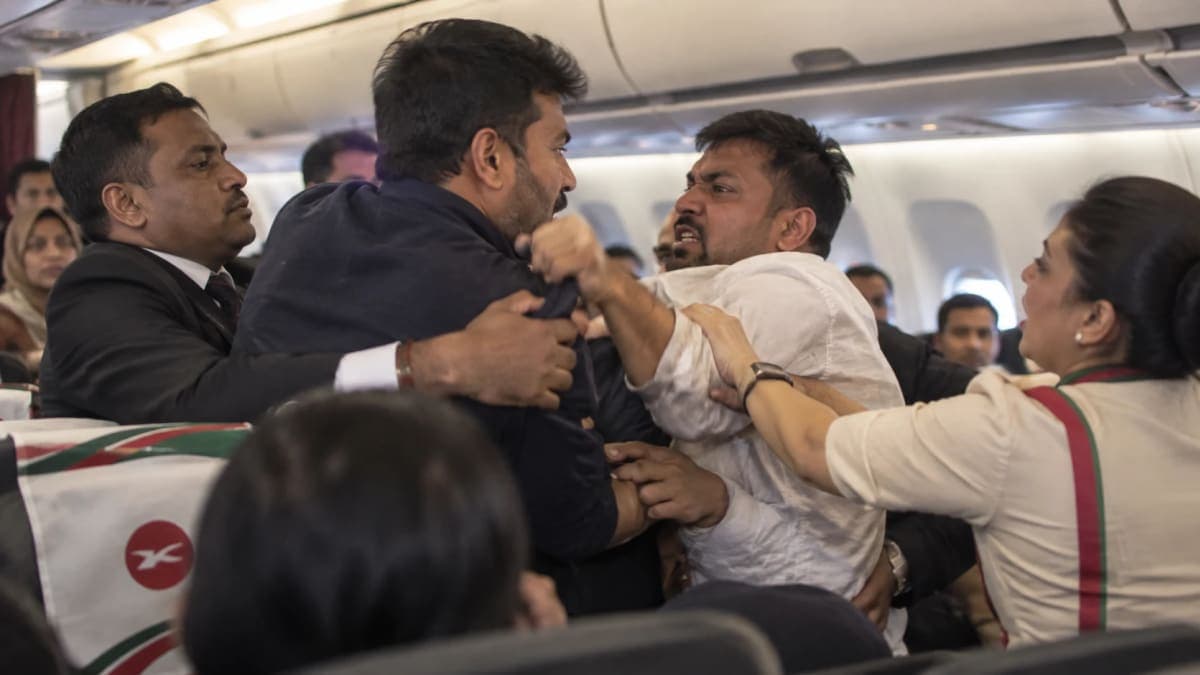
A Biman Bangladesh Airlines flight turned chaotic after two male passengers became involved in a physical fight inside the cabin, with footage of the confrontation spreading rapidly across social media. The video shows the men arguing and exchanging blows as cabin crew and other passengers attempt to separate them. At one stage, one man's T-shirt appears to be torn during the struggle.
While several reports have described the incident as taking place on a London-to-Dhaka flight, information attributed directly to Biman Bangladesh Airlines points in the opposite direction. The airline's public relations general manager told The Business Standard that the aircraft had departed Sylhet for London on September 17, 2026, and that crew members intervened after the dispute became physical.
That distinction matters because the viral clip itself does not establish the aircraft's route, flight number, exact location in the air or what triggered the confrontation.
What the viral video actually shows
The short video captures a confrontation between two men in the passenger cabin. They can be seen arguing at close range before the situation develops into a physical fight. One passenger's shirt appears to be torn as the confrontation intensifies.
Other travellers are close to the altercation, and crew members and passengers can be seen attempting to intervene. Bangladeshi reporting said the disturbance alarmed other people aboard, including children and elderly passengers.
The footage establishes that a physical confrontation occurred aboard a Biman aircraft. It does not, however, establish why the argument started.
That is an important distinction because social-media posts have begun attaching explanations to the video that have not been consistently supported by the airline or reliable reporting.
Biman confirms Sylhet-to-London flight
The strongest information about the route comes from Biman Bangladesh Airlines itself.
Mohiuddin Ahmed, identified by The Business Standard as general manager of Biman's public relations department, confirmed the incident and said the flight had departed Sylhet for London on the morning of September 17.
According to the statement reported by the newspaper, the two passengers became involved in a physical altercation at some point during the journey and cabin crew subsequently intervened and brought the situation under control.
This is more specific than an earlier Dhaka Tribune report, which described the aircraft as travelling from London to Bangladesh and quoted Biman General Manager Mahbubuddin Ahmed as saying at that stage that he was not yet aware of the matter and was checking it.
Later reporting therefore provides a stronger basis for identifying the direction of travel.
For that reason, JantaScope is treating Sylhet-to-London as the best-supported route unless Biman issues a subsequent statement correcting it.
Why are some reports calling it a London-Dhaka flight?
The conflicting descriptions are one of the most important details missing from much of the viral coverage.
India Today, for example, reported on September 18 that the aircraft was travelling from London to Dhaka. Its account otherwise describes essentially the same footage: two men arguing, exchanging blows, a torn T-shirt and intervention by cabin crew and fellow passengers.
Dhaka Tribune's initial September 17 report similarly described the flight as travelling from London to Bangladesh.
But The Business Standard subsequently cited Biman sources and a named Biman public-relations executive saying the incident happened on a flight that departed Sylhet for London on September 17.
This appears to be a case where a rapidly spreading video was reported before all of its basic details had been established.
The responsible conclusion is therefore not to pretend that every published account agrees. It does not.
What started the fight?
This remains unclear.
Available reliable reporting says the two passengers became involved in a heated argument before it escalated into physical violence. Neither the Biman statement reported by The Business Standard nor the original Dhaka Tribune account establishes the cause of the argument.
One report circulating in Indian media attributed the confrontation to a dispute over a seat, but JantaScope could not independently establish that explanation from Biman's confirmed account.
It should therefore be treated as unverified, not as the established cause of the fight.
The identities of the two passengers have also not been reliably established in the sources reviewed for this article.
How did the cabin crew respond?
The airline-confirmed account says cabin crew intervened after the argument became physical and resolved the confrontation between the two passengers.
The viral footage also shows people trying to separate the men as the situation unfolds.
That intervention is more significant than it may appear in a short viral clip.
A fight inside an aircraft is fundamentally different from an argument in an airport terminal. Cabin crew are responsible not only for passenger service but also for maintaining cabin safety in an environment where movement is restricted and where interference with crew duties can have wider operational consequences.
Biman's own conditions of carriage give the airline authority to take measures it considers necessary when a passenger's conduct endangers an aircraft or people or property aboard it, obstructs crew members, ignores crew instructions or causes behaviour to which other passengers may reasonably object. Those measures can include restraining a passenger.
Its international tariff rules go further. Certain prohibited behaviour, including injuring or credibly threatening another passenger or crew member, can result in refusal of future carriage, potentially extending to an indefinite or lifetime ban depending on the circumstances.
There is no verified evidence at this stage that Biman has imposed such a penalty on either person involved in this incident.
Why a passenger fight is an aviation-safety issue
The viral video is visually dramatic, but the broader issue is not simply bad passenger behaviour.
The International Civil Aviation Organization defines unruly or disruptive passengers as people who fail to respect rules of conduct aboard an aircraft or crew instructions in a way that disrupts good order and discipline.
ICAO guidance specifically identifies fights and assaults involving passengers among the types of disruptive behaviour that can create safety concerns aboard aircraft. In serious cases, such incidents can force an unscheduled landing.
A physical fight creates several potential problems simultaneously.
Passengers can be injured. Crew members may have to leave their normal duties to control the confrontation. People standing in aisles can interfere with movement through the cabin, while a rapidly escalating dispute in a confined space can be difficult to contain.
The UK Civil Aviation Authority similarly warns that aggressive or disruptive behaviour can cause distress and pose a risk to aircraft safety. In serious circumstances, disruptive passengers may face arrest, criminal proceedings, financial penalties, liability for diversion costs or an airline ban. The exact legal consequences depend on the jurisdiction and facts of each case.
International flights create another complication: jurisdiction
Because this was an international service, any potential enforcement action can involve questions that do not arise in an ordinary public-place fight.
An aircraft can be registered in one country, depart from another, fly over several jurisdictions and land somewhere else.
ICAO has specifically identified jurisdiction as a longstanding problem in dealing with disruptive passengers on international flights. The 2014 Montreal Protocol was designed in part to reduce those gaps by strengthening the ability of the state where an aircraft lands to exercise jurisdiction in qualifying cases.
That does not establish what legal action will be taken in this particular case.
As of the reporting reviewed by JantaScope, there was no independently verified announcement of arrests, criminal charges or penalties against the two passengers.
What happened to the flight itself?
Another detail absent from the confirmed reporting is any major operational disruption.
The airline's spokesperson said the crew intervened and resolved the situation, but the available account does not report an emergency diversion or unscheduled landing resulting from the fight.
That matters because social-media descriptions of an aircraft becoming “chaotic” can sometimes create the impression that the flight itself was endangered or forced to divert.
There is currently no verified basis for making either claim.
Similarly, JantaScope could not independently verify the exact flight number from the airline's statement. Although Biman operates services linking London with Bangladesh, matching a schedule to a viral video without an airline confirmation would risk attaching the incident to the wrong aircraft or service.
What this incident shows about viral aviation stories
The unusual part of this story is not only the fight. It is how quickly uncertainty about a viral video became part of the reporting.
Within hours, essentially the same footage was being described as a London-to-Dhaka incident, a London-to-Bangladesh incident and a Sylhet-to-London incident.
The later account sourced directly to Biman provides the clearest answer so far: the aircraft left Sylhet for London on September 17.
Other details remain unresolved.
There is no confirmed explanation for what started the argument, no independently verified identification of the passengers and no confirmed announcement of legal or airline disciplinary action.
Those gaps are worth preserving rather than filling with assumptions.
What can be established is straightforward: two passengers fought aboard a Biman Bangladesh Airlines aircraft, cabin crew intervened, the confrontation was brought under control, and footage of the incident subsequently spread online.
The next meaningful development will be whether Biman or aviation authorities announce an investigation, identify the cause of the confrontation or take action against those involved.