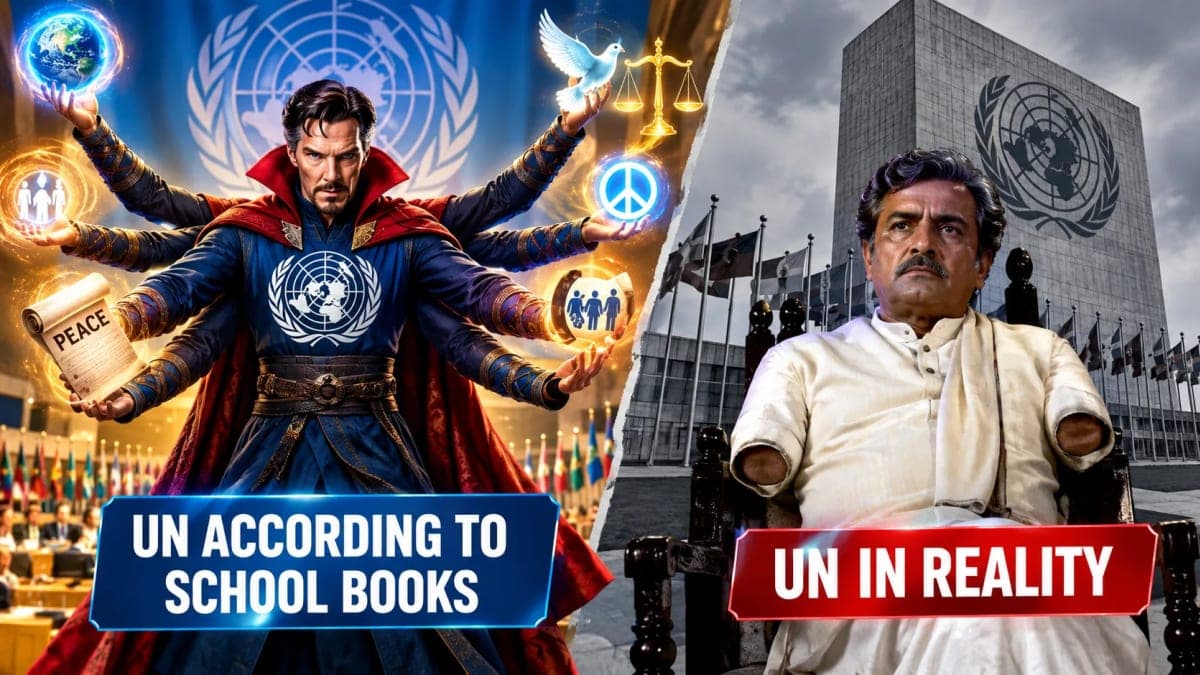
Iran Turns to Bollywood to Criticise the UN
Iran’s Embassy in India has drawn attention online after sharing a meme featuring Thakur Baldev Singh, the iconic character from the 1975 Bollywood film Sholay, in a satirical comparison aimed at the United Nations.
The meme, posted on X on September 29, contrasted two dramatically different images of the UN. One panel featured Marvel character Doctor Strange with multiple arms, labelled “UN according to school books.” The other showed Thakur, played by Sanjeev Kumar in Sholay, labelled “UN in reality.”
The comparison was designed to convey Iran’s view that the UN may appear highly capable in theory but faces significant limitations when responding to major international disputes.
Why Thakur Was Used in the Meme
Thakur Baldev Singh is one of the most recognisable characters in Indian cinema. In Sholay, the former police officer has lost both arms after an attack by the villain Gabbar Singh.
By placing the character alongside a multi-armed Doctor Strange, the embassy created a visual contrast between having many apparent capabilities and being unable to act.
Importantly, the embassy’s brief post did not identify a particular UN resolution or conflict as the specific subject of the meme. Reports interpreting the post have connected it with wider Iranian criticism of the international organisation, but that broader context should be distinguished from what the meme itself explicitly stated.
Wider Tensions Between Iran and the UN
The post appeared as Iranian officials were publicly criticising the UN’s response to international tensions involving Tehran.
Iranian Foreign Minister Abbas Araghchi recently met UN Secretary-General António Guterres in New York and accused the organisation of failing to respond adequately to what Iran describes as violations of the UN Charter by the United States and Israel. Those accusations represent the Iranian government’s position and remain part of a broader geopolitical dispute.
The UN’s actual ability to intervene in conflicts is also more complicated than the meme suggests. Under the UN Charter, the Security Council has primary responsibility for maintaining international peace and security, while substantive Council decisions depend on its voting structure, including the role of its five permanent members.
Pop Culture Becomes a Diplomatic Tool
The Sholay post is another example of diplomatic messaging moving beyond formal statements and press conferences.
Using a character immediately familiar to millions of Indians allows a complicated argument about international institutions to be communicated through a simple visual joke. Iran’s diplomatic missions have recently used other Indian-film references as part of their online messaging as well.
At the same time, a meme inevitably simplifies the issue. The UN is made up of member states and multiple institutions, and its capacity to act in conflicts depends heavily on political agreement among those states—particularly within the Security Council.
For Iran, however, the Sholay reference delivered its criticism in a format designed for the social-media age: familiar, brief and easily shareable.


