ICICI Bank Mobilises $17.88 Billion Through RBI’s FCNR(B) Window
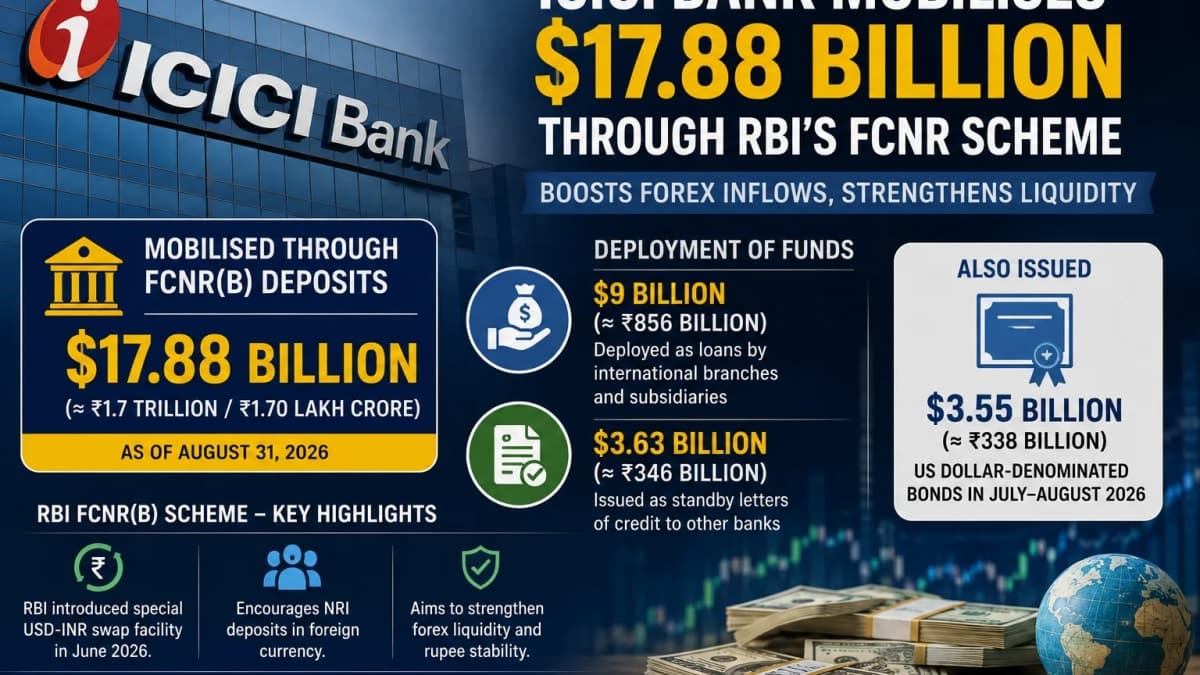
Mumbai, September 2, 2026: ICICI Bank has mobilised approximately $17.88 billion through Foreign Currency Non-Resident (Bank), or FCNR(B), deposits under a special foreign-exchange facility introduced by the Reserve Bank of India, highlighting the scale of foreign-currency inflows generated by the central bank's recent measures.
The amount, equivalent to roughly ₹1.7 trillion or ₹1.70 lakh crore, was mobilised through August 31, ICICI Bank said in a regulatory disclosure.
The fundraising makes ICICI Bank a significant participant in the RBI-backed initiative designed to attract foreign currency into India and improve forex liquidity.
The numbers are particularly notable because FCNR(B) deposits under the wider RBI initiative had reached $65.4 billion by August 21, meaning ICICI Bank's reported mobilisation alone represents a substantial share of the inflows recorded through that stage of the programme.
What ICICI Bank Did With the Funds
ICICI Bank disclosed additional details showing how part of the foreign-currency deposits has been deployed.
Around $9 billion, or approximately ₹856 billion, has been provided as loans by the bank's international branches and subsidiaries against deposits mobilised through the facility.
The lender has also issued approximately $3.63 billion, or ₹346 billion, in standby letters of credit to other banks in connection with loans backed by such deposits.
A standby letter of credit essentially provides a form of payment assurance. In this case, ICICI Bank's disclosure shows another channel through which the FCNR(B) mobilisation is supporting lending arrangements.
These figures describe deployment and guarantees associated with the deposits and should not be added together and treated as additional deposit mobilisation.
The headline mobilisation figure remains approximately $17.88 billion.
ICICI Bank Also Issues $3.55 Billion in Dollar Bonds
Separately, ICICI Bank said it issued approximately $3.55 billion, or ₹338 billion, of US dollar-denominated bonds during July and August 2026.
The bond issuance is distinct from the $17.88 billion mobilised through FCNR(B) deposits.
The combination nevertheless illustrates the scale of ICICI Bank's recent activity in international funding markets.
What Is an FCNR(B) Deposit?
FCNR(B) stands for Foreign Currency Non-Resident (Bank).
It allows eligible non-resident Indians to maintain term deposits with Indian banks in specified foreign currencies rather than converting their money into rupees at the time of deposit.
That distinction matters because the depositor's principal and interest remain denominated in foreign currency.
For NRIs, this can reduce exposure to fluctuations in the rupee against the currency in which the deposit is maintained.
For Indian banks and the broader financial system, FCNR(B) deposits provide a channel for attracting foreign-currency funding.
Why RBI Introduced the Special Facility
The Reserve Bank of India introduced a package of foreign-exchange measures in June 2026 as part of an effort to encourage overseas inflows and strengthen foreign-exchange liquidity.
A special USD-INR swap facility was introduced covering foreign-currency flows through channels including:
FCNR(B) deposits,
External Commercial Borrowings (ECBs), and
Overseas Foreign Currency Borrowings (OFCBs).
Under such a swap arrangement, banks can obtain greater certainty over the future rupee value of foreign-currency funds, reducing part of the exchange-rate risk associated with bringing dollars and other foreign currencies into India.
That made foreign-currency mobilisation more attractive for participating banks.
RBI Closed FCNR(B) Window on August 31
The special facility received a strong response.
The RBI eventually brought forward the deadline for fresh FCNR(B) deposits under the programme, with the window closing on August 31, 2026.
The central bank cited the encouraging response to its measures when announcing the earlier closure.
The facilities relating to ECBs and OFCBs, however, are scheduled to remain available until December 31, 2026.
That distinction means the FCNR(B) component has closed to fresh mobilisation under the special arrangement, while some of the RBI's other foreign-currency channels remain active.
Overall Inflows Had Already Reached $72.85 Billion
The broader scale of the programme helps put ICICI Bank's $17.88 billion mobilisation into perspective.
According to RBI figures reported for August 21, approximately $72.85 billion had entered through the three eligible channels.
FCNR(B) deposits dominated the flows.
They accounted for approximately $65.4 billion, or nearly 90% of the total recorded at that point.
The remaining inflows included:
OFCBs: approximately $4.86 billion
ECBs: approximately $2.59 billion
Because ICICI Bank's $17.88 billion figure runs through August 31 while the broader RBI figures cited above are through August 21, the two periods are not directly comparable.
Still, they demonstrate that ICICI Bank was a major participant in the FCNR(B) mobilisation drive.
FCNR(B) Inflows Put RBI's Forex Position in Focus
The influx of foreign currency has consequences beyond individual bank balance sheets.
Reuters reported that the RBI's foreign-exchange forward position reached an all-time high of $136.7 billion in July, with the increase linked partly to the surge in overseas deposits following the central bank's measures.
That highlights an important feature of the programme.
While foreign-currency inflows can help improve dollar availability and provide support to the rupee, the associated swap transactions can also influence liquidity conditions and the RBI's forward foreign-exchange book.
The programme therefore has implications for both the currency market and domestic banking-system liquidity.
Why the $17.88 Billion Mobilisation Matters for ICICI Bank
For ICICI Bank, the scale of the FCNR(B) mobilisation provides access to a substantial pool of foreign-currency funding.
Its disclosure that international branches and subsidiaries have already deployed approximately $9 billion as loans indicates that the programme is not simply accumulating deposits.
Part of the funding is being channelled into lending activities.
Meanwhile, the $3.63 billion in standby letters of credit illustrates how the deposits can support financing arrangements involving other banks.
The eventual financial impact on ICICI Bank will depend on factors including funding costs, loan deployment, margins, hedging arrangements and repayment performance. The headline mobilisation figure alone should therefore not be interpreted as equivalent to profit or revenue.
Bigger Picture: RBI's Push to Strengthen Dollar Inflows
ICICI Bank's numbers provide one of the clearest bank-level indications yet of the scale of participation in the RBI's 2026 foreign-currency initiative.
The central bank's strategy was aimed at making it more attractive to bring foreign currency into India at a time when dollar liquidity and the rupee were under pressure.
By August 21, FCNR(B) deposits had emerged as the dominant channel in the programme.
ICICI Bank's disclosure now shows just how large an individual bank's participation could become: $17.88 billion in deposits, $9 billion deployed through loans and $3.63 billion in standby letters of credit.
With the special FCNR(B) window now closed, attention is likely to shift from how much banks can mobilise to how effectively those funds are deployed—and what the extraordinary inflows ultimately mean for banking-system liquidity, credit and India's foreign-exchange market.