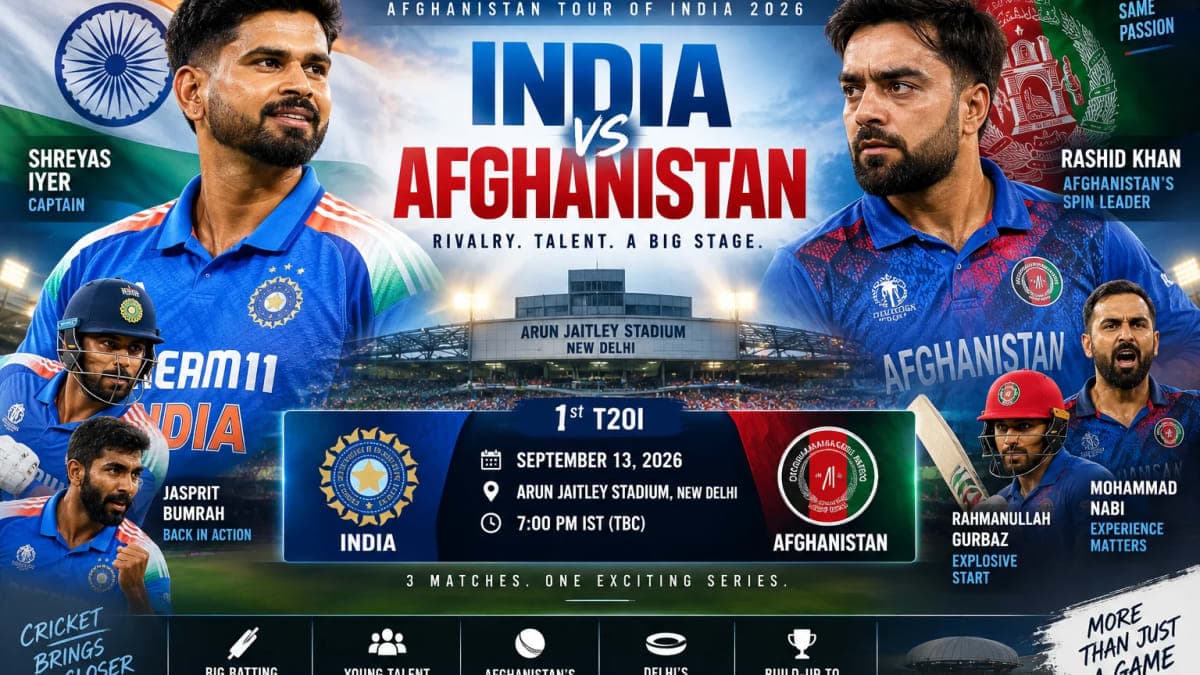
India begin a three-match T20I series against Afghanistan in Delhi on Sunday with no shortage of batting options, but also with decisions to make about how those pieces fit together.
The opening game at the Arun Jaitley Stadium on September 13, 2026 brings India back into T20I action under Shreyas Iyer, while Afghanistan arrive with a familiar source of strength in Rashid Khan and their spin-heavy attack.
There is an unusual element to the setting. Afghanistan are officially the hosts for the series even though all three matches will be played in New Delhi.
For India, however, the more immediate issue is selection. The squad offers several possible opening combinations, and the fitness of Ishan Kishan has added another consideration before the first ball is bowled.
India Have Options at the Top, but Few Easy Choices
Abhishek Sharma, Sanju Samson, Ishan Kishan and Vaibhav Sooryavanshi give India different ways to construct the top order.
Each option changes the balance of the side.
Samson and Kishan can keep wicket. Abhishek provides left-handed power at the top, while Sooryavanshi offers the attacking approach that has accelerated his rise through Indian cricket.
Kishan's fitness has complicated the calculation. He experienced back discomfort during training after attempting to evade a short delivery from Navdeep Saini, according to reports, leaving his availability for the opening match under scrutiny.
That could create an opening for another combination, although India's final XI will depend on more than replacing one player.
The management also has to decide how much experience it wants at the top and whether this is the right moment to give Sooryavanshi an extended opportunity.
At 15, the left-hander is one of the most closely watched players in the squad. His aggressive batting has already attracted considerable attention, but international cricket brings a different examination, particularly against an attack with Afghanistan's variety.
Practice sessions have provided a reminder of that adjustment. Sooryavanshi reportedly found India's leading fast bowlers difficult at times before responding with a more fluent display during a subsequent optional session.
Iyer Has Considerable Depth to Work With
India's options extend well beyond the opening partnership.
Iyer captains the side, with Tilak Varma named vice-captain. The squad also includes Axar Patel, Washington Sundar, Shivam Dube and Nitish Kumar Reddy, giving the team management several ways to distribute batting depth and bowling responsibility.
The return of Jasprit Bumrah strengthens the attack considerably.
Bumrah, Washington and Nitish have received fitness clearances, while India have had to make one enforced change. Harshit Rana was ruled out after sustaining a hamstring injury during a fitness test, with Yash Thakur coming into the squad as his replacement.
Alongside Bumrah, Arshdeep Singh gives India an established left-arm pace option, while Varun Chakaravarthy offers a different challenge through the middle overs.
The final balance could depend on conditions in Delhi. If India expect spin to become increasingly influential, the depth of their all-round options gives them room to adjust without substantially weakening the batting.
Afghanistan's Route Into the Match Runs Through Spin
Afghanistan have spent years building a competitive T20 side around a straightforward strength: they possess bowlers capable of controlling the middle of an innings.
Rashid Khan remains central to that approach.
His value is not simply measured by wickets. Rashid's ability to restrict scoring can force batters to take greater risks against bowlers operating at the other end, allowing Afghanistan to create pressure without needing favourable conditions throughout an innings.
That could become particularly important against an Indian batting order inclined to attack.
India's players are generally strong against spin, but familiarity does not remove the challenge. Afghanistan's attack has enough experience to punish poor shot selection if the pitch offers even modest assistance.
With Mohammad Nabi providing experience and Rahmanullah Gurbaz capable of setting an aggressive tempo with the bat, Afghanistan also have players accustomed to high-level franchise and international T20 cricket.
They will need that experience against an Indian side with considerably greater batting depth.
Delhi Could Reward Aggression, but Spin May Still Matter
The dimensions of the Arun Jaitley Stadium have often encouraged attacking cricket. Shorter boundaries can quickly turn a well-timed period of batting into a decisive passage of play.
That does not necessarily make the venue straightforward for batters.
The Delhi surface can bring slower bowling into the contest, particularly as a match develops. If the pitch grips, both teams have enough spin options to alter the pace of the innings through the middle overs.
Dew could further complicate the equation later in the evening. If it becomes significant, gripping the ball may become more difficult and the toss could influence how the captains approach the match.
Those conditions leave both teams with competing considerations. Packing the side with batting offers protection on a high-scoring surface, while additional bowling variety could become more valuable if the pitch slows.
Afghanistan Are the Hosts, Despite Playing in Delhi
The series carries an unusual administrative arrangement.
Afghanistan are the designated home team, but all three T20Is are being staged at the Arun Jaitley Stadium in New Delhi.
The series runs from September 13 to September 17 and forms part of the international calendar under the Future Tours Programme.
For Afghanistan, playing India in Delhi removes much of the conventional advantage associated with hosting a bilateral series. Indian players know the conditions, and the stands are likely to provide little sense of an away fixture for Iyer's side.
Afghanistan's challenge is therefore to prevent the location from defining the contest.
Their spin attack gives them a credible way of doing that.
India Look Beyond the Immediate Series
The three matches also arrive during an important stretch of India's T20 calendar, with the Asian Games providing another assignment later in September.
That gives the selectors an opportunity to examine combinations rather than simply settle on an established XI.
Sooryavanshi's potential role is part of that picture, as are the choices surrounding Samson, Kishan and Abhishek. India's depth creates competition for places, but it also means the management has to establish a clear batting order rather than continually reshuffle players with similar claims.
Afghanistan present a useful test for those decisions.
India have greater resources and will start with the stronger squad on paper. Afghanistan, however, have enough T20 experience to exploit periods of uncertainty, particularly if Rashid and the other spinners can dictate the middle overs.
The first match should therefore offer something more useful than an early series lead. It will provide the first indication of how India intend to organise a crowded batting line-up and whether Afghanistan can turn their clearest strength into sustained pressure.
Match Details
Match: India vs Afghanistan, 1st T20I
Date: September 13, 2026
Venue: Arun Jaitley Stadium, New Delhi
Series: Three-match T20I series
Official Host: Afghanistan
India Captain: Shreyas Iyer