New Delhi, September 1, 2026: India’s artificial intelligence startup boom is entering a more demanding phase.
After a period dominated by experimentation, foundation-model development, computing infrastructure and aggressive venture investment, AI companies are increasingly being judged on whether their technology can become a sustainable business.
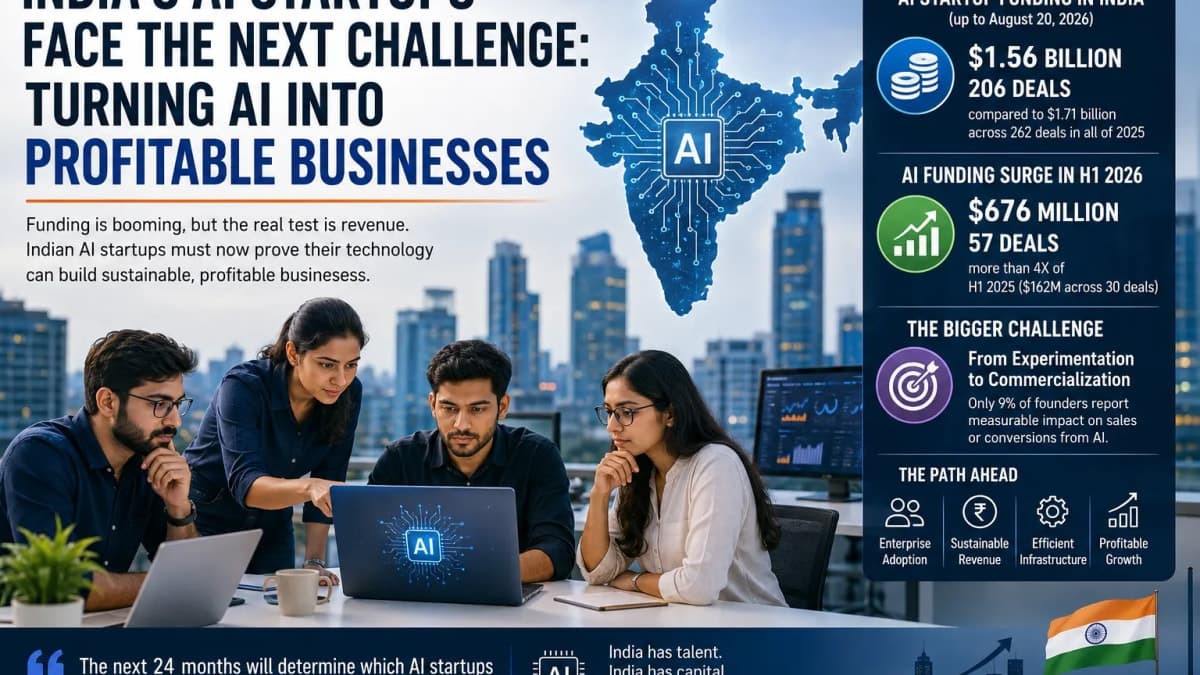
Funding remains strong. Indian AI startups had attracted $1.56 billion across 206 deals through August 20, 2026, according to data reported by Moneycontrol. That compares with $1.71 billion across 262 deals during the whole of 2025.
But capital alone will not determine the winners.
The bigger challenge for founders is increasingly commercial: convincing customers to pay for AI products at prices that can support the substantial costs of computing, model development, engineering and customer acquisition.
That transition could determine whether India produces a durable generation of AI companies or a large pool of technically promising startups that struggle to convert adoption into sustainable earnings.
AI Funding in India Is Accelerating
Investor appetite for Indian AI companies has increased sharply.
AI startups raised $676 million across 57 deals during the first half of 2026, according to Inc42. That was more than four times the $162 million raised across 30 deals during the corresponding period of 2025.
By August 20, AI funding had climbed to approximately $1.56 billion across 206 transactions, according to Moneycontrol.
The numbers suggest that investors are no longer treating artificial intelligence merely as an experimental category.
AI funding represented around 23% of India's overall venture-capital deal value through that period, according to the Moneycontrol report.
However, the distribution of investment also reveals an important qualification: large transactions can heavily influence headline funding numbers.
CRISIL Intelligence found that India attracted more AI capital during the first half of 2026 than during all of 2025, but said the increase was driven overwhelmingly by two transactions — Neysa Networks’ $600 million funding and Sarvam AI’s $234 million Series B round.
That concentration highlights the difference between a booming AI investment narrative and broad-based commercial maturity across the ecosystem.
The Question Is Shifting From “Can It Work?” to “Will Customers Pay?”
For the first wave of generative-AI startups, technological capability itself could attract attention.
A company capable of developing an advanced model, voice assistant, AI agent or enterprise automation platform could often demonstrate its potential through pilots and proofs of concept.
The commercial test is different.
Businesses ultimately need AI systems that either increase revenue, lower operating costs, improve productivity or solve problems sufficiently important to justify recurring expenditure.
Evidence suggests that this transition remains incomplete.
A 2026 Elevation Capital study on AI adoption among Indian startups found that only 9% of founders reported a measurable impact from AI on sales or conversions.
At the same time, enthusiasm remained high.
Around 86% of founders planned to increase their AI budgets during 2026, while 53% expected to more than double spending. Only 4% planned to reduce their AI investment.
That gap — between enthusiasm for AI and its measurable impact on revenue — illustrates the central commercial challenge facing the industry.
Commercial Viability Emerges as a Critical Test
CRISIL Intelligence has identified compute infrastructure, growth capital and commercial viability as three major tests facing India's AI industry.
Between January 2022 and June 2026, nearly half of tracked AI investment flowed into infrastructure, including GPU clouds and computing capacity.
Infrastructure may have a relatively straightforward commercial proposition because companies developing and deploying AI require computing capacity regardless of which individual models ultimately dominate.
Foundation models face a different challenge.
Building and operating sophisticated models can require substantial investment, while rapidly declining model prices and improvements in competing global technologies can make differentiation difficult.
For an Indian model company, therefore, technological capability alone may not be enough.
It needs customers, distribution, proprietary advantages and revenue capable of supporting continued development.
Valuation and Revenue Cannot Remain Disconnected Forever
India has already produced AI unicorns including Neysa Networks, Sarvam AI and Krutrim.
But CRISIL Intelligence has cautioned that valuations in parts of the sector have moved ahead of established commercial revenue.
That does not necessarily mean those valuations cannot eventually be justified.
AI companies are frequently valued on expectations of rapid future adoption rather than current profits. The crucial question is whether startups can eventually convert technological progress and investor backing into recurring commercial demand.
CRISIL said the next 24 months will be important in determining whether companies currently receiving government and investor support can develop sustainable commercial revenues.
Enterprise AI Could Provide the Clearest Route to Revenue
One potential path is emerging through enterprise adoption.
Instead of relying primarily on millions of individual consumers to purchase AI subscriptions, startups can sell technology directly to companies seeking measurable improvements in productivity and efficiency.
India is already seeing investment in this segment.
Bengaluru-based enterprise voice AI startup Ringg AI recently raised $10 million, taking its overall funding round to $15 million.
Across areas such as customer support, financial services, healthcare, software development, business automation and voice technology, enterprise AI companies have an opportunity to link pricing directly to business outcomes.
The challenge is moving beyond pilots.
Companies increasingly want AI systems that can operate reliably inside existing workflows, comply with security and governance requirements and demonstrate financial returns.
That makes deployment capability almost as important as the underlying model.
AI Is Also Changing How Technology Companies Get Paid
A broader transformation is already occurring across India's technology sector.
AI is reshaping contracts in the country's approximately $315 billion IT services industry, with clients increasingly demanding productivity gains and measurable outcomes rather than paying primarily for employee hours.
That shift has pushed companies toward performance- and outcome-based contracts.
The same principle could influence AI startups.
A company that promises to automate customer support, accelerate software development or reduce operational workloads may increasingly need to demonstrate exactly how much value its technology creates.
The result could be a fundamental change in AI pricing — from charging simply for access to software toward charging for usage, tasks completed or measurable outcomes.
India's Cost Advantage Is Both an Opportunity and a Challenge
India offers AI startups an enormous potential customer base, strong engineering talent and increasing government support.
But the domestic market is also highly price-sensitive.
That creates a difficult equation.
Startups need AI products affordable enough for Indian businesses while still generating margins sufficient to cover infrastructure and development costs.
Companies capable of solving that equation could potentially develop products that are competitive internationally.
India's linguistic diversity also creates opportunities in areas such as multilingual AI, voice interfaces and regional-language applications where globally developed systems may not always address local requirements as effectively.
The strongest companies may therefore be those that combine lower operating costs with India-specific data, distribution or domain expertise that is difficult for competitors to reproduce.
Government Support Can Build Infrastructure — But Not Business Models
The Indian government has made AI a strategic priority.
The IndiaAI Mission, launched with an outlay of approximately ₹10,000 crore, is supporting indigenous AI development through measures including grants, subsidised computing capacity and infrastructure.
These initiatives can lower some of the barriers facing startups.
But public infrastructure cannot guarantee commercial success.
Eventually, private customers must find enough value in AI products to continue paying for them without subsidies.
Government procurement frameworks, data-access policies and international cooperation could also influence how quickly domestic AI startups move from experimentation to sustainable revenue.
From AI Hype to AI Economics
The Indian AI ecosystem is no longer struggling primarily to attract attention.
Investors are interested. Entrepreneurs are entering the market. Enterprises are experimenting with AI, and government-backed computing infrastructure is expanding.
The next stage is about economics.
Successful AI startups will need to prove that the value generated for customers exceeds the cost of delivering their technology.
That means focusing on recurring revenue, customer retention, gross margins, infrastructure costs and unit economics — traditional business fundamentals that remain relevant even when the underlying technology is revolutionary.
The Next 24 Months Could Separate Leaders From Experiments
India's AI startup ecosystem is likely to continue producing new models, agents and applications.
But the number of AI companies created may ultimately matter less than the number capable of becoming sustainable businesses.
The companies best positioned for the next stage are likely to be those that can combine technological capability with proprietary advantages, strong distribution and clear customer returns.
India has already demonstrated that it can produce AI talent, infrastructure and ambitious startups.
The next challenge is more fundamental:
Can those companies turn artificial intelligence into businesses that customers consistently pay for — and eventually generate profits?
The answer could determine whether India's current AI investment boom becomes a lasting technology industry or remains primarily a period of intense experimentation.