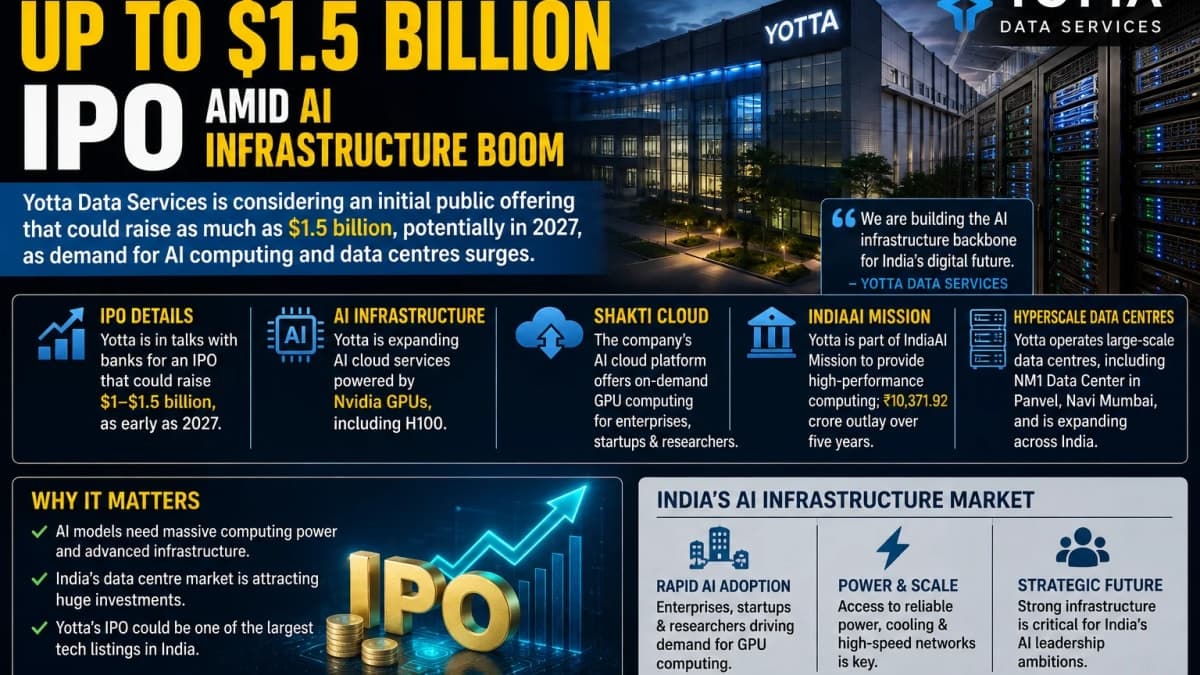
India’s rapidly expanding artificial intelligence infrastructure market could produce one of its biggest technology listings yet.
Yotta Data Services, the data-centre and cloud infrastructure company backed by the Hiranandani Group, is considering an initial public offering of up to $1.5 billion, according to people familiar with the matter cited in Bloomberg reporting.
The potential listing could take place as early as 2027, although discussions remain preliminary.
Yotta is reportedly speaking with banks about the proposed transaction, but important details—including the final IPO size, valuation and timing—could still change.
The company has not announced a final listing plan.
The discussions come as India experiences a sharp increase in demand for computing infrastructure driven by generative AI, cloud adoption, data localisation and the growing need for high-performance GPU capacity.
Yotta Could Raise Up to $1.5 Billion Through IPO
According to people familiar with the discussions, Yotta is evaluating an IPO that could raise between $1 billion and $1.5 billion.
If the company proceeds at the upper end of that range, the offering would represent a significant capital-market event for India’s digital infrastructure sector.
The listing could reportedly happen in 2027.
However, the plans remain under consideration.
That distinction is important: Yotta has not yet publicly confirmed a final issue size, valuation or listing date.
Companies frequently adjust IPO plans depending on market conditions, investor demand, financial performance and regulatory considerations.
The proposed transaction should therefore be viewed as a potential listing rather than a confirmed $1.5 billion fundraising.
Yotta Sits at the Centre of India’s AI Infrastructure Push
The timing of the potential IPO reflects a much larger transformation taking place across India’s technology infrastructure market.
Artificial intelligence models require enormous computing resources.
Training and running advanced AI systems depends on specialised processors—particularly GPUs—along with large data centres capable of delivering sufficient power, cooling, storage and high-speed networking.
That requirement has created an infrastructure race around the world.
Yotta has positioned itself as one of the Indian companies attempting to capture that opportunity by combining hyperscale data centres, cloud infrastructure and AI computing services.
Rather than competing only as a conventional data-centre operator, the company is increasingly positioning itself as part of India's AI computing backbone.
Nvidia GPUs Become Critical to Yotta’s AI Strategy
A central part of Yotta’s AI strategy is access to high-performance GPUs.
The company has built substantial computing capacity around processors supplied by Nvidia, whose GPUs have become foundational hardware for generative AI development.
Yotta has previously announced major deployments involving Nvidia's advanced AI chips, including H100 GPUs.
Its AI cloud platform, Shakti Cloud, is designed to provide organisations with access to GPU computing infrastructure for AI workloads.
The strategy addresses one of the biggest challenges facing Indian AI startups, enterprises and researchers: advanced AI computing hardware is expensive to purchase and operate directly.
Cloud-based access allows customers to rent computing capacity instead of building their own GPU clusters.
IndiaAI Mission Gives Domestic Computing Capacity Strategic Importance
Yotta’s expansion also intersects with the Indian government’s push to increase domestic AI computing capacity.
Under the IndiaAI Mission, the government has been working to make high-performance computing resources available to startups, researchers, academic institutions and other participants in the country's AI ecosystem.
The mission has a government outlay of ₹10,371.92 crore over five years.
One of its major components is the creation of shared AI computing infrastructure based on thousands of GPUs.
Yotta is among the infrastructure providers participating in this broader effort.
The government’s strategy reflects a simple problem: developing competitive AI models requires computing resources that can cost millions—or even billions—of dollars at scale.
Making GPU capacity available through domestic cloud providers can potentially lower the barrier to entry for Indian developers.
Why AI Is Driving a Data-Centre Investment Boom
AI is fundamentally changing the economics of data centres.
Traditional cloud workloads already required large amounts of computing capacity, but generative AI places significantly heavier demands on infrastructure.
Modern AI clusters require:
Thousands of high-performance GPUs
High-speed networking between processors
Massive data-storage capacity
Reliable electricity supply
Advanced cooling systems
Large-scale data-centre facilities
The result is an enormous increase in infrastructure spending.
Companies that can provide these resources are increasingly being viewed not merely as property or data-centre businesses, but as critical components of the AI economy.
That shift could influence how investors assess companies such as Yotta if it eventually enters public markets.
Yotta’s Hyperscale Data-Centre Footprint
Yotta operates large-scale data-centre facilities designed to support cloud, enterprise and AI workloads.
One of its flagship developments is the Yotta NM1 Data Center at the Integrated Yotta Data Center Park in Panvel, Navi Mumbai.
The company has also expanded its infrastructure footprint beyond Maharashtra.
Its strategy involves building large data-centre campuses capable of serving enterprises, hyperscale cloud providers and increasingly compute-intensive AI customers.
The ability to combine physical data-centre capacity with GPU cloud services could become an important competitive advantage as AI adoption increases.
Why India Is Attracting Huge Data-Centre Investments
India has become an increasingly important market for global and domestic data-centre operators.
Several structural factors are driving the expansion.
The country has hundreds of millions of internet users and rapidly growing consumption of digital services.
Cloud adoption among Indian enterprises is increasing, while financial services, e-commerce, streaming, gaming and digital public infrastructure continue to generate enormous quantities of data.
AI is adding another layer of demand.
At the same time, data-localisation requirements and concerns about digital sovereignty are encouraging companies to maintain more computing infrastructure within India.
These trends have attracted investment from Indian conglomerates, global cloud providers, private equity firms and specialist data-centre companies.
Power Availability Could Become the Critical Constraint
The AI infrastructure boom also creates major challenges.
Large data centres consume enormous quantities of electricity.
AI-focused facilities can be particularly power intensive because thousands of GPUs may operate continuously while generating significant heat that must be removed through sophisticated cooling systems.
As a result, access to reliable electricity is becoming one of the most important considerations for data-centre developers.
Companies must also address sustainability concerns.
The growth of AI computing could increase demand for renewable energy, more efficient cooling technologies and improved power-management systems.
For Yotta and its competitors, securing computing hardware may therefore be only one part of the infrastructure challenge.
Securing sufficient power at commercially sustainable prices could be equally important.
Nvidia’s AI Dominance Has Reshaped Infrastructure Economics
Yotta’s investment in Nvidia hardware reflects a broader transformation across the global technology industry.
Nvidia has become the dominant supplier of GPUs used for training and running many advanced artificial intelligence models.
Demand for those processors has been so strong that access to GPU capacity itself has become a strategic resource.
This has created opportunities for specialised AI cloud providers.
Instead of every startup or enterprise purchasing expensive GPU hardware, infrastructure companies can build large clusters and sell computing access as a service.
Yotta’s Shakti Cloud is positioned around this model.
If Indian demand for AI computing continues growing, utilisation of such infrastructure could become an important factor in the company's future financial performance.
Potential IPO Would Test Investor Appetite for AI Infrastructure
A Yotta IPO would also provide an important test of how public-market investors value India's emerging AI infrastructure businesses.
Investors would likely examine several factors beyond headline AI growth.
These could include the company's capital expenditure requirements, data-centre utilisation, customer concentration, power costs, debt levels, GPU depreciation cycles and ability to generate sustainable returns from expensive infrastructure.
AI infrastructure can require enormous upfront investment.
GPUs, networking hardware, data-centre construction, cooling equipment and electricity infrastructure all require significant capital.
The central financial question is therefore whether rapidly growing AI demand can generate sufficient utilisation and recurring revenue to justify those investments.
The Opportunity—and Risk—of Rapid GPU Innovation
Another challenge for AI infrastructure companies is the speed at which computing hardware evolves.
New generations of GPUs can deliver significant improvements in performance and energy efficiency.
That creates a potential depreciation risk for companies investing billions of dollars in computing hardware.
Infrastructure providers must therefore balance two competing priorities.
They need enough GPUs to meet current customer demand, but they must avoid overbuilding capacity that could become less competitive as newer processors enter the market.
For investors considering Yotta or similar businesses, hardware utilisation and upgrade cycles could become important metrics.
What a $1.5 Billion IPO Could Mean for Yotta
If Yotta ultimately raises close to $1.5 billion, the transaction could give the company significant financial capacity to expand.
Potential uses for large-scale capital in an AI infrastructure business can include data-centre construction, GPU procurement, power infrastructure, networking equipment and geographic expansion.
However, Yotta has not publicly confirmed how proceeds from the potential IPO would be allocated.
It would therefore be premature to attribute specific spending plans to the proposed offering.
What is clear is that AI infrastructure requires enormous amounts of capital, and access to public equity markets could potentially provide companies with another source of financing beyond debt and private investment.
India’s AI Race Is Becoming an Infrastructure Race
The larger significance of Yotta’s potential IPO extends beyond the company itself.
Much of the public discussion around artificial intelligence focuses on models, chatbots and software applications.
But the ability to build and operate those systems depends on an underlying physical layer:
chips, servers, electricity, cooling, networks and data centres.
Countries that want competitive domestic AI ecosystems increasingly need access to this infrastructure.
India has a large software-development base and a rapidly expanding startup ecosystem, but access to high-end AI computing capacity remains crucial if domestic companies are to develop increasingly sophisticated models.
That makes infrastructure providers such as Yotta strategically important to the country's AI ambitions.
From Data Centres to AI Factories
The data-centre industry itself is changing.
Facilities that were once designed primarily for hosting websites, enterprise applications and cloud storage are increasingly becoming highly specialised computing centres capable of operating massive GPU clusters.
These facilities are sometimes described as “AI factories” because their primary output is computing capacity used to train and operate artificial intelligence systems.
The shift requires new approaches to power density, networking and cooling.
Companies capable of adapting their infrastructure to these requirements could capture a disproportionate share of future demand.
What Investors Should Watch Before a Yotta IPO
The reported IPO remains at an early stage, meaning several variables could determine whether—and under what terms—it eventually proceeds.
Investors are likely to watch:
The final size and structure of the proposed IPO
Yotta’s eventual valuation
Revenue growth from AI cloud services
GPU utilisation rates
Expansion of data-centre capacity
Major enterprise and government contracts
Capital expenditure requirements
Debt and financing costs
Electricity availability and pricing
Competition from domestic and international cloud providers
Progress of India's broader AI infrastructure programme
Market conditions in 2027 will also matter.
Even rapidly growing technology companies can postpone listings when equity markets become volatile or investor appetite weakens.
Why Yotta’s IPO Plans Matter for India
Yotta's potential $1 billion-$1.5 billion IPO illustrates how quickly AI is changing India's technology investment landscape.
Only a few years ago, data centres were primarily discussed as infrastructure supporting cloud computing and India's expanding digital economy.
Today, the conversation increasingly revolves around GPU clusters, sovereign AI capacity and the computing power required to train and deploy artificial intelligence models.
That transformation is attracting enormous amounts of capital.
If Yotta proceeds with the listing, the IPO could become a significant benchmark for how Indian public markets value businesses positioned at the intersection of data centres, cloud computing and artificial intelligence.
For now, however, the proposed IPO remains under consideration.
The bigger story is already clear: as India attempts to become a major participant in the global AI economy, the race is no longer only about building better AI models.
It is also about building the enormous physical infrastructure required to run them.