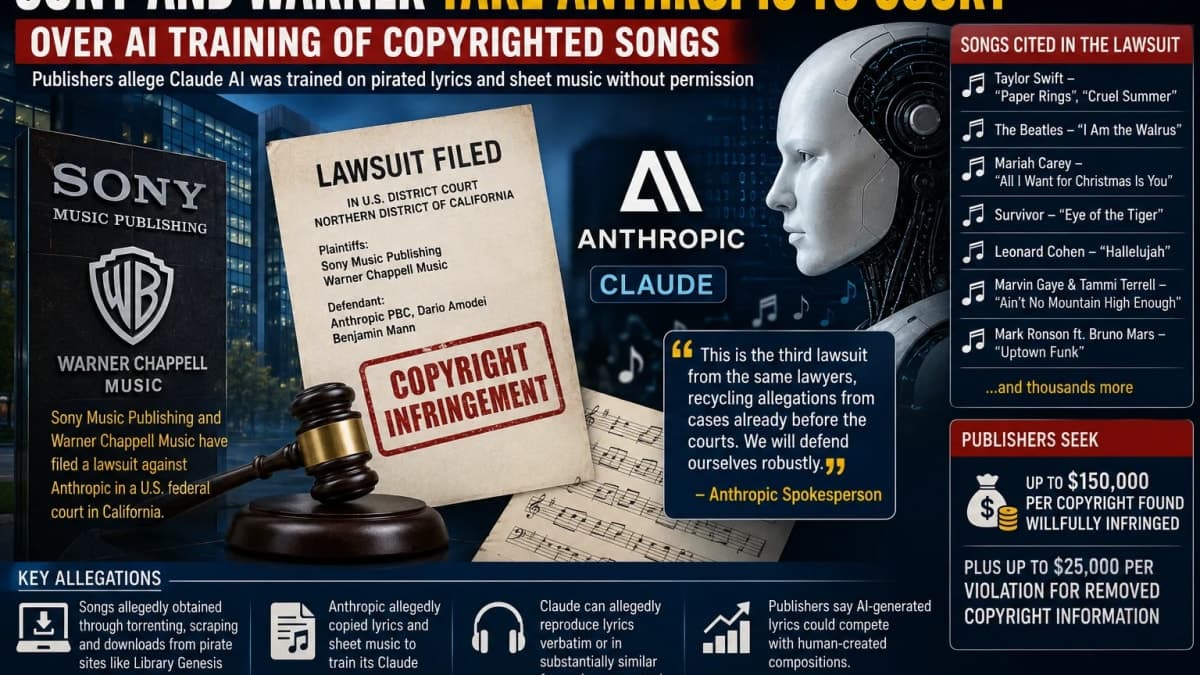
Sony and Warner Music Publishers Take Anthropic to Court Over AI Training
The legal battle over what artificial intelligence companies can use to train their models has expanded further into the music industry.
Sony Music Publishing and Warner Chappell Music have filed a federal copyright lawsuit against Anthropic, the company behind the Claude family of AI models, alleging that copyrighted musical compositions were obtained and copied without permission as part of the company's AI development.
The lawsuit was filed in the U.S. District Court for the Northern District of California.
Anthropic co-founder and CEO Dario Amodei and co-founder Benjamin Mann are also named as individual defendants.
At the centre of the case is a question increasingly confronting courts worldwide: even if training an AI model on copyrighted material can sometimes qualify as fair use, does that protection extend to copyrighted material allegedly obtained from pirated sources?
Sony and Warner say it does not.
Anthropic rejects the publishers' allegations and has indicated that it will fight the case.
Publishers Allege ‘Tens of Thousands’ of Songs Were Involved
The complaint alleges infringement involving a potentially enormous catalogue of music.
Sony Music Publishing and Warner Chappell claim Anthropic acquired and copied thousands—and potentially tens of thousands—of copyrighted musical compositions while developing Claude.
The material allegedly included song lyrics and sheet music.
The publishers claim the works were obtained through several methods, including torrenting, scraping and downloading material from online sources.
Among the sources identified in reporting on the complaint are alleged pirate repositories including Library Genesis and Pirate Library Mirror.
The lawsuit also raises allegations concerning material obtained from legitimate online services and datasets, including lyric platforms Musixmatch and LyricFind.
These are allegations made by the plaintiffs. The court has not determined that Anthropic unlawfully obtained or used these materials.
Taylor Swift, The Beatles and Mariah Carey Songs Cited
The complaint references works associated with some of the world's best-known musicians and songwriters.
Songs cited in reporting on the lawsuit include:
Taylor Swift's “Paper Rings” and “Cruel Summer”
The Beatles' “I Am the Walrus”
Mariah Carey's “All I Want for Christmas Is You”
Survivor's “Eye of the Tiger”
Leonard Cohen's “Hallelujah”
Marvin Gaye and Tammi Terrell's “Ain't No Mountain High Enough”
Mark Ronson and Bruno Mars' “Uptown Funk”
The presence of a song in the complaint does not itself establish infringement. The publishers will have to prove their claims under copyright law.
Lawsuit Says Claude Can Reproduce Copyrighted Lyrics
The dispute is not limited to what allegedly entered Anthropic's training datasets.
Sony and Warner also argue that Claude can generate copyrighted material in its responses.
According to the complaint, Claude can allegedly reproduce lyrics either verbatim or in substantially similar form when prompted.
The publishers further contend that the AI system can use what it learned from copyrighted compositions to produce large quantities of newly generated lyrics.
They argue that such AI-generated material could compete with professionally written and licensed compositions.
Anthropic has not accepted that characterisation.
The eventual legal analysis could therefore involve two related but distinct issues: how copyrighted works were acquired for training and what the resulting AI models can generate.
Sony and Warner Seek Up to $150,000 Per Copyright
The potential financial stakes are significant.
The publishers are seeking statutory damages of as much as $150,000 for each copyright that a court determines was willfully infringed.
With the lawsuit potentially involving thousands of works, damages could theoretically reach billions of dollars if the publishers establish their allegations across a sufficiently large number of compositions.
However, such a figure is not an existing judgment or confirmed liability.
The amount Anthropic might ultimately owe—if anything—will depend on what claims survive litigation, which works are proven to have been infringed and how a court calculates damages.
The publishers are also seeking an injunction aimed at preventing Anthropic from continuing to use their copyrighted material without authorisation.
Some reporting on the complaint also notes claims for as much as $25,000 per violation involving allegedly removed copyright-management information.
Anthropic: We Will Defend Ourselves ‘Robustly’
Anthropic has rejected the publishers' position.
“This is the third lawsuit from the same lawyers, recycling allegations from cases already before the courts,” an Anthropic spokesperson said.
The company said it would defend itself “robustly.”
Anthropic has also maintained its broader argument that using copyrighted works to train generative AI models can constitute fair use under U.S. copyright law.
That defence has already received some judicial support in an earlier copyright dispute involving the company.
But that earlier case also demonstrated why the source of training material could become critically important.
The Bartz Case Complicates the AI Copyright Debate
Anthropic scored an important legal victory in Bartz v. Anthropic, a lawsuit brought by authors over the use of books for AI training.
In June 2025, U.S. District Judge William Alsup found that using copyrighted books to train large language models could qualify as transformative fair use.
The reasoning provided significant support for one of the AI industry's central legal arguments: a model can analyse existing works to learn patterns without necessarily using those works as substitutes for the originals.
But the decision contained another crucial element.
The court treated Anthropic's acquisition and retention of pirated copies separately from the transformative nature of AI training.
That distinction has become increasingly important in subsequent copyright disputes.
In simplified terms, an AI developer may argue that training itself is transformative, while a copyright owner may separately argue that obtaining the training material through piracy remains unlawful.
Sony and Warner's new lawsuit appears designed in part around that distinction.
Anthropic Previously Reached a $1.5 Billion Settlement With Authors
The Bartz dispute eventually produced a major settlement.
Anthropic agreed in 2025 to pay $1.5 billion to resolve the class-action claims involving authors whose books were allegedly downloaded from pirate sources.
The new music-publisher complaint explicitly references that settlement.
Sony and Warner argue that the earlier financial penalty did not sufficiently deter what they describe as continuing copyright infringement.
Anthropic, meanwhile, maintains that the new lawsuit repeats issues already being litigated.
This Is Not Anthropic's First Music Copyright Battle
The latest lawsuit does not emerge in isolation.
Anthropic has already faced legal action from other music publishers.
Universal Music Publishing Group, Concord Music Group and ABKCO sued Anthropic in 2023 over allegations involving copyrighted song lyrics.
Additional litigation involving music copyrights has followed.
The expanding number of cases demonstrates that the dispute between AI companies and the music industry is moving beyond a theoretical policy debate and into a series of court battles that could establish practical rules for AI development.
The Crucial Question: Training Versus Acquisition
The Sony-Warner lawsuit illustrates why saying simply that “AI training is fair use” may no longer capture the full legal debate.
Courts may have to consider several separate questions:
Was the copyrighted material lawfully obtained?
Was copying the material into a training dataset permissible?
Is using that material to train an AI model transformative?
Can the resulting model reproduce protected expression?
Do AI-generated outputs compete economically with the copyrighted originals?
Different answers could apply at different stages of the process.
For example, a court could potentially consider model training transformative while still finding that acquiring copyrighted material through piracy violated copyright law.
That distinction could have enormous consequences for how AI companies construct future training datasets.
Why Music Presents a Particularly Difficult AI Copyright Problem
Music introduces challenges that differ from books, news articles and other forms of copyrighted material.
A song can involve multiple layers of intellectual property.
The musical composition generally covers elements such as lyrics and underlying music, while the sound recording protects a particular recorded performance.
Sony Music Publishing and Warner Chappell are publishers, meaning the current lawsuit focuses principally on rights connected with musical compositions rather than simply ownership of commercial sound recordings.
That distinction matters when discussing which rights are allegedly infringed.
It also illustrates why AI companies may eventually need sophisticated licensing arrangements covering different rights holders when training or deploying music-related AI systems.
A Case With Consequences Beyond Claude
The lawsuit could matter well beyond Anthropic.
Generative AI developers require enormous quantities of text, images, audio, video and other data to develop increasingly capable models.
Copyright owners, meanwhile, argue that companies should not be able to build commercially valuable AI products by copying protected works without permission or compensation.
AI companies counter that machine learning can involve transformative analysis rather than straightforward substitution for copyrighted works.
The unresolved issue is where courts will draw the boundaries.
If publishers establish that AI companies face substantial liability when training material is sourced from pirate repositories, developers could be pushed toward more heavily documented, licensed and provenance-controlled datasets.
If Anthropic successfully establishes broader protection under fair use, AI companies could gain greater legal certainty over training practices—although questions surrounding pirated source material could remain.
The AI Copyright Battle Is Entering Its Next Phase
The Sony Music Publishing and Warner Chappell case highlights an evolution in AI copyright litigation.
The question is increasingly not simply whether an AI system learned from copyrighted material.
Courts are also being asked to examine where that material came from, how it was copied, what information was removed from it and what the resulting model can reproduce.
For Anthropic, the case adds another potentially costly legal challenge as Claude competes in the rapidly expanding generative-AI market.
For Sony, Warner and other rights holders, it represents an attempt to establish that technological transformation does not eliminate the need to respect copyright ownership.
The outcome could help determine whether the future of AI training is built around broad interpretations of fair use, large-scale licensing—or some combination of both.