Japan has spent decades developing technologies designed to make buildings safer in one of the world's most earthquake-prone environments. Among the more unusual approaches is a system capable of temporarily lifting a building from its foundation when an earthquake is detected.
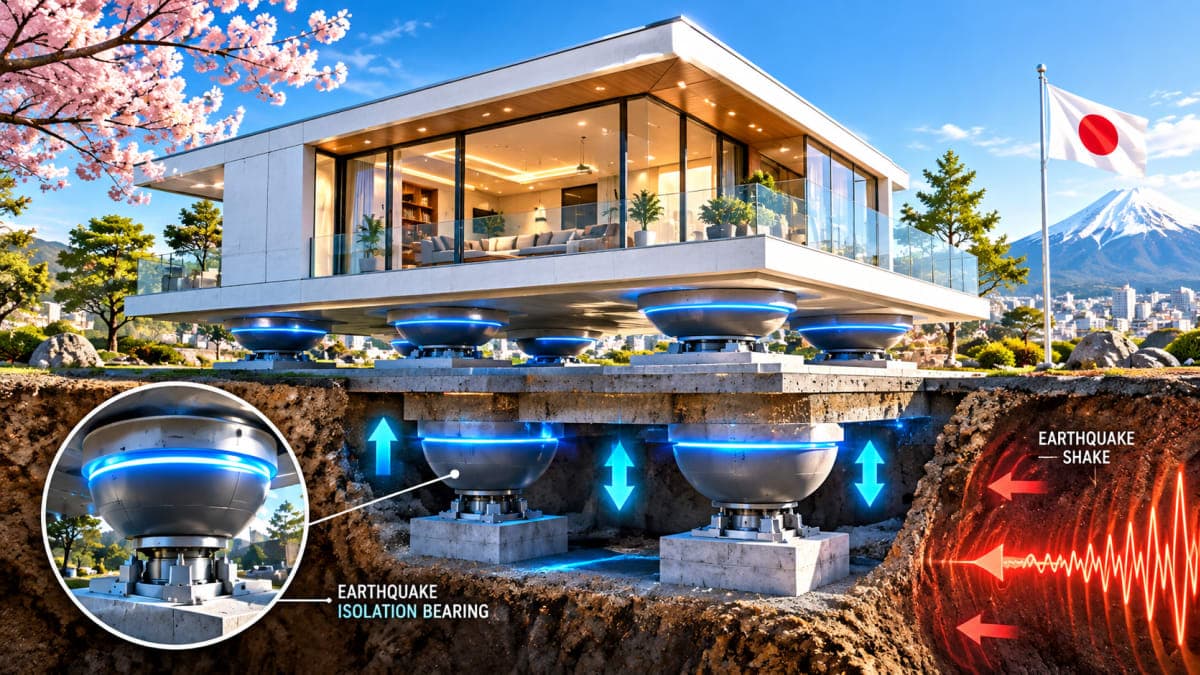
Known as AIR Danshin, the Japanese seismic-isolation technology uses compressed air to create a thin cushion beneath a building.
Instead of trying to make a house completely resist the movement of the earth beneath it, the system attempts to reduce how much of that movement reaches the structure in the first place.
The result is a building that can temporarily separate from its foundation during an earthquake before settling back into position afterward.
What Is Japan’s AIR Danshin System?
AIR Danshin is a form of seismic-isolation technology developed in Japan.
Its central concept is relatively simple: separate the building from the shaking ground for the period when damaging seismic motion is occurring.
Conventional buildings are mechanically connected to their foundations. When the ground moves during an earthquake, that movement can therefore be transferred upward through the foundation and into the structure.
AIR Danshin introduces an air layer between these components.
The system consists of a specially designed foundation, earthquake sensors, compressed-air equipment and mechanisms that allow the building to temporarily separate from the surface beneath it.
How Does a House Rise During an Earthquake?
The process begins when sensors detect seismic movement.
Once the system determines that an earthquake requiring isolation is occurring, compressed air stored for the system is rapidly released into the space between the building and its foundation.
According to Sansei AIR Danshin System, the process can begin approximately 0.5 to 1 second after detection.
The air pressure creates a thin supporting layer underneath the structure.
This allows the building to rise slightly from its normal resting position.
The important point is that the house does not need to rise dramatically. The separation involved is measured in centimetres rather than metres.
The objective is simply to create sufficient separation to reduce the direct transmission of horizontal ground movement into the building.
Why Can a Few Centimetres Make a Difference?
The underlying principle is seismic isolation.
Imagine a table suddenly being moved from side to side. An object firmly attached to the table will move with it.
If that object can instead be mechanically isolated from the table's horizontal movement, considerably less motion may be transferred to it.
A building during an earthquake presents a much more complicated engineering problem, but the basic principle is similar.
AIR Danshin attempts to interrupt the pathway through which some of the ground's movement reaches the structure.
A very small vertical separation can therefore be useful because the purpose isn't to move the house high into the air—it is to decouple the structure from the moving foundation.
Is It Really a ‘Floating House’?
Calling it a “floating house” makes the technology easier to visualize, but it isn't a literal description.
The building does not remain suspended in the air during normal conditions, nor does it float freely.
Instead, it rests conventionally on its foundation until the seismic-isolation system activates.
During activation, compressed air creates a temporary air cushion underneath the building.
Once the earthquake has passed, the air is gradually released and the structure settles back into its normal position.
One Japanese housing company offering AIR Danshin technology says this settling process can take approximately 90 seconds to three minutes.
A positioning mechanism helps the building return correctly to its original location.
It Uses Compressed Air, Not Magnetic Levitation
Another fascinating aspect of AIR Danshin is that the engineering does not require magnetic levitation.
The system primarily relies on compressed air and carefully engineered surfaces beneath the structure.
This makes it conceptually closer to an enormous air-bearing system than a futuristic magnetic platform.
Air bearings are already used in engineering applications where extremely heavy objects need to move with very little friction.
Applying a related principle to buildings allows engineers to explore another way of isolating structures from earthquake movement.
Where Did the Technology Come From?
AIR Danshin is not a recent concept.
Japanese reports trace the development of the technology to inventor Shoichi Sakamoto, who explored whether air pressure could be used to isolate buildings from earthquakes.
Japanese property publication SUUMO reported in 2011 that Sakamoto arrived at the idea of using air to lift a building in 2005, after considering ways of preventing earthquake movement from reaching a structure.
Experiments subsequently explored whether compressed air could support heavy concrete structures.
The idea eventually developed into a practical seismic-isolation system.
This history is important because AIR Danshin represents years of engineering development rather than a single experimental demonstration.
How Much Can the Building Rise?
Different descriptions and configurations of air-based isolation systems report slightly different lifting distances.
Some descriptions of AIR Danshin have discussed a separation of approximately 3 centimetres, while earlier Japanese reporting described systems producing a smaller separation.
The exact figure is less important than the engineering principle.
The system only needs sufficient clearance to reduce direct interaction between the moving foundation and the isolated structure.
Rather than thinking of the house as flying, it is more accurate to imagine it briefly resting on a pressurized cushion of air.
What Happens When the Earthquake Ends?
An earthquake-isolation system also needs to solve another problem: safely returning the building to its original position.
Once significant seismic movement has ended, the compressed air underneath the building is gradually released.
The structure then descends toward its normal foundation position.
AIR Danshin incorporates mechanisms designed to help guide the structure back to the appropriate location.
This entire sequence—detection, pressurization, isolation and settling—is intended to happen automatically.
Residents therefore do not need to manually activate the system after they feel an earthquake.
Can It Reduce Earthquake Shaking Inside a House?
Sansei AIR Danshin System says its technology can substantially reduce the shaking transmitted into an isolated building.
The company states that its system can reduce shaking associated with a Japanese seismic intensity of 7 to approximately 1/30 under its specified conditions.
That number should be understood as a manufacturer performance claim, not a guarantee that every building will experience exactly the same reduction in every earthquake.
Real earthquakes differ considerably.
Their effects depend on factors including ground conditions, distance from the source, frequency characteristics, duration, direction of movement and building design.
Installation and engineering specifications also matter.
Researchers Have Studied Air-Floating Seismic Isolation
Air-based seismic isolation has also been examined in engineering research.
Research involving Tokyo Denki University and Sansei AIR Danshin has studied the response-reduction effects of air-floating seismic-isolation systems using experiments and analytical models.
One published study examined the behaviour of an air-floating system through shaking-table experiments and numerical analysis.
Sansei also lists research covering air-floating base isolation, floor isolation and vibration-control systems developed with academic and engineering collaborators.
That makes AIR Danshin part of a broader engineering effort to understand whether air can be used effectively for seismic isolation.
The Technology Isn't Limited to Houses
The same fundamental idea can also protect equipment.
Earthquakes can damage far more than buildings themselves.
Hospitals, factories, semiconductor facilities, data centres and research laboratories may contain highly sensitive equipment that can be damaged even when the surrounding building remains standing.
Sansei has therefore developed air-based isolation technology for equipment including semiconductor manufacturing systems, servers, medical equipment and production machinery.
In these applications, the objective remains similar: isolate valuable equipment from destructive ground movement.
Why Japan Invests Heavily in Earthquake Engineering
AIR Danshin is only one example of Japan's extensive approach to earthquake-resistant construction.
Japanese engineers use several major strategies to manage seismic forces.
Seismic-resistant structures strengthen buildings so that they can withstand movement without catastrophic structural failure.
Vibration-control systems use dampers and other mechanisms to absorb part of the earthquake's energy.
Base-isolation systems attempt to reduce how much ground movement reaches the building above.
AIR Danshin belongs broadly to the third category, although its use of compressed air makes its mechanism particularly distinctive.
What Are the Limitations?
No earthquake technology makes a building invulnerable.
An AIR Danshin installation requires a building and foundation engineered to work with the system. Sensors, compressed-air equipment and mechanical components also have to function correctly when an earthquake occurs.
Different types of ground motion can create different engineering challenges.
And seismic isolation addresses only one part of earthquake risk.
A building may still face hazards from fire, landslides, liquefaction, falling objects, infrastructure failure or tsunami, depending on its location and the earthquake involved.
That is why seismic isolation is normally understood as one component of a broader structural-safety strategy rather than an absolute form of protection.
A Different Way of Thinking About Earthquake Protection
What makes AIR Danshin particularly interesting is not simply the sight of a building rising from the ground.
It represents a different engineering philosophy.
Instead of relying exclusively on making a structure stronger against earthquake forces, seismic isolation asks another question:
Can we prevent some of those forces from reaching the building in the first place?
AIR Danshin attempts to answer that question with compressed air.
Sensors detect an earthquake, air pressure temporarily separates the structure from its foundation, the building experiences less direct ground movement, and once the danger has passed, it returns to its normal position.
The movement may involve only a few centimetres.
But in earthquake engineering, those few centimetres illustrate an important idea: sometimes protecting a structure isn't only about resisting the ground beneath it—it can also mean temporarily separating the two.