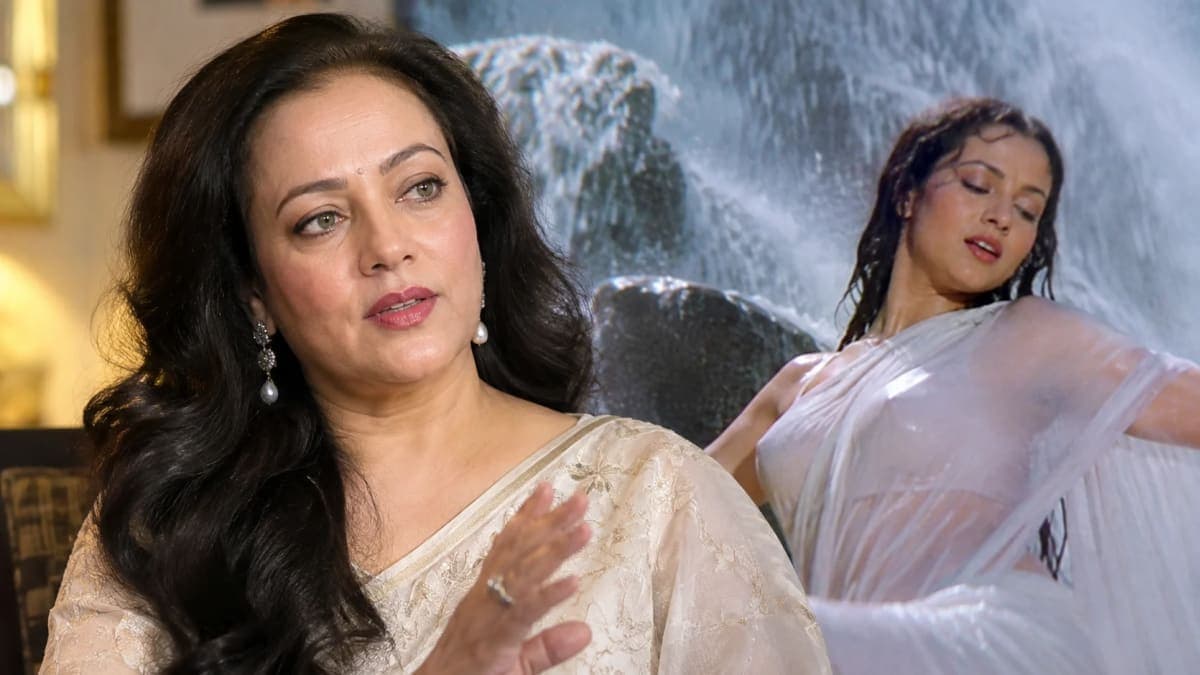
More than four decades after Ram Teri Ganga Maili turned Mandakini into one of the most recognisable faces of 1980s Hindi cinema, the actor has revisited two sequences that have followed both her and the film ever since: the waterfall scene in a translucent white saree and a scene widely perceived as showing her breastfeeding a baby.
Speaking in a recent interview with news agency ANI, Mandakini said she did not view the sequences as vulgar while filming them and described the atmosphere created by director Raj Kapoor as one in which she became absorbed in the filmmaking process.
Her recollections are significant not simply because they clarify how the scenes were made. They also reopen a larger conversation around Ram Teri Ganga Maili: how a film built around the idea of purity became famous — and controversial — partly because of the way its young heroine was photographed.
Mandakini says she was 16 when filming began
Mandakini recalled that she was 16 when shooting for Ram Teri Ganga Maili began and 17 by the time filming was completed.
She said her entry into cinema had not originally been her own plan. According to Mandakini, Ram Bhardwaj — father of filmmaker-composer Vishal Bhardwaj — knew her family through a school connection in Meerut and suggested that her parents take her to Bombay, now Mumbai, and meet people in the film industry.
Mandakini eventually met Raj Kapoor and underwent a screen test.
She recalled Kapoor asking about her family and whether she was accustomed to carrying and caring for younger siblings. Looking back, Mandakini said she believed the filmmaker was searching for an “Indian feel” appropriate for the character of Ganga.
That context matters because Ganga was not designed merely as a conventional romantic heroine.
The film uses her journey as an allegory for the River Ganga: beginning amid the perceived purity of the Himalayas and encountering exploitation and corruption as she moves towards the city. The Tuli Research Centre for India Studies similarly describes the character's journey as symbolic of a sacred river becoming polluted as it passes through society.
‘I was completely lost, and going with the flow’
Discussing how she approached the film's intimate or revealing sequences, Mandakini described Kapoor as a persuasive but gentle director.
She remembered the set as an environment where the cinematographer, director, choreographer and other crew members approached their work with an almost devotional seriousness.
“So, I was completely lost, and going with the flow,” she recalled.
Mandakini also said Kapoor explained scenes in such a gentle manner that she felt as though a family member were guiding her.
This is Mandakini's own retrospective description of her experience. It should not automatically be expanded into a broader conclusion about filmmaking practices or power relationships in the industry at that time. What can be established is that she has consistently defended the artistic intent behind these sequences while also acknowledging that she was very young when she made the film.
What actually happened during the waterfall scene?
One of Ram Teri Ganga Maili’s most enduring images comes from the song “Tujhe Bulayen Yeh Meri Bahen”, where Ganga bathes beneath a waterfall wearing a white saree.
Mandakini now says she initially experienced some discomfort over the clothing.
Her response was practical: she doubled the saree. According to her account, Kapoor agreed, and filming continued.
“It was a big thing for me as I came from a very small place,” she recalled. But she said neither she nor her parents ultimately considered the portrayal objectionable.
Mandakini's interpretation is closely tied to how she understands Ganga herself. She argues that the character was meant to remain pure despite a society repeatedly attempting to exploit or corrupt her.
That creates an important distinction between the filmmaker and actor's stated intention and how audiences interpreted the resulting images.
A scene can be conceived as an expression of innocence while simultaneously being received by sections of the audience as sensual. Those two readings are not necessarily mutually exclusive — and much of Ram Teri Ganga Maili’s cultural afterlife exists precisely in that tension.
Mandakini clears up the ‘breastfeeding scene’
Mandakini also addressed another persistent belief about the film: that she actually breastfed a baby for one sequence.
She says that did not happen.
“No, there was no breastfeeding,” Mandakini said in the latest interview.
According to her explanation, she herself performed the scene — there was no body double — but the impression was created through clothing, positioning the baby close to her body and camera framing.
This is not the first time Mandakini has made that clarification.
In a 2022 interview, she similarly said the sequence had been technically filmed to make it appear like breastfeeding and argued that its original presentation was “pure” rather than explicitly sexual.
The consistency between her earlier and latest accounts is useful: her 2026 explanation is not a newly invented version prompted by the current news cycle. She has publicly described the sequence in essentially similar terms before.
The controversy was bigger than celebrity gossip
It is easy, four decades later, to reduce the debate around Ram Teri Ganga Maili to a famous white-saree scene. Contemporary records show that questions about the film also reached India's Parliament.
In a Lok Sabha discussion on April 24, 1986, MP Dinesh Goswami raised Ram Teri Ganga Maili while questioning film-certification practices. He referred to its certification while arguing that films containing material he considered unsuitable could receive classifications that appeared inconsistent with treatment of other films.
That archival record is important because it demonstrates that the controversy was not created retrospectively by social media or later entertainment journalism.
The film became part of a contemporary debate about censorship, nudity, artistic freedom and whether influential filmmakers received different treatment from India's certification system.
It is also worth noting that Goswami's description in Parliament represented his criticism of the film and censorship process; it should not be treated as an objective classification of individual scenes.
A paradox at the centre of Ram Teri Ganga Maili
Released in 1985 and starring Mandakini opposite Rajiv Kapoor, Ram Teri Ganga Maili was Raj Kapoor's final directorial feature. Ravindra Jain composed its music. Library and research records confirm the film's 1985 release and principal cast and credits.
Its lasting fascination comes partly from a paradox.
Ganga is constructed as the embodiment of innocence, while the world around her becomes progressively more corrupt. Yet some of the imagery used to communicate that innocence also made Mandakini an object of intense public attention.
In other words, the controversy cannot be fully understood simply by asking whether the scenes were “bold”.
The more revealing question is how the same cinematic image can carry radically different meanings depending on who is looking at it.
For Mandakini, the waterfall sequence belonged to Ganga's purity and the visual language of Raj Kapoor's story. For critics and sections of the audience, the transparency of the saree created an unmistakably sensual image. The film's history shows that both interpretations existed almost from the beginning.
Success created pressure to repeat the image
Mandakini has also said that after Ram Teri Ganga Maili, other filmmakers wanted her to reproduce the famous waterfall imagery.
She refused.
Her reasoning provides another revealing detail about how she views the film today. Mandakini has argued that reproducing one provocative or memorable scene would not reproduce the success of an entire film; story, treatment and the director's message mattered as well.
That observation helps separate the original film from the image it generated.
A commercially successful movie can create an instantly marketable visual identity, after which the industry may attempt to reproduce the image while stripping away the narrative context that originally surrounded it.
Mandakini's refusal suggests that she herself saw a difference between participating in Raj Kapoor's storytelling and simply repeating the visual formula that had made her famous.
Four decades later, the conversation has changed
Seen from 2026, Mandakini's recollections invite questions that were not necessarily framed in the same language in 1985: the age of performers, informed consent, the authority of celebrated directors and the distinction between an actor's intention during production and the eventual public consumption of an image.
But applying today's assumptions mechanically to a production made four decades ago can also obscure what Mandakini herself is saying.
Her account is specific.
She acknowledges initial discomfort with the waterfall costume. She says she responded by doubling the saree. She says the supposed breastfeeding was a cinematic illusion. She says her family supported her, and she does not describe the scenes as something she regrets.
Those are confirmed statements about her own experience — not proof that every viewer must interpret the scenes the same way.
That distinction may be the most useful way to revisit Ram Teri Ganga Maili today.
Forty-one years after its release, audiences are still discussing images that lasted only minutes on screen. Mandakini's latest comments do not erase that controversy. They add something that debates about famous films often lose over time: the perspective of the person who was actually standing in front of the camera.


