One Goal Was Enough to Make History
India’s junior women did not need the avalanche of goals that had carried them through earlier rounds. In the final, one was enough.
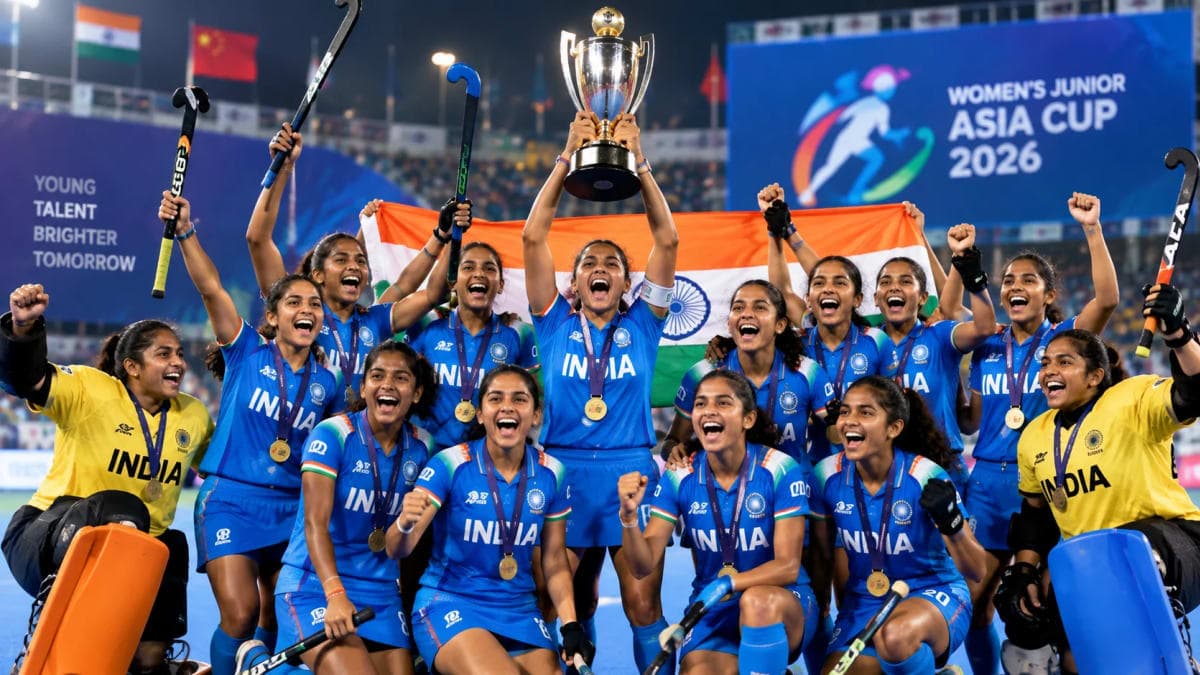
The Indian junior women’s hockey team defeated hosts China 1-0 at the Moqi Training Base in Hulunbuir on Sunday, September 13, retaining the Women’s Junior Asia Cup and completing a remarkable run of three consecutive titles.
Sanika Chandrakant Mane scored the only goal in the 17th minute, and India protected that narrow advantage for the rest of a tense final. The victory extended a run that began with the 2023 title and continued in 2024.
For a team that had scored freely throughout the competition, the final required something different: patience, defensive discipline and the ability to manage a one-goal lead against the host nation.
India delivered all three.
Sanika Mane Delivers the Goal That Separates India and China
The opening quarter ended without a goal as both teams approached the final cautiously.
India found its breakthrough shortly after the start of the second quarter.
In the 17th minute, Sanika Mane put India ahead, giving the defending champions the advantage that ultimately decided the tournament.
The goal changed the nature of the contest.
China now had to chase the game in front of its home crowd, while India had to resist the temptation to protect its lead too passively.
There would be no second goal.
Instead, India's defence absorbed China's attempts to find an equaliser and carried the 1-0 advantage all the way to the final whistle.
From 19-0 to 1-0: India Found Different Ways to Win
The final score also tells an important story about India's tournament.
Just three days earlier, India had overwhelmed Pakistan 19-0 in the quarter-final. Thirteen Indian players contributed goals as the defending champions scored 10 before half-time and another nine after the interval.
The semi-final brought another convincing result.
India beat South Korea 5-1, with drag-flick specialist Supriya scoring a hat-trick. Madhu Sidar and Sukhveer Kaur supplied the other two goals.
China offered a completely different challenge.
There was little space, no runaway scoreline and no room for defensive mistakes.
India still found a way through.
That ability to win both high-scoring matches and tight knockout contests gives the third successive championship more weight than the title count alone.
India Went Through the Tournament Unbeaten
India arrived in the knockout rounds after a strong preliminary campaign.
The team defeated South Korea 4-1, Malaysia 11-1 and Japan 7-0, before playing out a goalless draw against China. India finished on top of its group before entering the knockouts.
That earlier 0-0 meeting with China offered a warning about the final.
While India had been able to score heavily against several opponents, China had already demonstrated that it could contain India's attack.
The gold-medal match followed a similar pattern, except Mane's 17th-minute strike finally broke the deadlock.
This time India made the goal count.
Three Consecutive Asian Titles
The victory completed a sequence that is now unprecedented for India's junior women.
India won the tournament in 2023, successfully defended the title in 2024, and has now retained it again in 2026.
That makes the current generation the first Indian junior women's side to complete a hat-trick of Asia Cup championships.
It also provides a useful measure of consistency.
A single junior title can come from an exceptional age-group batch. Winning repeatedly is more difficult because junior teams naturally change as players age out of the competition.
Three consecutive championships therefore point not simply to one successful squad, but to sustained depth in India's development system.
Supriya's Semi-Final Hat-Trick Was Another Key Moment
Although Mane supplied the decisive touch in the final, India's path to the title contained several standout individual performances.
Supriya's semi-final against South Korea was among the most important.
India led through Madhu Sidar in the 13th minute before Supriya converted in the 17th. Sukhveer Kaur made it 3-0 four minutes later.
Supriya struck again in the 33rd minute and completed her hat-trick in the 56th as India won 5-1.
Her three penalty-corner conversions demonstrated another important part of India's attacking strength: the team did not depend exclusively on open-play goals.
The 19-0 Pakistan Win Showed India's Attacking Depth
If the final demonstrated India's ability to defend, the quarter-final demonstrated just how many attacking options the team possessed.
India's 19-0 victory over Pakistan featured goals from across the squad.
Pooja Malik scored a hat-trick, while Sanika Mane, Madhu Sidar, Roshni Aind and Supriya were among the players who scored multiple goals in reports from the match.
India led 10-0 by half-time.
But the significance of that result was not simply the size of the score. By the knockout stage, India had demonstrated that opposition defences could not concentrate on stopping one or two forwards.
Goals were coming from multiple positions.
That made China's achievement in restricting India to a single goal in the final notable in its own right.
It simply was not enough to take the title away.
Winning in China Adds Another Layer to the Achievement
India did not complete the three-peat at a neutral venue.
The final was played against host nation China at the Moqi Training Base in Hulunbuir.
Home conditions and support gave China an additional advantage, particularly in a final decided by such fine margins.
India had also failed to score against China when the teams met earlier in the competition.
Those circumstances made the final less predictable than India's dominant quarter-final and semi-final results might suggest.
Mane's goal ultimately became the difference between another difficult draw and a third consecutive championship.
What the Three-Peat Means for Indian Women's Hockey
Junior championships are not a guarantee of senior international success, but they are an important indicator of the player pipeline available to a national programme.
India's challenge is now to convert sustained continental success at junior level into players capable of competing for senior-team positions.
That transition is particularly relevant because a three-title sequence spans different batches of young players.
Rather than relying on one generation, India has continued to produce teams capable of winning the Asian championship.
For Hockey India, that depth is arguably the most valuable part of the achievement.
Hockey India Announces Cash Rewards
Following the title, Hockey India announced financial rewards for the victorious squad.
According to reports following the final, each player will receive ₹3 lakh, while members of the support staff will receive ₹1.5 lakh each.
The rewards recognise a campaign in which India remained unbeaten and successfully defended the continental title for a second time.
India Celebrate a Golden Double
The women's triumph was only half of a remarkable day for Indian junior hockey.
India's junior men's team also won its Asia Cup title, beating South Korea 4-1 in the men's final.
That gave India both the men's and women's Junior Asia Cup trophies on the same day.
The men's title was their sixth overall and fourth consecutive crown, while the women completed their own historic three-peat.
The double makes the 2026 edition particularly significant for India's junior programme: both national teams left the continental championship as Asia's title-holders.
India’s Route to the Women’s Junior Asia Cup 2026 Title
India's campaign combined comfortable victories with two much tighter encounters against China.
Group / preliminary stage
India beat South Korea — 4-1
India beat Malaysia — 11-1
India beat Japan — 7-0
India drew China — 0-0
Quarter-final
India beat Pakistan — 19-0
Semi-final
India beat South Korea — 5-1
Final
India beat China — 1-0
India therefore finished the competition unbeaten.
Why the 1-0 Final Matters More Than the Score Suggests
After scorelines such as 11-1 and 19-0, a 1-0 final can appear comparatively modest.
In reality, it provided a different test.
India already knew China was capable of frustrating its attack after the goalless meeting earlier in the tournament. The final demanded that the defending champions convert the limited opportunities they received and then defend under pressure.
Mane provided the finish.
The rest of the team made sure it remained decisive.
That combination completed something no previous Indian junior women's side had achieved: three successive Asian championships.
And on a day when India's junior men also lifted their trophy, the result gave Indian hockey a continental double to remember.