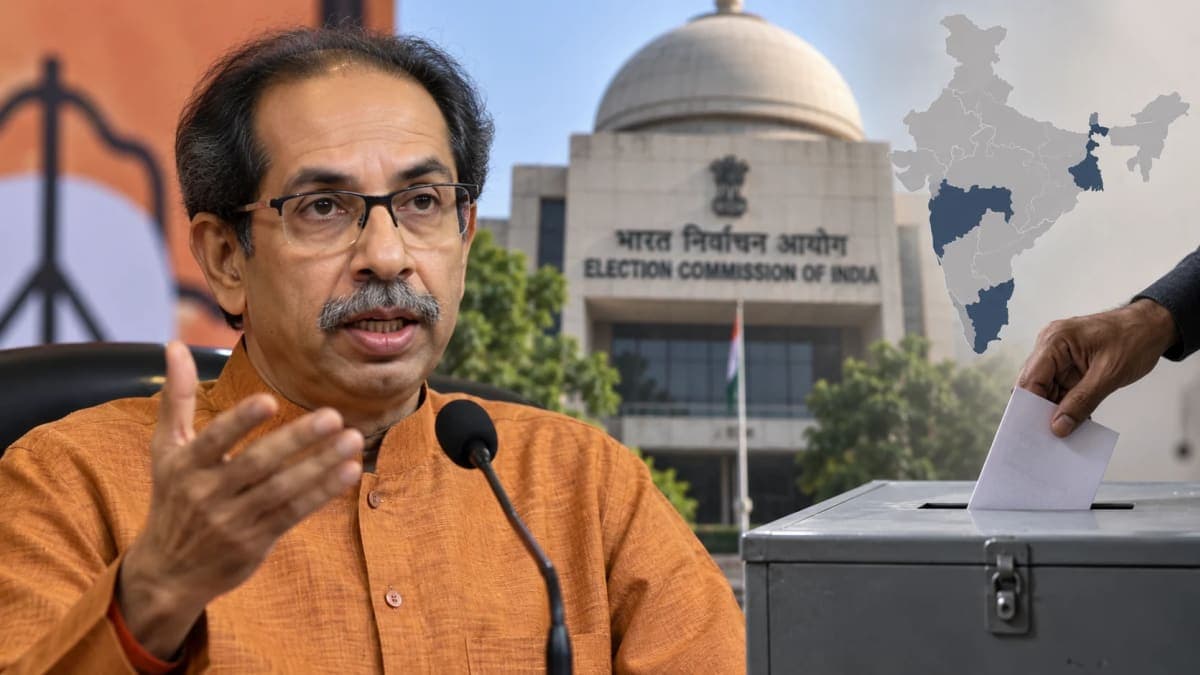
September 23, 2026: Shiv Sena (UBT) chief Uddhav Thackeray on Wednesday demanded fresh elections in Maharashtra, West Bengal and Tamil Nadu using ballot papers, as Opposition parties intensified their criticism of Chief Election Commissioner Gyanesh Kumar following reports of internal objections within the Election Commission.
Thackeray also demanded that Kumar be removed from office and jailed, while calling on courts to take cognisance of the controversy. These are political demands made by Thackeray; no court or competent authority has made such a finding against the Chief Election Commissioner in the material reviewed for this report.
The controversy follows an Indian Express investigation reporting that Election Commissioners Sukhbir Singh Sandhu and Vivek Joshi had put objections on record at least 14 times over 10 months concerning steps linked to electoral-roll procedures and the Special Intensive Revision (SIR).
What Uddhav Thackeray Demanded
Addressing a press conference, Thackeray called for elections held in Maharashtra, West Bengal and Tamil Nadu to be annulled and conducted again through ballot papers.
“Gyanesh Kumar should be immediately sacked and jailed,” Thackeray said.
He also thanked Election Commissioners Sandhu and Joshi, saying: “I thank Election Commissioners (ECs) Sukhbir Singh Sandhu and Vivek Joshi for exposing Gyanesh Kumar.”
Thackeray further called upon Opposition parties to unite over the issue and said the two Election Commissioners should reverse what he described as “wrong decisions” taken by the poll body.
These statements represent Thackeray's allegations and demands, rather than established findings against Kumar or the Election Commission.
What Triggered the Election Commission Controversy?
The political dispute erupted after The Indian Express reported that Sandhu and Joshi had raised objections on record at least 14 times in 10 months regarding steps involving electoral rolls.
According to the report, the issues included the addition and deletion of voters, changes involving voter-registration Form 6 and the management of electoral-roll data. The newspaper reported that the commissioners had also objected to some actions that they said were undertaken without their knowledge.
The report has become politically significant because the Election Commission is a multi-member constitutional body responsible for administering elections in India.
However, the existence of objections during internal deliberations does not by itself establish that the Election Commission's final decisions were unlawful or that election results were invalid.
Election Commission Rejects Claims of a Split
The Election Commission has pushed back against the interpretation that the reported objections demonstrate a breakdown within the institution.
In its response on Wednesday, the Commission said differing views, observations and technical suggestions are a normal feature of decision-making within a multi-member constitutional body.
The Commission maintained that its final decisions relating to the SIR and other major electoral measures were taken unanimously.
“All these decisions are an outcome of the unanimous decisions of the full Commission in the past one year,” the Election Commission said.
The poll body also argued that focusing on a limited number of internal notes without considering the broader set of approvals, decisions, instructions and initiatives could present an incomplete picture of how the Commission functions.
What Were the Reported Objections About?
The Indian Express investigation described concerns spanning several aspects of electoral-roll management.
These reportedly included questions surrounding voter deletion and restoration, registration of new voters, Form 6 and the handling and centralisation of electoral-roll data.
In one reported internal objection, Sandhu described certain action taken contrary to the commissioners' written advice as “unauthorised and illegal.”
The Election Commission, however, has said that observations made during drafting and deliberation should not be treated as equivalent to the Commission's final decisions.
It says its official orders and decisions have the necessary legal sanction and follow established statutory procedures.
Opposition Parties Step Up Pressure on CEC Gyanesh Kumar
Thackeray is not the only Opposition leader to respond to the report.
Congress, the Samajwadi Party, AAP, TMC and other Opposition figures have raised questions about the Election Commission's functioning and CEC Gyanesh Kumar's role. Their demands have varied, including calls for Kumar's removal, investigations into Election Commission decisions and suspension or review of the SIR process.
Samajwadi Party chief Akhilesh Yadav said future elections should not be conducted under Kumar.
AAP national convenor Arvind Kejriwal called for Kumar's arrest and prosecution and demanded fresh elections in several states.
Congress leader P Chidambaram said that if the reported internal objections were accurate, recent Election Commission decisions should be examined by a parliamentary committee and the SIR should be suspended.
These remain political demands and allegations, which the Election Commission disputes.
Why the SIR Is at the Centre of the Debate
The Special Intensive Revision, or SIR, is an electoral-roll revision exercise involving the verification and updating of voter records.
The current controversy is therefore broader than disagreement among individual Election Commissioners. It touches on how decisions concerning voter registration, deletion and electoral databases are made and reviewed inside India's election administration.
The Election Commission maintains that Electoral Registration Officers and District Election Officers continue to exercise their statutory responsibilities for voter registration and deletion according to law.
It has also said that digital platforms including ECINet operate under data-security protocols designed to prevent unauthorised manipulation or tampering.
What Is Confirmed — and What Remains Contested
Several points are important in separating confirmed developments from political claims.
It is confirmed that reports have documented written objections attributed to Election Commissioners Sandhu and Joshi. It is also confirmed that the Election Commission has responded publicly, arguing that internal differences are normal and that final Commission decisions were unanimous.
Opposition claims that these developments establish electoral manipulation, justify cancelling election results or warrant criminal action against the CEC are disputed political claims, not findings established by the Election Commission's response or by a judicial ruling cited in the material reviewed for this article.
That distinction is central to understanding the controversy: the dispute now concerns not only individual electoral-roll decisions, but also how internal deliberation within the Election Commission should be interpreted and scrutinised.
What Happens Next?
The political pressure surrounding the Election Commission is likely to continue as Opposition parties seek greater scrutiny of the SIR process and the reported internal objections.
For now, however, the two competing positions remain clear.
Opposition leaders including Uddhav Thackeray argue that the reported objections raise fundamental questions about recent electoral decisions. The Election Commission maintains that disagreement during deliberations is part of normal institutional functioning and that its final decisions were taken collectively and unanimously.