Where the Banana-Leaf Packaging Story Actually Began
One of the clearest primary accounts comes from Chiang Mai property company Perfect Homes, whose staff photographed vegetables at a branch of Rimping Supermarket.
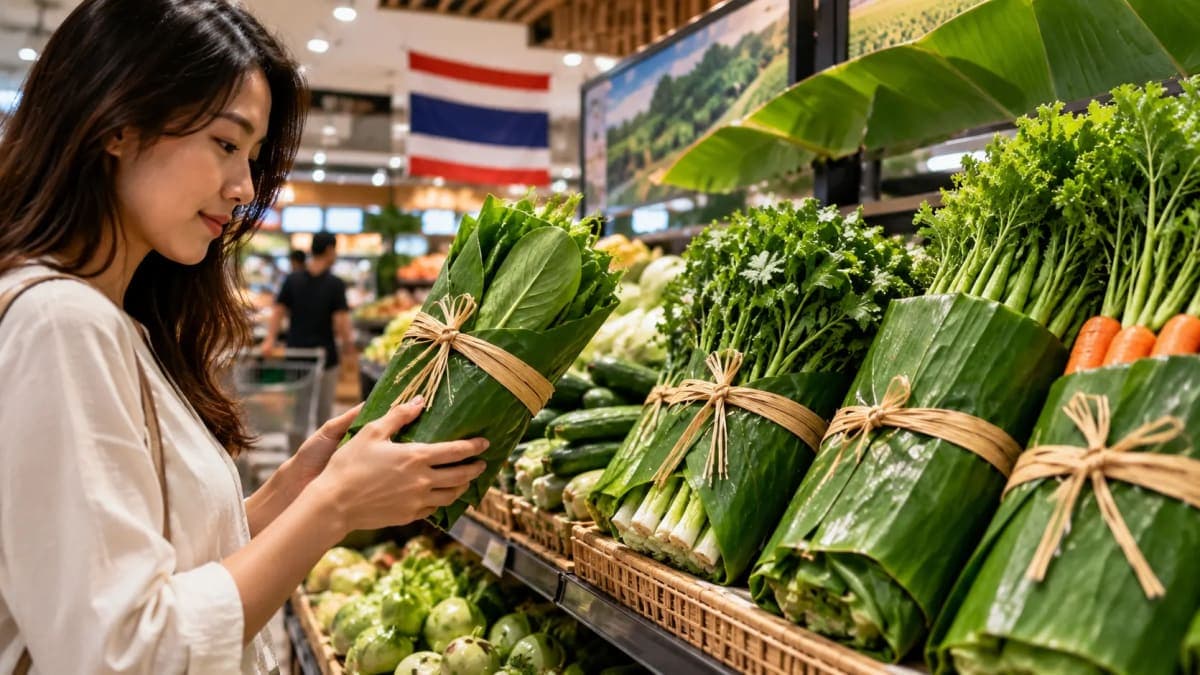
According to the company's account, Rimping was bundling some of its fresh greens in banana leaves secured with fibre ties. Perfect Homes photographed the packaging and posted the images online.
The photographs rapidly went viral.
Perfect Homes says its post eventually accumulated more than 3.5 million views and 16,000 shares, spreading first through Thailand and Vietnam before gaining international attention.
International media subsequently reported on the initiative, including Forbes in March 2019, which identified the retailer as Rimping Supermarket in Chiang Mai.
Rimping remains an operating supermarket business in Chiang Mai. Its current official website lists nine branches around the city.
So there is solid evidence behind the basic story: a Thai supermarket did use banana leaves as an alternative to conventional plastic packaging for some fresh produce.
What cannot be concluded from that evidence is that all — or even most — supermarkets across Thailand have now replaced plastic produce packaging with banana leaves.
Why Banana Leaves Make Sense as Packaging
The concept works partly because banana leaves are hardly an exotic material in Southeast Asia.
Using leaves to wrap, cook and transport food has a long history across the region. Applying the same material to modern retail packaging essentially combines a traditional practice with a contemporary environmental problem.
Packaging Europe, which revisited the subject in 2026, noted that Southeast Asian retailers using banana leaves repeatedly become viral online. It traced some of the earliest widely reported supermarket examples to Rimping's 2019 initiative.
The publication highlighted several practical characteristics: banana plants are native to the region, the leaves are sufficiently durable for certain packaging applications, and their usable lifespan can correspond reasonably well with that of fresh produce.
There is another obvious advantage.
A banana leaf can perform several basic functions that thin plastic film performs: grouping vegetables together, protecting them during handling and giving shoppers a convenient package.
Afterwards, however, the two materials have very different end-of-life characteristics. A natural leaf is biodegradable, whereas conventional plastic packaging can persist in the environment unless it is properly collected and recycled.
That makes the concept particularly attractive for produce that does not require airtight or highly protective packaging.
But Banana Leaves Cannot Simply Replace Every Plastic Package
The viral images can also oversimplify the packaging problem.
Plastic is used in food distribution for reasons beyond appearance. Depending on the product, packaging can help protect food from contamination, physical damage, moisture loss and other factors affecting shelf life.
Banana leaves therefore shouldn't be viewed as a universal substitute for plastic.
They are much better suited to certain vegetables and other fresh products than to liquids, processed foods or goods requiring sealed packaging.
There can also be environmental costs associated with any alternative if it needs extensive cleaning, refrigeration, transportation or additional materials.
The meaningful question is consequently not whether banana leaves can "eliminate plastic", but whether retailers can remove unnecessary plastic from products where a simpler biodegradable material performs the required job adequately.
That is a more limited claim — but potentially a much more practical one.
Thailand's Wider Fight Against Plastic Waste
The supermarket experiment also fits into a much larger environmental policy story.
Thailand has adopted a Roadmap on Plastic Waste Management 2018–2030, focused on reducing targeted single-use plastics, encouraging environmentally friendly alternatives and improving the reuse and recycling of plastic waste.
Thailand's Ministry of Natural Resources and Environment has also moved to a second-phase plastic-waste action plan covering 2023–2027.
Among its goals are reducing targeted plastics going to landfill, bringing targeted plastics into recycling systems and cutting the risk of plastic waste reaching the ocean by 50% by 2027.
Thailand's government has previously reported substantial reductions through campaigns targeting plastic shopping bags and foam food containers.
An official government account says an earlier campaign involving fresh markets, municipalities, private businesses, department stores and convenience stores reduced usage by more than 3.4 billion plastic bags and foam containers, equivalent to approximately 9,824 tonnes, between July 2018 and December 2019.
That broader context is important.
Banana-leaf-wrapped vegetables are visually memorable, but Thailand's plastic challenge cannot realistically be solved by one packaging material. Reduction, reuse, recycling, product redesign and waste collection all form parts of the larger system.
Why This Old Story Keeps Going Viral
There is a reason the banana-leaf photographs continue to return to social media.
They communicate a complicated environmental idea almost instantly.
A shopper doesn't need to understand polymer chemistry or recycling infrastructure to see the contrast between a disposable plastic wrapper and a large green leaf.
There is also an appealing reversal involved: instead of inventing another highly engineered material to solve a modern waste problem, the solution borrows from a packaging technique that existed long before single-use plastic became commonplace.
That simplicity makes the photographs exceptionally shareable.
But it also creates fertile ground for missing context.
A 2019 supermarket experiment can easily be reposted years later with wording suggesting that Thailand has just introduced a sweeping new packaging policy.
Recent reporting from Packaging Europe specifically notes that images of Southeast Asian retailers using banana leaves continue to circulate on social media today, despite some of the best-known examples dating back years.
What the Viral Post Gets Right — and What It Doesn't
The central concept shown in the viral post is based on a genuine practice.
A supermarket in Chiang Mai used banana leaves to package some fresh produce, and the initiative attracted global attention. Thailand also has a genuine national policy programme aimed at reducing plastic waste.
However, the statement that “supermarkets in Thailand are replacing plastic packaging with banana leaves” is too broad if interpreted as a current nationwide change.
Available evidence supports a narrower description: some Thai retail examples have used banana leaves as alternatives to plastic for selected fresh produce, with Rimping Supermarket's Chiang Mai initiative becoming the best-known viral example.
That is still an important experiment.
Its real significance isn't that Thailand has suddenly discovered a replacement for every plastic package. It is that something as ordinary as a banana leaf demonstrates how retailers can reconsider whether plastic is necessary for every product in the first place.