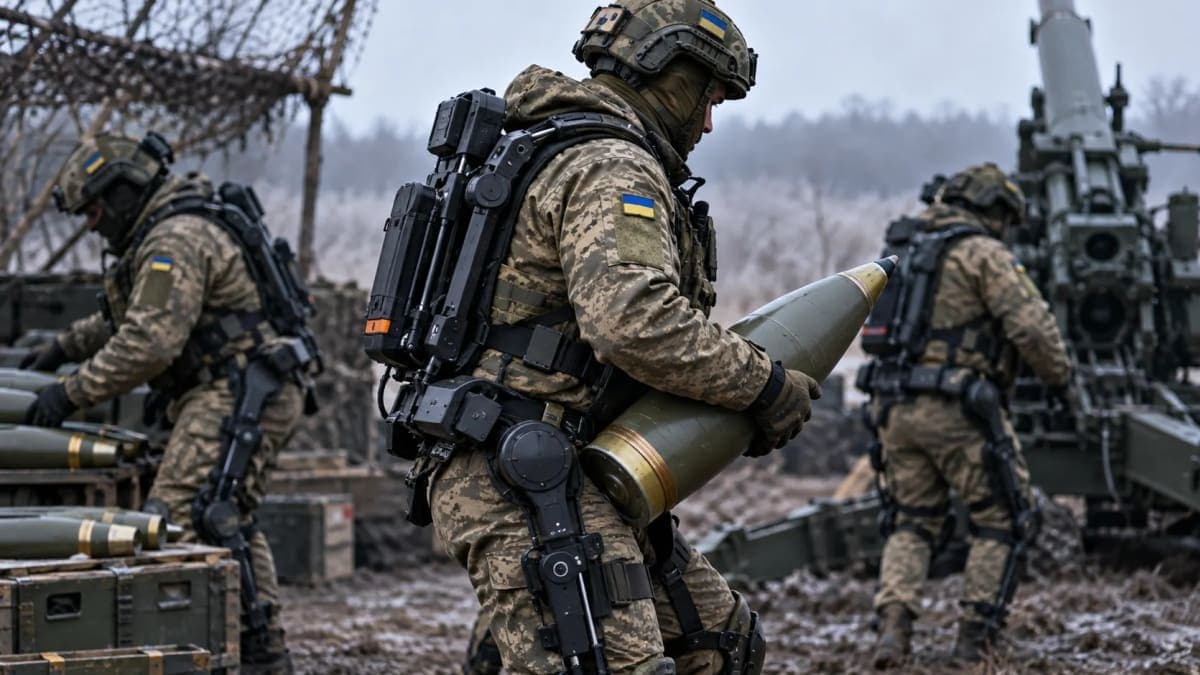
Ukraine's armed forces have begun testing wearable exoskeleton technology in frontline conditions, highlighting another way advanced technology is being introduced into battlefield operations during the continuing war with Russia.
The 7th Air Assault Corps reported in March 2026 that test systems had been provided to its units, including the 147th Separate Artillery Brigade operating in the Pokrovsk direction. The equipment has been evaluated in logistics operations as well as at combat positions.
While social-media posts have recently described the equipment as “anti-drone frames,” available reporting and statements attributed to the Ukrainian military describe a different primary function: helping soldiers cope with heavy physical workloads.
Why Ukraine is testing exoskeletons
Artillery operations require soldiers to repeatedly move extremely heavy ammunition.
Colonel Vitalii Serdiuk, identified as deputy commander of the 7th Air Assault Corps and head of its rocket forces and artillery, said artillery personnel can handle 15 to 30 shells per day, with each shell weighing around 50 kilograms. According to the corps' testing, soldiers using the exoskeletons experienced less fatigue and were able to work faster while maintaining their effectiveness for longer periods.
EFE subsequently reported that the technology was being introduced following testing by the 147th Separate Artillery Brigade under combat conditions in the Pokrovsk direction.
What can the exoskeleton reportedly do?
According to specifications reported from the Ukrainian military's testing, the powered exoskeleton can reduce muscular strain by as much as 30%.
The system has also been reported as capable of supporting movement at speeds of up to 20 km/h and operating over approximately 17 kilometres on one battery charge. The equipment weighs around 2 kg, according to information accompanying the military demonstration.
The system reportedly uses artificial intelligence to analyse a wearer's movements and adjust assistance according to changing physical loads. Around 10 operating modes were also described.
These figures should be understood as reported specifications associated with the test equipment, rather than independently verified battlefield performance measurements.
Exoskeletons being evaluated in combat conditions
The significance of the Ukrainian programme is not simply the existence of military exoskeleton technology. Similar concepts have been researched internationally for years.
What makes Ukraine's case notable is the reported testing of the technology during an ongoing high-intensity war.
Business Insider reported that Ukrainian troops were combat-testing foldable exoskeletons in the Pokrovsk sector and that video released by the 7th Air Assault Corps showed soldiers using them while handling artillery ammunition.
The Ukrainian corps described the equipment supplied to its units as test samples, meaning the development should not be interpreted as evidence that exoskeletons have become standard equipment across Ukraine's armed forces.
Are these really “anti-drone frames”?
This is where the viral claim needs correction.
The screenshot circulating on social media states:
“Ukraine begins exoskeletons on front lines as soldiers prepare to use anti-drone frames in combat.”
The first part broadly reflects a genuine development: Ukrainian forces have tested exoskeletons on the front line.
The description “anti-drone frames,” however, is not supported by the sources reviewed for this article.
Reporting from Ukrainska Pravda, EFE and other outlets describes the systems primarily as wearable devices intended to reduce physical strain and assist soldiers carrying heavy equipment and ammunition.
Ukraine certainly faces an enormous drone threat and is simultaneously developing dedicated counter-UAV technology. For example, Ukraine's Ministry of Defence reported in May that more than 10 military units were using an AI-powered turret designed to detect, track and engage UAVs. That is a separate counter-drone technology, not evidence that the exoskeleton itself is an anti-drone device.
Ukraine is also developing a passive exoskeleton
Ukraine's experimentation is not limited to one powered system.
In April, Euromaidan Press reported that a separate Ukrainian system known as Gyurza-1 was undergoing field testing. Unlike the powered system demonstrated by the 147th Artillery Brigade, Gyurza-1 was described as a passive mechanical exoskeleton requiring neither electronics nor a power supply.
Its developer said the sub-2 kg system was designed to help personnel handle loads of up to 70 kg while reducing stress on the back and musculoskeletal system. Those performance claims come from the developer and should therefore be treated as manufacturer-reported specifications rather than independently established results.
Exoskeleton development becomes a wider Ukrainian defence priority
The effort has since expanded beyond individual battlefield trials.
In July 2026, reporting on Ukraine's state-backed Brave1 defence innovation programme said combat exoskeletons had been included among the country's technology-development priorities. The programme was expanded to support projects across dozens of defence-technology areas.
That suggests Ukraine is exploring exoskeletons not merely as an isolated experiment but as one potential component of a broader technology-driven approach to military operations.
What is confirmed — and what isn't
Confirmed: Ukrainian forces have tested exoskeletons in frontline conditions; the 147th Separate Artillery Brigade has been publicly associated with the trials in the Pokrovsk sector; and the systems are intended to reduce physical workload during demanding military tasks.
Not established: that the exoskeletons shown in the viral post are specifically “anti-drone frames,” or that such equipment has been deployed throughout Ukraine's entire front line.
The more accurate description is therefore that Ukraine is testing military exoskeletons to improve soldiers' endurance and reduce the physical burden of heavy battlefield tasks while separately expanding its counter-drone technologies.
Sources
The article is based primarily on reporting from Ukrainska Pravda — March 20, 2026 and EFE — March 30, 2026, with additional verification from Ukraine's 7th Air Assault Corps official website and the Ministry of Defence of Ukraine. Additional reporting was checked from Defense Express, UNITED24 Media and Business Insider.