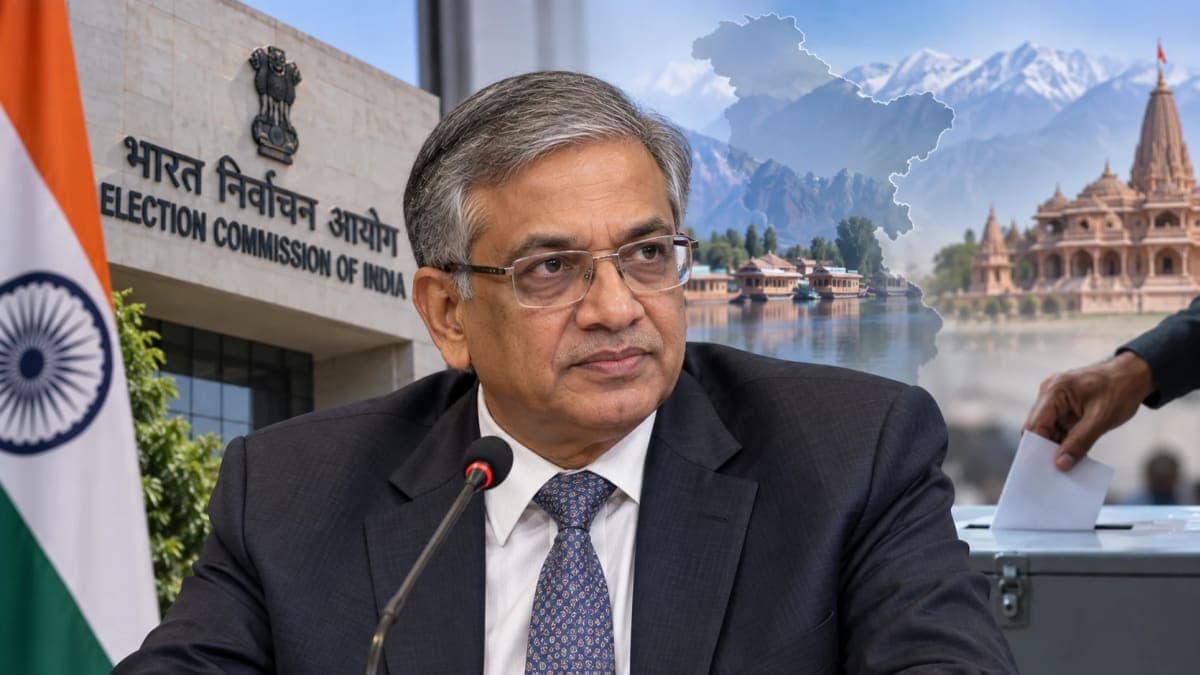
New Delhi, September 23, 2026: Chief Election Commissioner Gyanesh Kumar, a former IAS officer whose administrative career included senior assignments in the Union Home Ministry during major developments involving Jammu and Kashmir and Ayodhya, is at the centre of a fresh political and institutional controversy over the Election Commission’s handling of electoral rolls.
The immediate trigger is an investigation by The Indian Express, which reported that Election Commissioners Sukhbir Singh Sandhu and Vivek Joshi formally recorded objections at least 14 times over the past 10 months to steps they said had been taken or orders issued without their knowledge.
The Election Commission has challenged the interpretation that these objections demonstrate an institutional split. It says differences and observations are normal during deliberations and maintains that final decisions concerning the Special Intensive Revision (SIR) and other major matters were unanimous.
The controversy has put renewed attention on Kumar himself: who he is, the government assignments that shaped his career, and how he rose from the civil service to become India's 26th Chief Election Commissioner.
Who Is Gyanesh Kumar?
Gyanesh Kumar is a 1988-batch Kerala-cadre Indian Administrative Service officer.
He studied Civil Engineering at IIT Kanpur and later studied Business Finance at ICFAI in India and Environmental Economics at Harvard University's Harvard Institute for International Development, according to his official Election Commission biography.
His career included numerous assignments in Kerala.
Among them were Sub Collector of Adoor, Municipal Commissioner of Cochin, District Collector of Ernakulam, Managing Director of the Kerala State Cooperative Bank and Resident Commissioner of Kerala House in New Delhi.
He also handled departments including Public Works, Finance Resources, Fast Track Projects, Food and Civil Supplies and the Modernising Government Programme while serving as Secretary to the Kerala government.
From Kerala Administration to the Centre
Kumar subsequently moved into important positions in the Union government.
His central-government assignments included serving as Joint Secretary in the Ministry of Defence, followed by roles as Joint Secretary and Additional Secretary in the Ministry of Home Affairs.
He later served as Secretary in the Ministry of Parliamentary Affairs and Secretary in the Ministry of Cooperation.
These assignments placed him inside the administrative machinery of the Union government during periods of significant policy activity.
His Role During Article 370 Changes and Ayodhya
Kumar's tenure in the Home Ministry has received particular attention.
The IIT Kanpur profile of Kumar states that he served as Joint Secretary and Additional Secretary in the Home Ministry while “unprecedented transformations” were taking place in Jammu and Kashmir as well as Ayodhya.
The Indian Express profile published on September 23 cited people who had worked with Kumar while examining his reputation as an administrator. One former colleague was quoted as describing him as someone who “knew how to implement orders from above.”
That description is an attributed assessment from a former colleague; it should not be treated as an independently established characterization of Kumar's motives or decision-making.
His administrative background has nevertheless become part of the current political discussion because of the substantial authority attached to his present position as Chief Election Commissioner.
Appointment to the Election Commission
Kumar retired from the civil service on January 31, 2024.
Soon afterwards, he entered the Election Commission.
On March 14, 2024, the government announced the appointment of Kumar and former IAS officer Sukhbir Singh Sandhu as Election Commissioners. Kumar assumed charge on March 15, 2024.
As Election Commissioner, Kumar was involved during the 2024 Lok Sabha election and Assembly elections in Jammu and Kashmir, Haryana, Maharashtra, Jharkhand and the National Capital Territory of Delhi.
He subsequently became Chief Election Commissioner.
Gyanesh Kumar Becomes 26th Chief Election Commissioner
Kumar took charge as India's 26th Chief Election Commissioner on February 19, 2025.
His appointment followed a Ministry of Law and Justice notification dated February 17.
Upon assuming office, Kumar said voting was the first step in nation-building and encouraged every eligible Indian citizen aged 18 or above to register and vote.
He also said that, in accordance with the Constitution, electoral laws, rules and instructions, the Election Commission “was, is and will always be with the voters.”
Kumar currently serves on the three-member Commission alongside Election Commissioners Sukhbir Singh Sandhu and Vivek Joshi.
Why SIR Has Put Kumar Under the Spotlight
The Special Intensive Revision (SIR) of electoral rolls has become one of the most closely scrutinised issues of Kumar's tenure.
The latest controversy stems from reporting that Sandhu and Joshi recorded objections to a series of electoral-roll-related decisions.
According to The Indian Express, the reported disagreements included matters involving voter additions and deletions, changes connected to Form 6, centralisation of controls for electoral-roll systems and other administrative decisions.
One particularly contentious issue concerned changes to Form 6, which is used by new voters seeking inclusion in the electoral roll.
The investigation reported that questions connected to SIR were introduced into the digital Form 6 process. Sandhu and Joshi reportedly objected, describing the change as “illegal” and “unauthorised” and arguing that it should be removed.
Those descriptions are the reported views of the two Election Commissioners, not a judicial finding that the Commission acted illegally.
The Significance of the ‘14 Objections’
The number at the centre of the latest controversy is 14.
According to the investigation, Sandhu and Joshi formally objected at least 14 times over 10 months to decisions they said were taken without their knowledge. Four objections were reportedly recorded on a single day.
The reported disagreements included changes to Form 6, centralisation of ERONet controls in Delhi, voter-deletion appeals in West Bengal and the non-addition of some eligible voters to electoral rolls in Goa.
The existence of these reported objections has prompted Opposition leaders to question Kumar's leadership of the Commission.
However, internal objections during deliberation do not by themselves establish that the Commission's final decisions were unlawful or that any election result was invalid.
Election Commission Says Final Decisions Were Unanimous
The Election Commission has strongly disputed suggestions that the reported internal correspondence proves that its major decisions lacked collective approval.
Responding to the investigation, the Commission said differing opinions and observations are a normal feature of institutional deliberation before final decisions are reached.
It maintains that decisions relating to SIR and other major electoral matters ultimately received the approval of the full Commission.
EC sources separately told Hindustan Times that all three commissioners approved the Commission's final decisions, including those concerning SIR.
This creates an important distinction in the current debate: the investigation concerns reported objections during the decision-making process, while the ECI's position concerns the status of the eventual final decisions.
Why Gyanesh Kumar’s Administrative Background Matters to the Debate
Kumar's career spans state administration, defence, internal security, parliamentary affairs, cooperation policy and electoral administration.
Supporters and critics may interpret that record differently. The verifiable point is that his government service placed him in senior administrative positions during several consequential policy periods before his appointment to the Election Commission.
The current controversy therefore involves two separate questions that should not be conflated.
One concerns Kumar's long record as a civil servant and the administrative roles he performed under different governments. The other concerns the specific processes through which decisions have been made during his tenure at the Election Commission.
The first can be established through his official career record. The second is now the subject of competing accounts: investigative reporting describes repeated objections from the other commissioners, while the Election Commission says its final decisions were collectively approved.
What Is Confirmed and What Remains Contested?
Several facts are established.
Kumar is a retired 1988-batch Kerala-cadre IAS officer who served in senior positions in the Home, Parliamentary Affairs and Cooperation ministries. He joined the Election Commission in March 2024 and became Chief Election Commissioner in February 2025.
It is also established that The Indian Express has reported at least 14 recorded objections from Sandhu and Joshi concerning electoral-roll decisions over a 10-month period.
What remains contested is what those objections demonstrate about the Commission's overall decision-making.
The Election Commission says internal differences are part of normal deliberation and insists its final decisions were unanimous. Opposition politicians have interpreted the disclosures differently and have demanded further scrutiny of Kumar and the Commission.
Those political allegations should therefore be distinguished from facts established by official records, documentary reporting or judicial findings.
Why the Controversy Matters
The dispute is significant because the Election Commission is the constitutional authority responsible for administering elections to Parliament and state legislatures as well as elections for the offices of President and Vice-President.
Questions about electoral rolls directly affect who is registered to participate in elections.
For that reason, the current debate is not simply about Gyanesh Kumar's personality or bureaucratic style. The substantive issue is how India's three-member Election Commission deliberates, records disagreements and ultimately authorises decisions affecting electoral rolls.
The latest disclosures have brought those internal processes into unusually close public scrutiny — while the Election Commission maintains that its final institutional decisions remain unanimous.