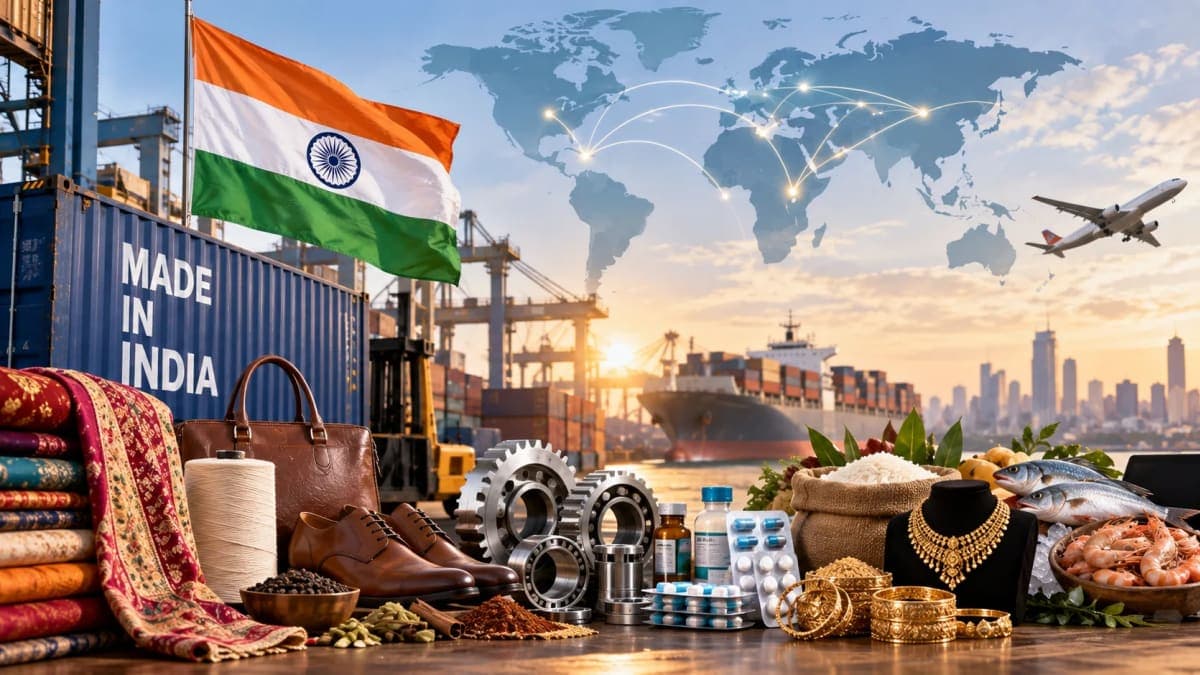
India's trade map is changing faster than it has in years.
The country has recently secured or implemented major trade agreements covering the European Union, United Kingdom, New Zealand, Oman and the four EFTA economies—Switzerland, Norway, Iceland and Liechtenstein. Together, these deals are opening preferential access to markets stretching from Europe to the Gulf and the Indo-Pacific.
The scale is significant.
Under the India–EU agreement, preferential access covers about 96.8% of tariff lines and 99.5% of India's exports by value, with 90.7% of export value scheduled for duty-free treatment from entry into force.
The UK agreement gives duty-free access to almost 99% of Indian exports, covering nearly all trade value.
New Zealand has committed to zero-duty access across 100% of its tariff lines for Indian exports.
Oman's CEPA provides zero-duty market access covering 98.08% of tariff lines and 99.38% of India's export value to Oman.
EFTA's TEPA commitments cover 92.2% of tariff lines and 99.6% of India's exports, including all non-agricultural products.
The question for businesses is therefore no longer simply, “Has India signed more FTAs?”
It is:
Which Indian industries are positioned to turn this new market access into actual exports?
Based on the tariff concessions contained in the agreements, India's existing export capabilities and the sectors repeatedly identified in official trade documents, these are 10 industries worth watching.
1. Textiles and Apparel
Few industries appear as consistently across India's new trade agreements as textiles and clothing.
The EU agreement immediately eliminates duties on major labour-intensive exports including textiles and apparel. India's Commerce Ministry says more than $33 billion of exports across labour-intensive sectors including apparel, textiles, leather, footwear, gems and jewellery stand to benefit from duty-free EU access once the agreement enters into force.
The UK agreement is also particularly important.
Indian textile and apparel products previously faced tariffs reaching roughly 10% in relevant categories. CETA moves qualifying Indian exports to zero duty.
Oman similarly provides full tariff elimination for textiles, while New Zealand's agreement removes tariffs that had reached up to 10% across several manufacturing categories.
The opportunity is not merely lower tariffs.
Indian manufacturers compete with textile-exporting economies that have sometimes enjoyed preferential access unavailable to India. Removing that tariff disadvantage can change the landed-cost calculation for buyers.
Where the opportunity lies
Garments, home textiles, cotton products, technical textiles and value-added apparel could gain.
Export clusters in Tamil Nadu, Gujarat, Maharashtra, Punjab, Rajasthan and Uttar Pradesh may therefore have greater incentives to build distribution relationships in newly accessible markets.
But tariffs alone will not determine the winners.
Fast delivery, sustainability compliance, traceability and consistent quality will increasingly determine whether Indian manufacturers convert preferential access into orders.
2. Leather and Footwear
Leather and footwear may be one of the clearest examples of an industry where an FTA can directly change price competitiveness.
India's UK agreement eliminates tariffs that previously reached around 10% on relevant leather and footwear products.
The EU agreement also provides immediate tariff elimination across important labour-intensive categories including leather and footwear. Oman specifically lists both among sectors receiving full tariff elimination.
That creates overlapping preferential access across several markets rather than dependence on one FTA.
India already has major leather and footwear manufacturing clusters around Kanpur, Agra, Chennai, Ambur and Kolkata.
For these exporters, even a single-digit tariff disadvantage can matter when competing for large international sourcing contracts.
The bigger challenge
European buyers increasingly care about environmental standards, chemicals used in processing, labour compliance and supply-chain traceability.
The FTA removes customs duties.
It does not remove those requirements.
That distinction could separate companies that merely receive theoretical tariff access from those that actually gain market share.
3. Gems and Jewellery
Gems and jewellery appears repeatedly among sectors identified by the Commerce Ministry as potential beneficiaries of India's new agreements.
The EU agreement provides immediate duty elimination for important gems and jewellery exports, while the UK agreement also gives the sector zero-duty access.
Oman's agreement identifies gems and jewellery among India's major labour-intensive sectors receiving tariff elimination.
The opportunity extends beyond finished jewellery.
India has a large ecosystem covering diamond cutting and polishing, gold jewellery, coloured gemstones and manufacturing services.
For export centres such as Surat, Mumbai and Jaipur, easier access to several affluent consumer markets could support greater diversification.
However, jewellery trade is particularly sensitive to rules of origin, precious-metal prices, certification and sourcing requirements.
FTA access should therefore not be confused with frictionless trade.
4. Engineering Goods and Machinery
Engineering could ultimately be one of the most economically significant beneficiaries because of the sheer scale of India's industrial export base.
Department of Commerce data show Indian engineering-goods exports reached about $65.4 billion in January–June 2026, up roughly 12.2% year on year.
India's newer agreements expand access for products including machinery, industrial components, precision instruments and other manufactured goods.
The UK agreement explicitly identifies auto parts and machinery among high-value Indian products gaining zero-duty access.
Oman's CEPA opens opportunities in machinery, precision instruments, transport equipment and related industrial products.
EFTA's own expected high-impact areas include mechanical and electrical engineering.
Why this matters beyond tariffs
Engineering exporters can become part of international supply chains rather than simply selling finished consumer products.
That means the opportunity may include:
components → sub-assemblies → machinery → maintenance → engineering services.
India's FTAs could therefore help manufacturers deepen their role in global value chains rather than merely increase shipment volumes.
5. Auto Components and Transport Equipment
India's automotive opportunity is subtly different from the headline debate around imported European luxury cars.
For exporters, the more interesting story may be components.
The UK agreement identifies auto parts among high-value products receiving zero-duty access.
Oman's agreement provides tariff opportunities across transport equipment and auto components, while the EU agreement also creates opportunities for India-made automobiles under calibrated reciprocal access.
India already manufactures engines, transmission components, castings, forgings, electronics, braking systems and increasingly EV-related components.
That means an Indian supplier does not necessarily need to export an entire vehicle to benefit.
It may enter another country's manufacturing ecosystem one component at a time.
For India, that could ultimately prove more important than the consumer-facing question of whether imported cars become cheaper.
6. Pharmaceuticals and Medical Devices
Pharmaceuticals present another potentially high-value opportunity.
India is already a major global producer of generic medicines, and several recent trade agreements improve commercial access for pharmaceutical products or services.
The UK agreement identifies pharmaceuticals among high-value Indian exports gaining improved tariff access.
Oman's CEPA explicitly includes pharmaceuticals and medical devices among sectors receiving tariff elimination.
New Zealand also identifies pharmaceuticals among sectors expected to gain from expanded access.
EFTA could be particularly interesting for another reason: Switzerland is home to one of the world's most sophisticated pharmaceutical ecosystems.
Official Indian material identifies pharmaceuticals and healthcare among sectors likely to see significant impact from TEPA.
But pharma demonstrates why tariffs tell only half the story.
Regulatory approvals, manufacturing standards, clinical requirements, intellectual-property rules and procurement systems can matter more than customs duties.
For pharmaceutical exporters, regulatory access may therefore determine how much of the theoretical FTA opportunity becomes real business.
7. Agriculture and Processed Foods
India's new trade agreements also create openings for agricultural exporters—but this sector requires more nuance than simply saying “agriculture becomes duty-free.”
Under the EU agreement, India secured preferential access across around 87% of agricultural tariff lines of interest, including products such as tea, coffee, spices, table grapes, gherkins, dried onions, sweet corn and selected fruits, vegetables and processed foods.
New Zealand eliminates duties across all tariff lines for qualifying Indian exports, while its government remains able to enforce food-safety and biosecurity rules.
The UK agreement provides duty-free access for nearly all Indian agricultural exports, subject to limited exceptions.
Oman's CEPA also expands opportunities for agricultural and processed-food exports.
Potential beneficiaries
Tea, coffee, spices, rice, fruits and vegetables, processed foods and value-added agricultural products could gain.
But agriculture also demonstrates the importance of SPS rules—sanitary and phytosanitary standards.
A product can face a zero tariff and still be unable to enter a market if it fails food-safety, pesticide-residue, plant-health or traceability requirements.
For Indian farmers and food processors, compliance capacity may therefore be as valuable as tariff reduction.
8. Marine Products
Seafood and marine exports deserve separate attention.
India's EU agreement provides immediate duty elimination for certain marine exports while other marine products receive phased reductions or tariff-rate quota treatment.
The UK agreement also identifies marine products among important labour-intensive export sectors.
Government documents additionally identify seafood and maritime industries among sectors expected to be affected by the EFTA agreement.
India already has a significant seafood export industry covering shrimp, frozen fish and processed marine products.
The Commerce Ministry has said fisheries exports more than doubled from about ₹30,213 crore in 2013–14 to ₹62,408 crore in 2024–25, while the share of value-added products rose from 2% to 11%.
The larger opportunity may therefore be moving from commodity seafood toward higher-value processed products.
Again, compliance will be crucial.
Food-safety inspections, traceability and approval of processing establishments can determine whether tariff access translates into actual shipments.
9. Chemicals, Plastics and Rubber
This sector receives less consumer attention than textiles or jewellery but appears repeatedly in India's trade agreements.
The EU agreement identifies chemicals and plastics/rubber among labour-intensive or industrial sectors benefiting from improved access.
The UK agreement provides zero-duty opportunities for organic chemicals, while Oman's CEPA specifically identifies opportunities across chemicals, plastics and rubber.
This matters because these industries feed into numerous downstream sectors:
automobiles, packaging, construction, pharmaceuticals, consumer goods and industrial manufacturing.
An FTA can therefore help not only companies exporting finished chemical products but suppliers participating in larger manufacturing chains.
European environmental regulation, however, makes compliance particularly important for this category.
Tariff elimination does not exempt Indian exporters from product-safety or environmental rules in destination markets.
10. IT, Professional and Business Services
The final sector is different because the opportunity does not primarily come from customs tariffs.
India's new FTAs increasingly include services and professional mobility.
Under the UK CETA, the UK has provided market access across 137 services subsectors, including IT/ITeS, professional services, financial services, telecom and education.
The India–EU agreement includes access across 144 services subsectors, covering IT/ITeS, professional services, other business services and education, alongside a framework for temporary business mobility.
Oman has commitments covering 127 services subsectors, including computer-related, professional, engineering, education and health services. It also raises the ceiling for intra-corporate transferees from 20% to 50%.
This creates opportunities not just for India's biggest technology companies but potentially for consulting firms, engineering companies, education providers, architects, accountants and specialized professional-services businesses.
India's FTA story is therefore no longer exclusively about containers leaving ports.
Increasingly, it is also about people, software and expertise crossing borders.
Which sectors have the broadest opportunity?
There is no reliable evidence yet to rank these ten sectors by the export gains they will ultimately achieve.
But one pattern is unusually clear.
Textiles/apparel, leather/footwear, engineering, gems and jewellery, agriculture/processed foods and services recur across multiple agreements rather than depending on a single FTA.
That matters.
A company that gains access to only one new market has an opportunity.
A company that simultaneously gains better access to the EU, UK, Gulf, EFTA and Indo-Pacific markets has a diversification strategy.
That may be the more important consequence of India's current FTA push.
India's FTA map is becoming an export-diversification tool
India's Department of Commerce says exports of goods and services reached a record $863.1 billion in FY2025–26.
At the same time, global exporters are navigating geopolitical tensions, tariff changes and supply-chain disruptions.
FTAs provide Indian companies with another option: diversify the countries they sell to instead of depending disproportionately on a handful of markets.
The EU agreement is particularly significant because more than $33 billion of exports from labour-intensive sectors are positioned for duty-free access from entry into force.
The UK provides almost universal duty-free coverage.
New Zealand offers tariff-free access across every tariff line.
Oman provides near-universal coverage of India's existing export value.
EFTA adds access to wealthy European markets and an unusual investment component.
Together, these agreements are creating something more useful than one-off tariff cuts:
a wider preferential-market network for Indian businesses.
JantaScope Analysis: Zero tariff is the starting line, not the finish line
It would be easy to look at these agreements and conclude that Indian exports must now surge.
Trade does not work that automatically.
An FTA can eliminate a 5% or 10% tariff disadvantage, but it cannot guarantee a buyer.
Companies still have to meet standards, obtain certifications, comply with rules of origin, build distribution networks, finance inventory and manage logistics.
This creates a likely divide inside each sector.
Export-ready companies that already meet international standards may be able to exploit tariff reductions relatively quickly.
Smaller businesses that lack certifications, overseas distribution or knowledge of FTA paperwork may receive the same legal market access without receiving the same commercial benefit.
That is why FTA utilisation could become as important as FTA signing.
For Indian businesses, the practical question is not:
“Does India have an FTA with this country?”
It is:
“Does my exact product qualify, what tariff did it face before, what is the new tariff, what rule of origin applies, and can I meet the destination country's regulatory requirements?”
That product-level calculation is where the real winners of India's FTA expansion will eventually emerge.