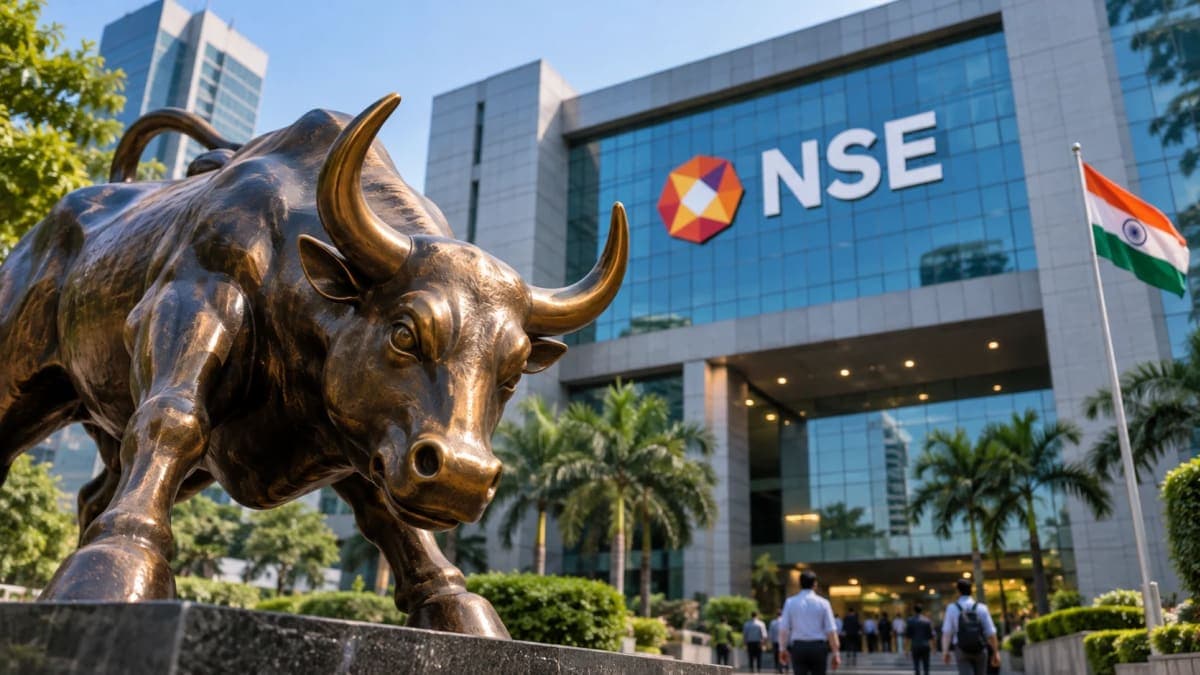
India’s National Stock Exchange is finally heading to the public market after a wait stretching back nearly a decade.
The National Stock Exchange of India (NSE) has filed its Red Herring Prospectus and fixed a price band of ₹1,700 to ₹1,785 per share for its initial public offering. The issue is scheduled to open for public subscription on September 17, 2026 and close on September 21. NSE’s own investor-relations disclosures record the RHP filing and subsequent price-band announcement, while SEBI’s public-issues database lists NSE’s RHP dated September 11.
At the top of the price band, the offer could be worth roughly ₹22,560 crore, putting it among India’s largest IPOs.
But the size of the deal is only part of the story.
For investors, NSE’s listing creates an unusual proposition: the opportunity to own a stake in the infrastructure company sitting at the centre of a large part of India’s equity and derivatives market.
It also brings several questions into sharper focus—from NSE’s dependence on trading activity and derivatives to regulatory risk, valuation and how much future growth is already reflected in the IPO price.
NSE IPO: Key Details
The IPO is expected to offer approximately 126.4 million existing shares, with the price fixed between ₹1,700 and ₹1,785 per share. Reuters reported that the upper end implies an NSE valuation of roughly ₹4.42 trillion, or about $46 billion.
The issue is expected to open on September 17 and close on September 21, with the listing targeted for around September 24.
A particularly important point for investors is that this is an Offer for Sale (OFS).
NSE is not issuing new shares to raise money for itself. Existing shareholders are selling part of their holdings, so the IPO proceeds will go to those selling shareholders rather than being injected into NSE's business.
That distinction matters.
Buying shares in the IPO gives investors ownership exposure to NSE, but the transaction itself does not provide the exchange with a large pool of fresh capital for expansion.
Why the NSE IPO Is Such a Significant Event
This is not an ordinary financial-services IPO.
NSE operates critical infrastructure underpinning India's capital markets. It provides trading platforms across multiple asset classes and is closely associated with benchmarks including the Nifty 50.
Its scale is particularly striking in derivatives.
Reuters describes NSE as the world's most active derivatives exchange by the number of contracts traded.
That creates an unusual business model.
A conventional listed company generally makes money by manufacturing products or providing services to customers. An exchange earns revenue from activity occurring across the financial-market ecosystem—including transactions, listings, data, technology and related market infrastructure.
For long-term investors, that means the central question is not simply whether India's stock market rises or falls next year.
It is whether India's capital-market ecosystem continues expanding over the next decade.
The IPO Has Been Nearly a Decade in the Making
The significance of the September 2026 IPO becomes clearer when viewed against NSE's unusually long path to listing.
NSE originally began its attempt to go public around 2016, but regulatory investigations and related issues delayed the process.
A major turning point arrived on January 30, 2026, when NSE disclosed that it had received a No Objection Certificate from SEBI for listing its shares on a recognised stock exchange.
The process then accelerated.
NSE announced the selection of IPO intermediaries in March, while SEBI's records show a DRHP for National Stock Exchange of India Limited dated June 18, 2026. By September, the RHP had been filed and the price band formally announced.
For investors, that regulatory history should not simply be treated as background. It demonstrates that regulatory relationships and compliance are material considerations when valuing a market-infrastructure institution.
NSE Has Also Reduced the Size of the Share Sale
The final offering is smaller than initially proposed.
Reuters reported that NSE's offer was reduced by more than 15%, from about 148.91 million shares to approximately 126.4 million shares.
The final IPO therefore represents a relatively limited slice of NSE's overall equity.
Several existing investors are participating as selling shareholders. Reuters identified shareholders including State Bank of India and Canada Pension Plan Investment Board among those selling shares.
Because this is an OFS, changes in how many shares individual shareholders choose to sell affect the IPO's size but do not directly alter NSE's operating capital.
The Bigger Question: How Should Investors Think About NSE?
The investment case is different from simply saying that NSE is India's dominant exchange.
An exchange benefits from network effects.
Liquidity tends to attract traders. Traders attract more liquidity. Brokers connect where their clients trade, while issuers and financial-product providers generally value deep and active markets.
Once that ecosystem becomes sufficiently large, competing purely on technology or transaction costs becomes difficult.
But network effects do not eliminate risk.
For NSE, one of the biggest issues is the relationship between trading activity, regulation and revenue.
Derivatives Are Both a Strength and a Risk
NSE's extraordinary scale in equity derivatives has been a major competitive advantage.
It also creates an important concentration question.
Reuters reported that options trading has accounted for a large portion of NSE's revenue and that derivatives volumes have declined from their previous peak following regulatory changes aimed at the derivatives market.
This matters because India's regulator has taken multiple steps affecting the equity-derivatives market.
A reduction in speculative derivatives activity may be desirable from an investor-protection or market-stability perspective, but for an exchange it can also affect transaction-linked revenue.
The implication is straightforward:
NSE's long-term value depends not only on India's growing investor base but also on the composition of that trading activity.
Investors therefore need to distinguish between growth driven by the broader financialisation of Indian savings and revenue that depends heavily on particular high-volume trading products.
NSE Is Trying to Diversify
Management appears conscious of this issue.
NSE CEO Ashishkumar Chauhan has said growth in businesses outside weekly options could reduce the proportion of revenue coming from that segment.
The broader NSE ecosystem includes businesses related to cash equities, derivatives, market data, indices, technology, clearing and international trading infrastructure.
Reuters has also reported diversification initiatives involving additional commodity products and other areas of market infrastructure.
That diversification may become one of the most important metrics for shareholders after listing.
Instead of watching only trading volume, investors may increasingly need to monitor how much revenue NSE can generate from data, technology, indices, clearing, new asset classes and international operations.
Financial Performance Remains Strong—but Growth Is Not Risk-Free
NSE entered the IPO process with substantial profitability.
For the quarter ended June 30, 2026, Reuters reported revenue of approximately ₹45.6 billion and net profit of about ₹31.2 billion, representing year-on-year increases of roughly 13% and 6.7%, respectively.
NSE itself has published consolidated and standalone financial results for the June 2026 quarter, alongside audited FY2025-26 results, through its investor-relations portal.
Those numbers illustrate one of NSE's attractions: exchange businesses can produce high profitability once a large trading ecosystem has been established.
But investors should avoid automatically extrapolating past growth.
Trading volumes can fluctuate, regulations can change market structure, new competitors or products can emerge, and pricing or transaction economics can evolve.
What Does the IPO Valuation Tell Us?
At ₹1,785 per share, the IPO reportedly values NSE at approximately ₹4.42 trillion.
That is substantial.
It means investors are not being offered an unknown exchange at an early stage of development. They are being offered a stake in an already dominant and highly profitable market-infrastructure business.
Consequently, the investment debate shifts from:
“Is NSE a strong business?”
to:
“What growth is already priced into NSE shares?”
Those are very different questions.
An excellent business can still generate disappointing investment returns if purchased at a valuation that assumes extremely strong future growth.
Conversely, short-term fluctuations in derivatives activity do not necessarily undermine a long-term investment thesis if India's broader capital markets continue expanding.
Valuation therefore needs to be assessed alongside earnings growth, diversification and regulatory risk rather than market dominance alone.
NSE vs BSE: An Unusual New Comparison
NSE's listing will also create an interesting situation for Indian investors because listed exchange exposure is already available through BSE Ltd.
The two exchanges should not automatically be valued as identical businesses.
They differ in market share, product mix, trading volumes and revenue composition.
Once NSE becomes publicly traded, investors will have direct market valuations for both major Indian stock exchanges.
That could make metrics such as these increasingly important:
transaction revenue growth;
cash-market and derivatives market share;
data and index revenue;
clearing and settlement income;
operating margins;
return on equity;
regulatory costs;
diversification beyond core trading activity; and
valuation relative to earnings and cash generation.
The market will effectively begin assigning a continuously observable price to the competitive positions of India's two major exchanges.
What the NSE IPO Means for Retail Investors
The biggest change is simple: ordinary investors will finally be able to gain listed exposure to NSE itself rather than merely using NSE's infrastructure to buy shares in other companies.
But IPO demand and investment quality should not be treated as the same thing.
A heavily subscribed IPO can still be expensive.
Similarly, grey-market premiums are unofficial indicators and are not a reliable substitute for analysing a company's earnings, risks and valuation.
For investors evaluating NSE, five questions matter more than short-term IPO excitement:
1. Can India's capital markets keep expanding?
Growth in demat accounts, systematic investing, institutional participation and household financialisation can expand the underlying ecosystem from which exchanges benefit.
2. How dependent will NSE remain on derivatives?
This is particularly important because regulatory intervention can materially change trading behaviour.
3. Can NSE diversify revenue?
Data, indices, technology, clearing, international markets and new products could reduce dependence on individual trading segments.
4. How much growth is already reflected in the IPO valuation?
Market leadership does not automatically make any valuation attractive.
5. What regulatory risks remain?
NSE is itself part of India's regulated market infrastructure. Regulation is therefore not merely an external risk—it is fundamental to its operating environment.
Analysis: NSE Could Become a Proxy for India's Capital-Market Expansion
Perhaps the most interesting way to view NSE after listing is not as a conventional financial stock.
It may increasingly function as a listed proxy for the scale and activity of India's capital markets.
If more Indians invest, more companies raise capital, institutional participation expands, trading activity grows and financial products become more sophisticated, exchanges can benefit from multiple parts of that ecosystem.
But the same relationship works in reverse.
Lower trading volumes, regulatory restrictions, changing derivatives economics or weaker market activity can affect exchange revenue.
That makes NSE potentially less dependent on the performance of any single listed company—but more dependent on the overall health, activity and regulatory structure of India's capital markets.
What Investors Should Watch After Listing
The IPO itself will dominate attention over the next few days, but the more useful indicators will emerge after NSE becomes publicly traded.
Quarterly results should reveal whether the exchange can sustain earnings growth despite changes in derivatives regulation.
Investors should also watch whether non-derivatives businesses increase their contribution to revenue, whether NSE maintains its competitive position across key trading categories and how management deploys cash generated by the business.
The valuation gap or premium between NSE and BSE could eventually become another useful signal of how investors perceive their respective growth prospects.
Bottom Line
NSE's IPO represents far more than another large public issue.
It brings one of the central pieces of India's financial infrastructure into the listed market after years of regulatory and procedural delays.
The offer opens on September 17, 2026, at a price band of ₹1,700–₹1,785 per share, with existing shareholders selling approximately 126.4 million shares. NSE itself will not receive the proceeds because the IPO is entirely an Offer for Sale.
For investors, the strongest part of the story is NSE's scale and position at the centre of India's expanding capital markets.
The central questions are valuation, regulatory exposure, dependence on derivatives and whether NSE can broaden its revenue base as India's financial markets evolve.
Those factors—not IPO hype or unofficial grey-market premiums—will ultimately determine how NSE performs as a listed company.