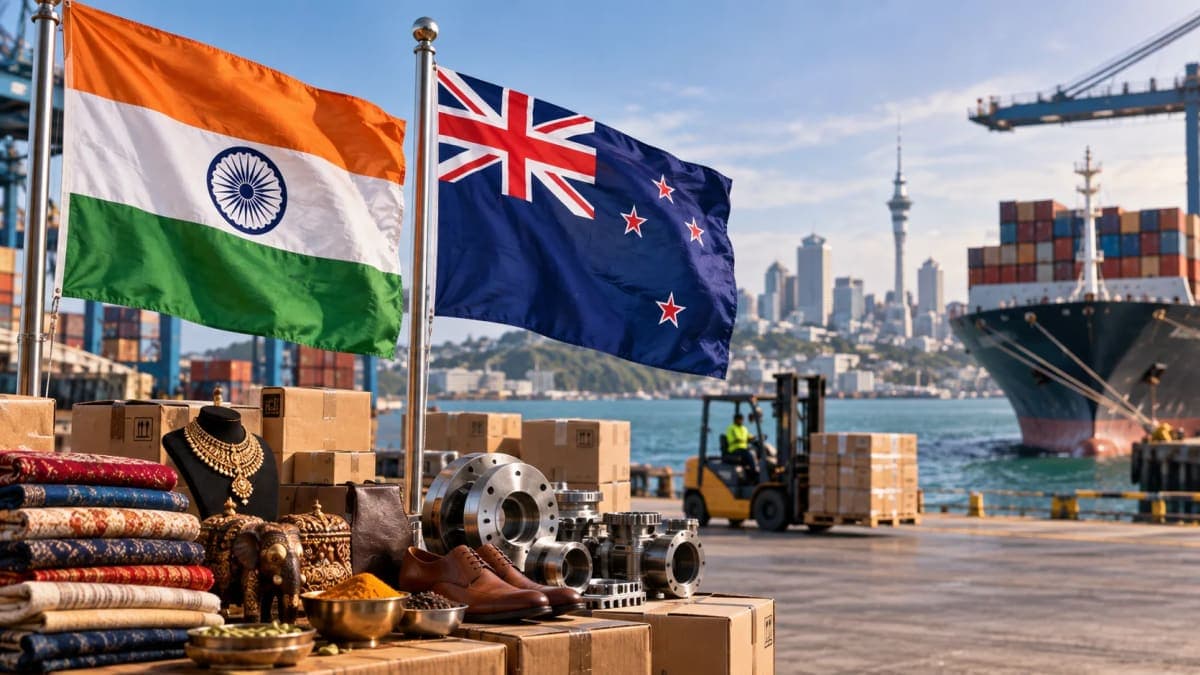
Indian Exporters Get 100% Duty-Free Access to New Zealand as Trade Deal Clears Key Hurdle
Indian exporters are moving closer to gaining completely tariff-free access to the New Zealand market after New Zealand’s Parliament approved legislation implementing the India–New Zealand Free Trade Agreement.
The legislation passed on September 16 by 93 votes to 29, according to the New Zealand government. The parliamentary approval removes a major domestic hurdle before the agreement can enter into force.
For India, one provision stands out: New Zealand has agreed to provide zero-duty access to 100% of Indian exports across all tariff lines from the agreement’s entry into force.
That potentially creates new opportunities for Indian manufacturers and exporters in sectors ranging from textiles and footwear to engineering products, jewellery and processed foods.
But “100% duty-free access” needs an important qualification: zero customs duty does not automatically mean zero barriers to selling in New Zealand.
Rules of origin, product standards, biosecurity requirements and other regulatory conditions will continue to matter.
What exactly happened on September 16?
New Zealand’s Parliament passed the legislation needed to implement the free trade agreement with India.
New Zealand Trade and Investment Minister Todd McClay confirmed the 93–29 vote, describing the result as evidence of broad parliamentary support for the agreement.
India and New Zealand had signed the FTA on April 27, 2026.
The agreement does not become operational merely because New Zealand’s Parliament has now approved the implementing legislation. The two countries still have to complete the required domestic procedures and formally bring the agreement into force.
Indian Commerce Secretary Rajesh Agrawal has indicated that implementation could take place around late October 2026, although the final commencement date should be treated as subject to formal confirmation.
The headline benefit for India: zero duty on every tariff line
According to India's Department of Commerce documentation, the agreement provides:
Zero duty on 100% of Indian exports to New Zealand from entry into force.
That is broader than merely offering tariff concessions on selected products.
It means qualifying Indian-origin goods covered by the agreement will be able to enter New Zealand without ordinary customs tariffs once the pact takes effect.
This could be particularly relevant for labour-intensive Indian industries.
Government information identifies potential beneficiaries including:
textiles and apparel,
leather and footwear,
gems and jewellery,
engineering goods,
and processed food products.
The actual commercial gain, however, will vary significantly by product.
Why the advantage could matter even though New Zealand is a relatively small market
New Zealand is not among India's largest export destinations, so the agreement should not be interpreted as a transformation of India's overall export economy by itself.
Its importance is more strategic.
Indian companies competing against suppliers from countries that already enjoy preferential access can lose orders even when their manufacturing cost is competitive, simply because an import tariff makes the final landed price higher.
Removing that tariff can narrow or eliminate this disadvantage.
For sectors such as apparel, footwear, engineering goods and selected processed products, even a relatively modest tariff difference can influence sourcing decisions where margins are tight.
The FTA therefore changes one part of the competitiveness equation:
Indian exporters no longer have to overcome New Zealand's normal import tariff on qualifying Indian-origin products.
They still have to compete on price, quality, logistics, certification and delivery reliability.
India did not offer New Zealand the same 100% access
The agreement is not symmetrical in its tariff structure.
While New Zealand is providing duty-free access across 100% of its tariff lines for Indian exports, India has offered market access on 70.03% of its tariff lines, representing approximately 95% of bilateral trade, according to official information.
India has excluded roughly 29.97% of tariff lines from concessions.
The exclusions cover politically and economically sensitive areas, including dairy and several agricultural products.
That distinction is important because the agreement does not mean New Zealand has unrestricted zero-duty access to every part of India's market.
Instead, India has preserved protection for several sensitive domestic sectors while obtaining universal tariff-free access for its exports entering New Zealand.
What New Zealand gets from India
India will immediately eliminate duties on approximately 30% of tariff lines under the agreement.
These include products such as wood, wool, sheep meat and raw hides.
Another 35.60% of tariff lines are scheduled for tariff elimination over periods of three, five, seven or ten years.
Other products will receive tariff reductions rather than complete immediate elimination.
These include categories involving wine, pharmaceuticals, polymers and certain aluminium, iron and steel products.
Some agricultural products are subject to tariff-rate quotas, including products such as Mānuka honey, apples and kiwifruit.
This carefully structured access explains why describing the agreement simply as “both countries eliminating all tariffs” would be inaccurate.
Why textiles, clothing and footwear deserve attention
For India, some of the most interesting opportunities may emerge in labour-intensive manufacturing.
Textiles, garments, leather and footwear are industries where tariff differences can meaningfully affect landed prices.
India already has substantial production capacity in these sectors, but international sourcing decisions increasingly depend on a combination of:
tariffs + production cost + logistics + lead times + compliance.
The FTA removes the tariff component for qualifying Indian products entering New Zealand.
That does not guarantee additional orders, but it improves the commercial equation for Indian suppliers trying to compete for them.
For MSMEs, the opportunity could be especially useful if distributors and retailers begin considering India as an alternative sourcing base.
Engineering goods could be another important category
Engineering products are another area where the agreement may create opportunities.
India's engineering-export ecosystem spans machinery, components, electrical equipment, industrial products and metal-based manufacturing.
Zero tariffs can improve pricing competitiveness, particularly for standardized products where buyers can shift between international suppliers relatively easily.
But New Zealand's relatively limited market size means exporters should evaluate opportunities product by product rather than assuming the FTA creates large demand across every engineering category.
“Duty-free” does not mean exporters can simply ship anything at zero tax
This may be the most important practical point for Indian businesses.
FTA benefits generally depend on rules of origin.
An exporter cannot necessarily import a product from a third country, re-export it through India and automatically claim Indian preferential treatment.
Products must satisfy the agreement's applicable origin requirements.
Exporters will therefore need to verify the product's tariff classification and applicable rules before claiming preferential treatment.
They must also continue complying with New Zealand's other import requirements.
These can include product standards, labelling, sanitary and phytosanitary rules, and particularly strict biosecurity controls for relevant agricultural and food products.
So the real equation is:
Duty-free ≠ regulation-free.
The bigger story: India's network of preferential markets is expanding
The New Zealand agreement becomes more significant when viewed alongside India's broader trade strategy.
Indian exporters now have increasingly wide preferential access across several important markets.
Australia's government confirms that 100% of imports from India are now tariff-free under the Australia–India Economic Cooperation and Trade Agreement.
India's trade agreements with the UK, EFTA countries, Oman and other partners have also expanded preferential access for Indian products.
The strategic effect is potentially bigger than any single FTA.
Instead of Indian manufacturers relying excessively on one or two major export markets, a broader network of agreements can make market diversification easier.
That matters particularly when global trade policy is becoming less predictable.
A $20 billion investment commitment adds another dimension
The India–New Zealand agreement is not limited to tariffs.
Official Indian information describes a New Zealand commitment involving $20 billion of investment into India over 15 years.
That gives the agreement an investment dimension in addition to conventional goods-market access.
The pact also includes cooperation in agriculture, including areas such as horticulture, planting material, research, orchard management, post-harvest practices, supply chains and food safety.
Whether the investment commitment ultimately translates into the anticipated capital flows will have to be evaluated over time rather than assumed at the agreement's launch.
Services are part of the deal too
Goods tariffs are likely to attract most attention, but services form another important part of the agreement.
New Zealand has made commitments covering 118 service sectors and offered Most-Favoured-Nation treatment across 139 sectors, according to Indian government information.
This matters because India's economic relationship with developed markets increasingly involves not only merchandise exports but also professional and business services.
The eventual value of these provisions will depend on the detailed commitments, eligibility conditions and how businesses actually use them.
JantaScope Analysis: The biggest opportunity is not “free exports”—it is better competitiveness
The phrase “100% duty-free access” is powerful, but exporters should not confuse tariff elimination with guaranteed export growth.
An FTA removes one obstacle.
It does not create customers.
Indian businesses still have to identify buyers, meet New Zealand standards, establish distribution networks, manage freight costs and compete with suppliers that may already have established commercial relationships.
The most immediate benefit is therefore better described as improved competitiveness rather than guaranteed sales.
For a company that was previously losing orders because its product carried a tariff while a competitor's did not, the change can be meaningful.
For products where New Zealand's existing tariff was already zero, however, the incremental advantage may naturally be smaller.
That is why exporters should examine the agreement at the individual tariff-line level rather than treating “100% duty-free access” as an identical benefit for every product.
What Indian exporters should check before the FTA starts
Businesses considering New Zealand should first identify their product's HS classification and determine whether the existing New Zealand tariff is currently above zero.
They should then examine the FTA's rule of origin for that product and determine what documentation will be required to claim preferential treatment.
Companies dealing in food, agricultural, plant, animal or other biosecurity-sensitive products should separately examine New Zealand's import and biosecurity requirements.
Finally, exporters should compare their post-FTA landed cost against competitors already supplying New Zealand.
That calculation will reveal whether the agreement creates a genuine pricing advantage for their particular product.
What happens next?
The September 16 parliamentary vote represents a major implementation milestone, but the agreement still needs to formally enter into force before exporters can use its tariff benefits.
Indian officials have indicated that implementation could occur around late October 2026.
Until the commencement date is formally confirmed, exporters should avoid assuming that zero-duty treatment is already available merely because New Zealand's Parliament has passed the legislation.
Once the FTA takes effect, however, qualifying Indian exports will receive something unusually comprehensive:
zero-duty access across 100% of New Zealand's tariff lines.
For India's exporters, the real opportunity will depend on what they do with that access.