For Indian households, the interest-rate conversation has changed remarkably quickly.
The Reserve Bank of India has not raised the repo rate again yet. Its key policy repo rate remains at 5.25%. But after months in which the bigger question was how long rates would stay low, economists and financial markets are increasingly discussing something different: whether the RBI could begin raising rates again as early as its next monetary-policy meetings.
The change matters far beyond bond traders.
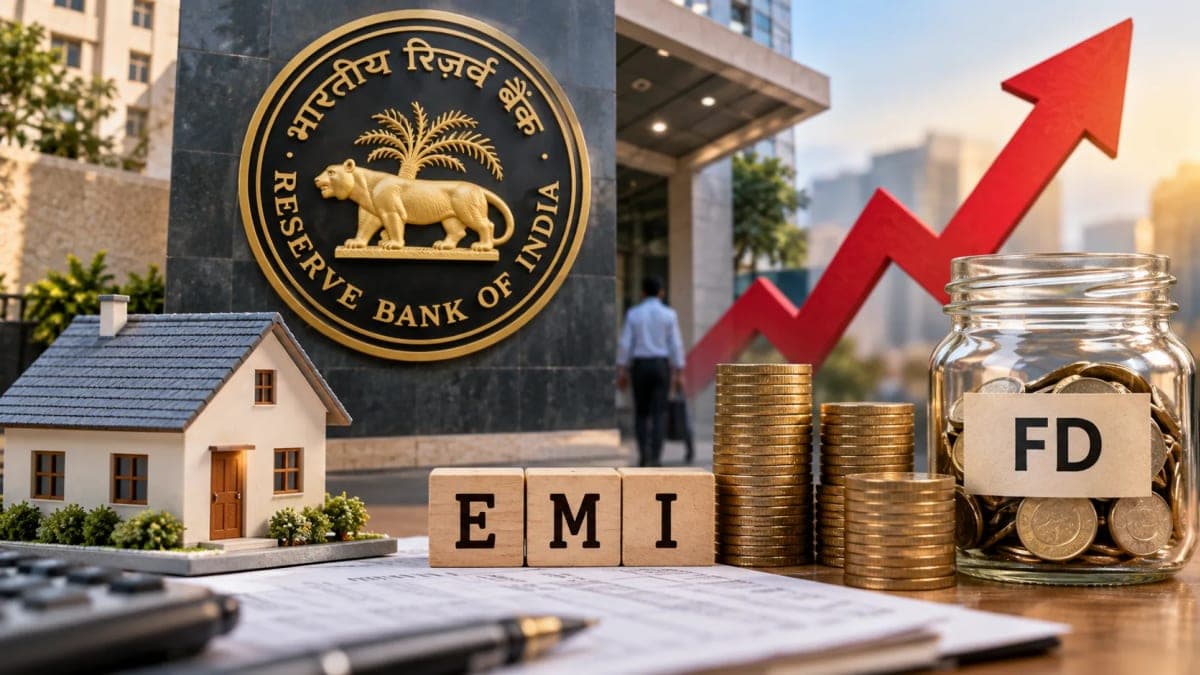
A rate increase could eventually make some floating-rate home loans more expensive. At the same time, savers could see better returns on new fixed deposits if banks respond by raising deposit rates.
What has changed is essentially a combination of inflation, oil prices, the rupee and domestic liquidity.
First, the confirmed position: RBI has not raised the repo rate
As of September 16, the RBI's policy repo rate remains 5.25%. The standing deposit facility rate is 5.00%, while the marginal standing facility rate and Bank Rate are 5.50%.
So headlines saying that an RBI rate hike has already occurred would be inaccurate.
What has changed is the market's expectation of what the central bank may do next.
Reuters reported on September 15 that rising inflation and expensive crude oil had prompted some economists to bring forward their expectations for RBI tightening. Citi and Deutsche Bank were among those whose expectations shifted towards an earlier increase.
That remains a forecast, not an RBI decision.
Why have rate-hike expectations suddenly returned?
Three developments are particularly important.
1. Inflation climbed to 4.82%
India's annual consumer inflation increased to 4.82% in August 2026, from 4.45% in July, according to the latest official inflation release reported by Reuters.
It was also slightly above the 4.80% median expectation in a Reuters economist poll.
The official Ministry of Statistics and Programme Implementation records confirm that the August 2026 CPI release was published on September 14.
More important for monetary policy is where inflation is coming from.
Reuters reported that price pressures were becoming broader rather than being restricted to one volatile category. Food inflation rose to around 5.95%, while measures of underlying inflation also strengthened.
A single month's CPI figure does not determine RBI policy. But sustained broad-based inflation would make it more difficult for the central bank to ignore price pressures.
2. Oil has become a much bigger risk
India imports most of the crude oil it consumes, making a sustained increase in international oil prices potentially important for domestic inflation, the trade balance and the rupee.
Brent crude was trading around $108 a barrel on September 15 amid global geopolitical and supply concerns.
If high oil prices persist, the effects can eventually spread through transportation, logistics, manufacturing and other parts of the economy.
That is one reason economists are watching the inflation trajectory rather than treating the August increase as an isolated number.
3. The rupee is under pressure
The Indian rupee has also weakened sharply.
On September 15, it closed around ₹95.955 per US dollar, its weakest level in more than a month, according to Reuters. The RBI was believed to have intervened in the foreign-exchange market to limit excessive volatility.
On September 16, the rupee continued trading close to ₹96 per dollar as high oil prices and rising US Treasury yields remained important pressures.
A weak currency does not automatically trigger an RBI rate increase. But persistent depreciation can complicate monetary policy because imported goods—particularly energy—can become more expensive in rupee terms.
The other problem: India has a huge liquidity surplus
The RBI is dealing with another unusual issue.
India's banking system accumulated a very large liquidity surplus after a special foreign-currency deposit programme attracted about $127 billion, according to Reuters.
RBI Governor Sanjay Malhotra subsequently said the central bank has several instruments available to manage excess liquidity, including bond sales and foreign-exchange swaps.
This distinction matters.
Liquidity tightening is not the same thing as a repo-rate hike.
The RBI can remove excess money from the banking system through liquidity-management operations without changing the 5.25% policy rate.
That means investors should not automatically interpret every RBI bond sale or liquidity operation as evidence that a repo-rate increase has already begun.
Could RBI raise rates in October?
It is possible, but it is not confirmed.
Reuters reported after the August inflation release that some economists now see a rate increase potentially arriving as early as October, while others expect tightening later, including in December.
The RBI itself has not pre-committed to such an increase.
That distinction should remain central to any interpretation of the current market discussion.
The decision is likely to depend on several moving variables: whether inflation continues rising, whether oil remains above $100, what happens to the rupee, how food prices evolve and whether underlying inflation becomes persistent.
There is also a counterargument to the increasingly hawkish market view.
India's Chief Economic Adviser V. Anantha Nageswaran said on September 15 that the recent increase in food inflation may not persist through year-end, pointing to expectations for crop production.
If food inflation moderates and oil prices retreat, pressure on the RBI to raise rates quickly could diminish.
That is why a rate hike should currently be treated as a risk scenario rather than a certainty.
What would a repo-rate hike mean for your home loan?
For households, this is where the story becomes practical.
A large share of newer floating-rate retail loans are linked to external benchmarks. When the relevant benchmark rises and a lender passes the increase through, the effective lending rate can rise as well.
But a repo increase does not necessarily mean every borrower's EMI changes immediately or by exactly the same amount.
The outcome depends on the lender, benchmark, spread, reset date, remaining tenure and whether the bank adjusts the EMI, loan tenure or both.
Consider a simplified example.
Suppose someone has a ₹50 lakh outstanding home loan, with 20 years remaining, and the interest rate is 8%.
The approximate EMI would be:
At 8.00%: ₹41,822 per month
If the loan rate increased by 25 basis points:
At 8.25%: ₹42,603 per month
That is an increase of roughly ₹781 per month.
If the effective rate rose another 25 basis points to 8.50%:
At 8.50%: ₹43,391 per month
Compared with 8%, that would be approximately ₹1,569 more each month.
These are illustrative calculations, not forecasts of actual bank lending rates.
The real effect can differ substantially depending on the loan structure.
The hidden cost may be tenure, not EMI
Borrowers should also watch something less visible.
Banks do not always respond to a floating-rate increase simply by raising the EMI. Depending on the loan terms and borrower choices, they may extend the remaining repayment tenure.
That can make the immediate monthly impact look smaller while increasing the amount of interest paid over the remaining life of the loan.
For someone with a long-duration mortgage, therefore, the most useful numbers to monitor after any rate reset are not merely the new EMI but also:
remaining principal, revised interest rate, remaining tenure and total projected interest.
What would higher RBI rates mean for fixed deposits?
For savers, the direction can be the opposite.
If policy and market interest rates rise, banks may eventually increase FD rates to attract deposits.
But the relationship is not mechanical.
A 25-basis-point RBI increase does not guarantee that every bank will increase every FD rate by 25 basis points.
Banks set deposit rates according to their own funding requirements, liquidity, maturity profile and competition for deposits.
RBI's published rate indicators recently showed term-deposit rates above one year broadly around 6.00%-6.75%, although individual bank rates and special-tenure products can differ.
If the monetary cycle genuinely shifts towards tightening, new FD rates could become more attractive.
Existing fixed-rate deposits, however, generally continue earning their contracted rate until maturity unless the depositor breaks and reinvests them, which can involve penalties or other costs.
Should FD investors wait?
Trying to perfectly predict the peak of an interest-rate cycle is difficult.
One approach investors sometimes use during an uncertain or potentially rising-rate environment is FD laddering—dividing money across deposits with different maturity dates instead of locking the entire amount into one long-term deposit.
For example, instead of putting an entire sum into a single three-year FD, a saver could divide it among shorter and longer maturities.
That allows portions of the portfolio to mature periodically and potentially be reinvested if rates rise.
Whether that approach is appropriate depends on liquidity needs, taxes, available rates and the investor's financial circumstances.
Borrowers and savers now face opposite risks
The current situation creates an interesting divide.
For borrowers, the risk is that inflation remains stubborn, oil stays expensive and the RBI eventually tightens policy, pushing floating borrowing costs higher.
For FD investors, the risk is almost the reverse: locking a large amount into a long-term deposit immediately and then seeing new deposit rates rise later.
But neither outcome is guaranteed.
If oil prices fall and food inflation eases, the pressure for aggressive monetary tightening could reduce substantially.
JantaScope Analysis: Watch the inflation trend, not the rate-hike headlines
The most useful way to interpret the current debate is not to ask simply whether RBI will raise rates at its next meeting.
The more important question is whether India's inflation regime is changing.
August CPI at 4.82% remains below the RBI's upper tolerance boundary, but the combination of higher food inflation, expensive crude oil, a weaker rupee and broader price pressures has altered the balance of risks.
At the same time, the central bank is already dealing with substantial excess banking-system liquidity.
That creates several possible policy paths.
RBI can drain liquidity without changing the repo rate. It could keep the repo rate unchanged while waiting for more inflation data. Or, if inflation and external pressures persist, it could eventually raise the policy rate.
For households, therefore, the sensible conclusion is not that higher EMIs or higher FD rates are inevitable.
It is that interest-rate risk has returned.
What home-loan borrowers should watch now
Borrowers with floating-rate loans should check exactly which benchmark their loan follows and when the next interest-rate reset takes place.
They should also check whether their lender responds to rate changes primarily through higher EMIs, longer tenure or a combination of the two.
Borrowers considering large prepayments may want to compare the guaranteed interest saving from reducing principal with the return they could earn elsewhere, while also considering liquidity and tax implications.
Most importantly, borrowers should not change financial plans merely because economists expect a rate increase. The actual RBI decision and the lender's subsequent transmission matter.
What FD investors should watch
FD investors should compare deposit rates across maturities rather than focusing only on the highest advertised rate.
The next RBI decision, inflation readings, banking-system liquidity and banks' demand for deposits could all affect future FD pricing.
Tax also matters: an advertised FD interest rate is not the same as the investor's post-tax return.
The bottom line
As of September 16, 2026, the RBI repo rate remains 5.25%.
What has changed is the economic environment around it.
August retail inflation has risen to 4.82%, oil prices have surged, the rupee has come under pressure and economists have started bringing forward expectations for monetary tightening.
That makes another RBI rate hike a meaningful possibility—but not a confirmed outcome.
For home-loan borrowers, a future increase could translate into higher EMIs, a longer repayment period or both.
For fixed-deposit investors, a sustained move towards higher rates could eventually improve new FD yields.
The next few inflation readings, oil prices and RBI communication will therefore matter much more than any single prediction about the next policy meeting.