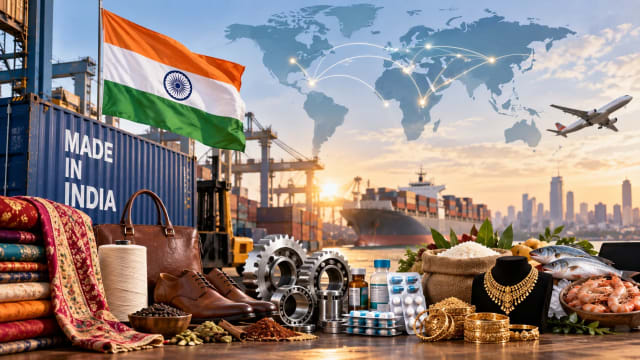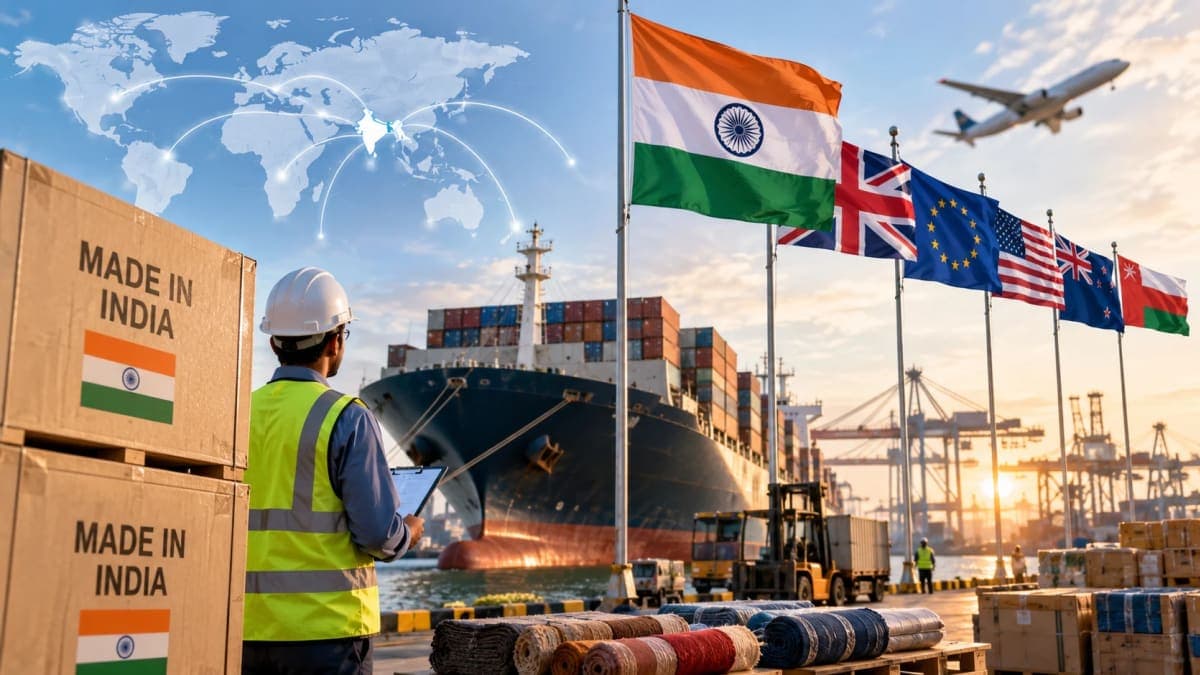
India is quietly redrawing its global trade map.
Over roughly a year, New Delhi has signed or concluded major trade agreements involving the United Kingdom, Oman, New Zealand and the European Union, while simultaneously pursuing a wider bilateral trade agreement with the United States.
For Indian businesses, the headline benefit is straightforward: many products that previously entered important overseas markets after paying import duties can now—or, once pending agreements enter into force, will—receive preferential or zero-duty access.
But the deals are not identical.
Some are already operational. Others are signed but awaiting full implementation. The EU agreement still has legal and approval stages ahead, while the U.S. arrangement is a framework for an interim agreement rather than a completed conventional FTA.
Understanding those differences is essential for exporters deciding where the real opportunities are today.
India's New Trade Map at a Glance
United Kingdom: CETA entered into force on July 15, 2026. India says almost 99% of its exports receive duty-free access, covering nearly 100% of trade value.
Oman: The India-Oman CEPA was signed on December 18, 2025 and entered into force on June 1, 2026. Oman offered zero-duty access across 98.08% of its tariff lines, covering 99.38% of India's export value to Oman.
New Zealand: The FTA was signed on April 27, 2026. New Zealand has committed to duty-free access across 100% of tariff lines for Indian exports once the agreement enters into effect. As of the Indian government's July status update, it remained under ratification. New Zealand's parliament approved implementing legislation on September 16, moving the agreement another step toward operation.
European Union: Negotiations concluded on January 27, 2026, but the FTA is not yet in force. The European Commission says the agreement still requires the necessary internal legal procedures before becoming binding.
United States: India and the U.S. announced a framework for an interim trade agreement in February 2026, while negotiations toward a broader Bilateral Trade Agreement continue. It should therefore not be described as a fully implemented India-U.S. FTA.
That distinction changes the story considerably.
India is not simply signing more FTAs. It is constructing a network of preferential access across several major developed markets while attempting to protect particularly sensitive domestic sectors.
UK: One of the Biggest Immediate Changes for Indian Exporters
The India-UK Comprehensive Economic and Trade Agreement is already operational.
It entered into force on July 15, 2026.
According to India's Commerce Ministry, the agreement provides zero-duty access for roughly 99% of Indian exports to the UK, representing nearly 100% of India's trade value with Britain.
That matters particularly for sectors where relatively small tariff differences can determine whether an Indian supplier is competitive.
The government identifies potential beneficiaries including:
textiles and apparel;
leather and footwear;
gems and jewellery;
engineering goods;
auto components;
chemicals;
pharmaceuticals;
processed foods; and
artisanal products.
The significance is greater than simply removing customs duty.
Indian exporters often compete against suppliers from countries that already enjoy preferential access to overseas markets. An FTA can remove that tariff disadvantage and put Indian products on a more comparable footing.
For labour-intensive industries such as garments, footwear and jewellery, even modest tariff differences can influence sourcing decisions by international buyers.
Oman: India's Gulf Trade Strategy Expands Beyond the UAE
India's trade agreement with Oman provides another important piece of the strategy.
The India-Oman Comprehensive Economic Partnership Agreement (CEPA) was signed on December 18, 2025 and became operational on June 1, 2026.
Oman offered zero-duty access on 98.08% of its tariff lines, representing approximately 99.38% of India's exports to Oman by value.
The Indian government identifies major beneficiaries including gems and jewellery, textiles, leather, footwear, sports goods, plastics, furniture, agricultural products, engineering products, pharmaceuticals, medical devices and automobiles.
India did not reciprocate by opening every domestic sector.
Instead, India offered tariff liberalisation on 77.79% of its tariff lines, covering 94.81% of imports from Oman by value.
Sensitive products were protected through exclusions or tariff-rate quotas. India's exclusion list includes categories such as dairy, tea, coffee, rubber and tobacco products, along with certain bullion, jewellery and labour-intensive products.
That illustrates an important feature of India's newer trade policy.
The objective is not simply maximum tariff elimination.
India is attempting to obtain wide overseas access for its exporters while maintaining protection around sectors considered particularly vulnerable domestically.
New Zealand: 100% Duty-Free Access for Indian Exports
The New Zealand agreement goes even further on India's export side.
India and New Zealand signed their FTA on April 27, 2026.
Once effective, New Zealand will provide zero-duty access across 100% of its tariff lines for Indian exports.
That includes opportunities in:
textiles and clothing, leather and footwear, engineering goods, pharmaceuticals, chemicals, agricultural and processed foods and other manufacturing categories.
Some Indian products previously faced New Zealand tariffs of up to 10%, including categories such as textiles, apparel, leather products, ceramics, carpets, automobiles and auto components.
India, however, has not provided equivalent across-the-board tariff elimination.
Its offer covers about 70% of tariff lines, representing roughly 95% of bilateral trade value, while nearly 30% of tariff lines are excluded.
Crucially, India protected sensitive areas including dairy and several agricultural categories.
That is particularly significant because New Zealand is a major agricultural exporter.
India's decision to retain protections around dairy demonstrates the negotiating balance underlying its new generation of FTAs: opening export opportunities without automatically exposing every politically or economically sensitive domestic industry to unrestricted competition.
EU: Potentially the Most Economically Significant Deal
The India-EU agreement could ultimately be considerably larger in economic significance than several of the individual bilateral agreements.
India and the European Union concluded FTA negotiations on January 27, 2026.
But there is an important caveat:
The agreement is not yet in force.
The European Commission states that the published agreement text remains subject to legal processes and becomes binding only after the parties complete the necessary internal procedures.
The scale of the relationship explains why the agreement matters.
The European Commission says EU-India goods trade reached approximately €118 billion in 2025, representing 11.1% of India's total trade.
India says the negotiated agreement gives preferential market access across 96.8% of EU tariff lines, covering 99.5% of Indian exports, with 90.7% of Indian exports by trade value scheduled to become duty-free from entry into force.
Labour-intensive Indian industries could be particularly important beneficiaries.
The government's FTA material highlights sectors including textiles, apparel, leather, footwear, marine products, gems and jewellery, engineering products, chemicals and processed foods.
For some businesses, therefore, the EU agreement could do more than increase exports.
It could change where manufacturers choose to build production capacity if European market access becomes sufficiently valuable.
Steel Shows Why “Zero Tariff” Doesn't Tell the Whole Story
One of the most useful examples of the complexity of modern FTAs is steel.
India has secured additional country-specific access to the EU steel market. Reuters reported this week that India will have access covering up to 1.64 million tonnes annually under the new arrangements, including an FTA-linked quota.
But Indian steel entering Europe can still face the EU's carbon-related requirements.
In other words, reducing a customs tariff does not necessarily mean an exporter faces no additional cost.
Modern international trade increasingly involves:
carbon rules;
product standards;
certification requirements;
rules of origin;
sanitary and phytosanitary requirements;
quotas;
digital regulations; and
customs documentation.
For Indian companies, understanding these non-tariff requirements may become almost as important as the headline tariff rate.
The U.S. Situation Is Different
The United States deserves separate treatment because describing the current arrangement as another completed Indian FTA would be misleading.
India and the U.S. announced a framework for an Interim Agreement in February 2026 and reaffirmed their intention to negotiate a broader Bilateral Trade Agreement.
Under the framework, the United States said it would apply an 18% reciprocal tariff rate to originating Indian goods in several categories and, subject to successful conclusion of the Interim Agreement, remove that reciprocal tariff for a wider group of products including certain generic pharmaceuticals, gems and diamonds and aircraft parts.
The framework also covers non-tariff barriers, rules of origin, standards, digital trade and economic-security cooperation.
But the broader BTA remains under negotiation.
So exporters should distinguish between measures already legally operational and commitments dependent on completing further negotiations.
EFTA: The Overlooked Agreement With an Investment Dimension
India's recent trade push actually began before several of these headline deals.
The Trade and Economic Partnership Agreement with the European Free Trade Association (EFTA)—Iceland, Liechtenstein, Norway and Switzerland—was signed in March 2024 and entered into force on October 1, 2025.
India secured tariff commitments covering 92.2% of EFTA tariff lines and 99.6% of Indian exports, according to Commerce Ministry material.
What makes this agreement unusual is that it connects trade liberalisation with investment commitments, giving it a different structure from a conventional tariff-focused FTA.
Together with the UAE and Australia agreements already operating from earlier years, EFTA provides the foundation beneath India's newer UK, Oman, New Zealand and EU push.
Why India Is Signing So Many Trade Agreements Now
The broader strategy appears to have several dimensions.
1. Diversifying Export Markets
Heavy dependence on a small number of destinations exposes exporters to geopolitical shocks, tariffs and demand changes.
Preferential access across the UK, Europe, the Gulf and Oceania spreads that risk.
2. Helping Labour-Intensive Manufacturing
Textiles, footwear, leather, gems and jewellery, food processing and similar sectors appear repeatedly in India's official descriptions of FTA beneficiaries.
These industries are significant because export growth can translate into employment as well as foreign-exchange earnings.
3. Integrating India Into Global Supply Chains
An FTA can influence investment as well as exports.
A manufacturer deciding where to locate a factory considers not only domestic costs but also which foreign markets can be served competitively from that location.
If India has preferential access to more large economies, manufacturing in India can become more attractive for companies targeting multiple export destinations.
4. Responding to a More Fragmented Global Trading System
The global trading environment has become increasingly shaped by bilateral tariffs, strategic supply chains, industrial policy and geopolitical competition.
India's response appears to be increasingly pragmatic: negotiate market access country by country while continuing to protect particularly sensitive domestic sectors.
What This Means for Indian Exporters
The immediate opportunity is not evenly distributed.
Businesses selling textiles, garments, footwear, leather goods, engineering products, pharmaceuticals, chemicals, jewellery, processed foods and agricultural products appear repeatedly among the potential beneficiaries of the new agreements.
But a tariff reduction does not automatically create an export order.
Companies still need to meet:
rules-of-origin requirements;
quality standards;
packaging regulations;
certification requirements;
customs procedures;
environmental standards; and
delivery and pricing expectations.
That means smaller exporters may need considerably more compliance support before they can fully exploit the agreements.
This could become one of the biggest differences between the theoretical benefits and the real economic benefits of India's FTA strategy.
What Could Become Cheaper for Indian Consumers?
Trade agreements work in both directions.
India is also lowering or eliminating tariffs on selected imports from partner countries.
That can eventually reduce the landed cost of some imported products and industrial inputs, although lower customs duties do not guarantee an equivalent reduction in retail prices.
Transport costs, currency movements, distributor margins, taxes and demand also affect the final price consumers pay.
More importantly, cheaper imported machinery, technology or intermediate goods can potentially reduce production costs for Indian businesses.
That means some of the biggest FTA benefits may appear indirectly inside Indian factories rather than immediately on supermarket shelves.
The Risks India Still Has to Manage
FTAs inevitably create winners and competitive pressure.
Industries that gain overseas access may benefit, while domestic producers exposed to cheaper imports can face stronger competition.
Agriculture remains particularly sensitive.
That explains why India has retained exclusions and safeguards around sectors such as dairy in agreements including New Zealand.
Rules of origin are another critical issue.
Without effective origin rules, products from third countries could theoretically be routed through an FTA partner to obtain preferential treatment.
Modern agreements therefore require exporters to demonstrate that goods genuinely meet agreed origin criteria.
Analysis: India's Trade Strategy Has Changed
For years, India's trade policy was often characterised by caution toward broad tariff liberalisation.
The recent sequence of agreements points toward a more selective model.
Instead of opening the economy uniformly, India is negotiating individual partnerships where it sees export opportunities while retaining exclusions for vulnerable domestic sectors.
The result is a kind of hub-and-spoke trade strategy.
India sits at the centre while preferential corridors extend toward the Gulf, Europe, Britain, Australia, New Zealand and EFTA economies, with negotiations continuing elsewhere.
If implemented effectively, this could strengthen India's position as both a production base and an export platform.
But the real test will not be how many agreements India signs.
It will be whether Indian businesses actually use them.
The Metric That Matters Now: FTA Utilisation
Tariff concessions have economic value only when exporters claim them.
That requires companies to understand product classifications, origin documentation, certificates, customs procedures and partner-country standards.
For large corporations with dedicated trade teams, that is manageable.
For smaller manufacturers and MSMEs, it can be a significant barrier.
India's next challenge therefore moves from negotiating FTAs to operationalising them.
Export growth, utilisation rates, investment flows and changes in sector-level market share will provide better evidence of success than the number of agreements signed.
Bottom Line
India is undergoing one of the most significant expansions of its preferential trade network in years.
The UK and Oman agreements are already operational. The New Zealand agreement has been signed and is advancing through ratification. EU negotiations have concluded but implementation still requires further legal steps, while the United States relationship remains at the interim-framework and broader BTA-negotiation stage.
For Indian exporters, the biggest opportunity is increasingly clear: products ranging from textiles and footwear to engineering goods, pharmaceuticals, chemicals and processed foods are gaining preferential access to markets that collectively represent hundreds of millions of consumers.
But zero-duty access is only the starting line.
The companies that benefit most will be those able to meet rules of origin, product standards and other regulatory requirements while building reliable distribution networks overseas.
India has spent the past few years negotiating access.
The next phase is turning that access into exports.