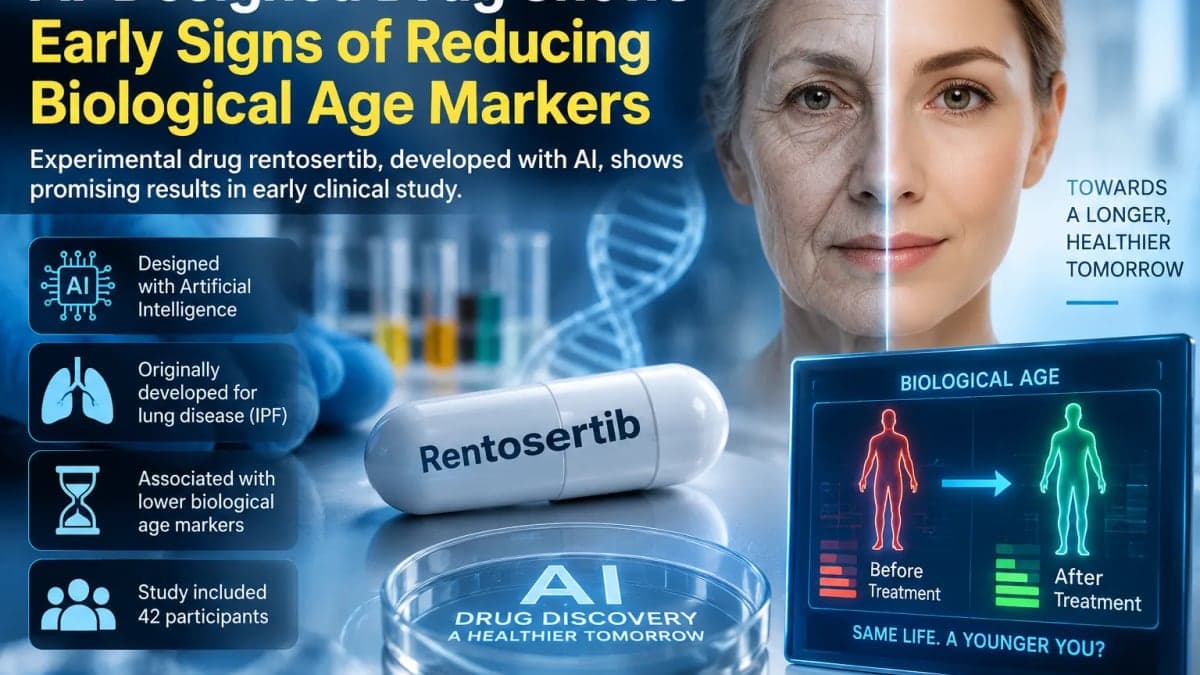
Artificial intelligence is already changing how scientists identify drug targets and design new molecules. Now, an experimental treatment created with AI has produced an unexpected signal that could broaden the technology's role in longevity research.
Rentosertib, developed by Insilico Medicine as a potential treatment for idiopathic pulmonary fibrosis (IPF), was associated with reductions in predicted biological age across six different proteomic aging clocks in an analysis published September 7 in Nature Biotechnology. The findings came from blood-protein measurements collected during a Phase 2a clinical trial.
The results are preliminary. They do not establish that rentosertib makes people biologically younger, slows aging in healthy adults or extends lifespan. Instead, they provide evidence that treatment was associated with measurable changes in proteins used by computational models to estimate biological age.
What Researchers Found
The analysis involved 42 participants at baseline, all enrolled in a clinical study involving IPF, a progressive disease in which lung tissue becomes scarred.
Researchers examined blood-protein profiles using six independently developed proteomic aging clocks. Despite differences in how the models were built and what they were trained to predict, all six detected shifts associated with rentosertib treatment toward lower predicted biological age.
Across the treatment regimens, the researchers conducted comparisons at weeks two, four and 12. Of 54 comparisons, 21 reached the study's statistical-significance threshold, with the strongest concentration of signals appearing at week four. Eleven of 18 comparisons at that point showed significantly lower changes in predicted biological age among treated participants.
The 30 mg twice-daily regimen produced the most consistent result across the different clocks, accounting for nine significant comparisons. The 60 mg once-daily regimen produced seven, while the 30 mg once-daily regimen produced five.
Some Aging Clocks Estimated a Multi-Year Shift
For participants receiving 60 mg once daily, all four clocks trained to estimate chronological age recorded significant reductions at week four, ranging from approximately 2.71 to 3.46 years compared with placebo.
The 30 mg twice-daily regimen, however, produced the broadest agreement because both chronological-age and mortality-trained clocks detected changes.
Researchers also examined organ-specific models. A mortality-based artery aging clock showed reductions relative to placebo ranging from 6.95 to 16.57 years across treatment groups and time points, while some brain, pancreas, stomach and immune-system clocks also recorded significant changes.
These figures should not be interpreted literally as patients becoming that many years younger. Aging clocks are statistical models based on biological measurements, and changes in their predictions are not equivalent to demonstrating additional years of life or reversal of the aging process.
What Exactly Is a Biological Aging Clock?
Chronological age simply measures how much time has passed since birth. Biological-age models attempt to estimate the condition or aging trajectory of the body using measurable biological features.
In this study, researchers used proteomic aging clocks, which analyze patterns among proteins circulating in the blood. Different clocks can be trained for different outcomes, including chronological age or mortality risk.
That distinction matters because the models do not necessarily measure the same biological processes. In the study, chronological clocks correlated relatively closely with one another, while correlations between chronological and mortality-based clocks were considerably weaker.
The fact that several independently developed models moved in a similar direction is therefore scientifically interesting, but it remains an indirect measure rather than proof of slower human aging.
Rentosertib Was Developed for Lung Disease, Not as an Approved Anti-Aging Drug
Rentosertib was created primarily as a treatment candidate for idiopathic pulmonary fibrosis, not as a consumer longevity treatment.
Insilico used AI systems during the drug-discovery process, first applying computational methods to identify potential therapeutic targets and then using generative AI techniques to help design molecules capable of interacting with those targets.
Earlier clinical work indicated that rentosertib could improve lung-function measurements in patients with IPF. The biological-aging analysis used samples collected as part of that clinical program rather than a dedicated trial in healthy people.
That creates an important scientific question: are the younger-looking protein profiles evidence of a broader effect on aging, or are they partly a consequence of treating serious lung disease?
The current study cannot fully resolve that issue.
Effect Appeared Strongest Around Week Four
Another reason for caution is the study's relatively short duration.
The biological-age signal was strongest around week four. By week 12, fewer comparisons remained statistically significant. The researchers described the later pattern as more consistent with a plateau than a clear reversal of the earlier response.
Longer studies would therefore be needed to determine whether the observed changes persist, increase, disappear after treatment or translate into meaningful improvements in health.
Small Trial Means Bigger Studies Are Needed
The study provides an early proof of concept rather than definitive evidence of an anti-aging therapy.
The sample was small, participants had IPF rather than being healthy volunteers, and biological aging was assessed through computational biomarkers rather than outcomes such as reduced disease incidence, disability or mortality.
Eric Topol, a cardiologist and author who was not involved in the work, described the drug as encouraging but cautioned that a definitive trial is still needed before firm conclusions can be drawn.
The Nature Biotechnology paper itself characterizes the results as exploratory and says additional investigation is required to understand what is driving the observed protein changes.
Why the Study Matters for AI Drug Discovery
The significance of the research extends beyond aging.
AI drug-discovery companies argue that machine-learning systems can help identify promising biological targets and generate potential drug molecules faster than conventional discovery pipelines. Rentosertib provides a notable real-world test of that approach because an AI-assisted molecule has advanced into human clinical development.
The new study adds another possibility: future clinical trials could incorporate biological-aging measurements alongside disease-specific outcomes.
If larger and longer studies validate these findings, researchers may gain a new way to evaluate whether experimental treatments influence biological processes associated with aging while simultaneously testing their effects on specific diseases.
For now, however, rentosertib should be viewed as an experimental IPF drug with an intriguing biological-aging signal—not as a proven age-reversal treatment.