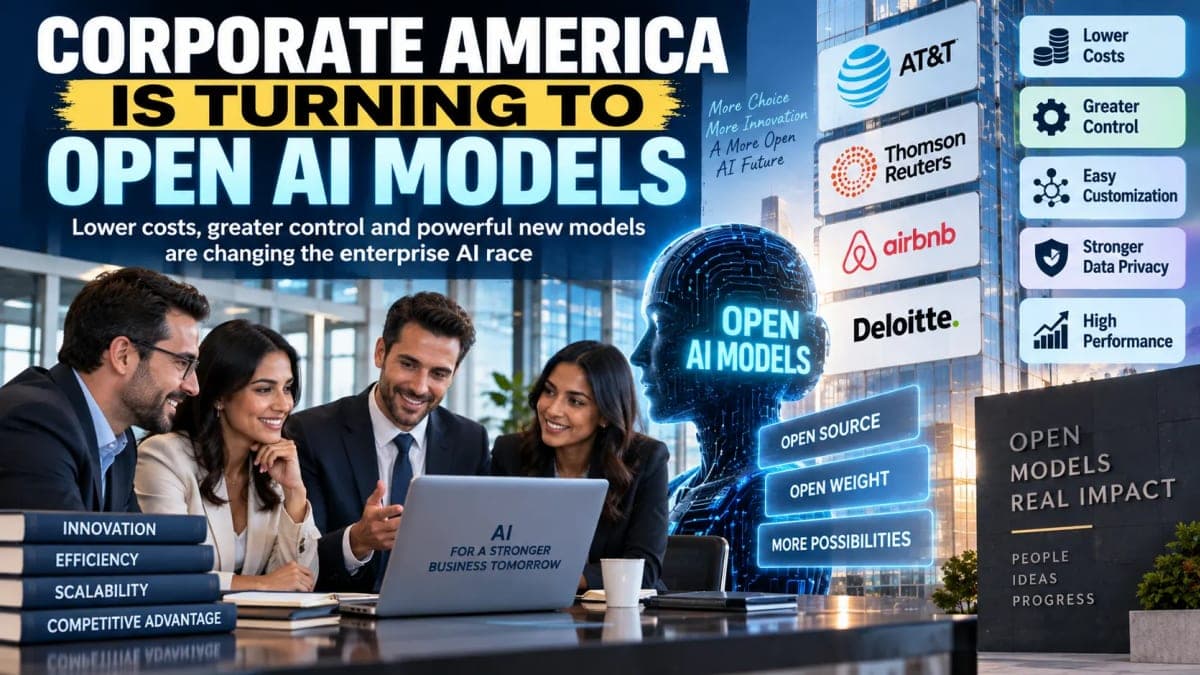
Corporate America's artificial-intelligence strategy is beginning to change.
For much of the generative AI boom, businesses looking for powerful models largely turned to proprietary systems supplied by companies such as OpenAI and Anthropic. Those platforms remain deeply embedded in enterprise AI spending, but an alternative is becoming increasingly difficult for corporate technology leaders to ignore.
Open-source and, more precisely in many cases, open-weight AI models are becoming capable enough — and cheap enough — for companies to move a growing share of their workloads away from expensive frontier systems.
AT&T is one of the clearest examples. Open models now account for roughly 40% of the company's AI usage, and the telecommunications giant expects that proportion could eventually rise to 60%. The company estimates that switching appropriate workloads to open models can generate cost savings of as much as 80%.
The shift does not mean proprietary AI is disappearing. Instead, businesses are becoming more selective about when they actually need the most powerful — and often most expensive — model available.
Why Corporate America Is Looking Beyond Closed AI
The economics are becoming increasingly difficult to ignore.
Companies pay providers of proprietary AI systems according to usage, typically based on the number of tokens processed by a model. For businesses operating AI across thousands of employees, customers or automated agents, those costs can accumulate rapidly.
Open-weight models change the calculation.
Rather than paying a premium every time a proprietary model processes a request, companies can download or access models whose weights are available and deploy them on infrastructure they control or through specialized model-serving providers.
That gives enterprises greater freedom to optimize inference costs, customize the model and determine where their data is processed.
AT&T's experience illustrates the potential savings.
The company has moved suitable workloads away from expensive closed models and estimates open alternatives can reduce costs by as much as 80%. Other major organizations, including Airbnb and Deloitte, are also adopting open models for portions of their AI workloads.
Open Models Are No Longer Just the Cheap Alternative
Cost alone would not be enough to drive widespread corporate adoption if open models could not perform the work businesses require.
That performance gap, however, has narrowed considerably.
Open models that once trailed the most sophisticated proprietary systems are increasingly capable of handling coding, document analysis, customer-service functions and specialized enterprise applications.
Data published in the July 2026 State of Open Source AI report illustrates how close the competition has become.
The strongest closed model scored 61 on the Artificial Analysis Intelligence Index, compared with 57 for the highest-performing open model. The leading open model ranked fourth overall, ahead of several closed systems.
For a chief information officer, the relevant question is therefore changing.
Instead of simply asking which AI model is the smartest, companies can ask which model is good enough for a particular task at the lowest acceptable cost.
That distinction becomes enormously important when AI is deployed at corporate scale.
AT&T Shows How the Economics Can Work
AT&T's strategy offers a useful example of what enterprise AI may increasingly look like.
Rather than relying exclusively on frontier proprietary models, the company is directing suitable tasks toward open alternatives.
Open models currently represent about 40% of its AI usage, according to recent reporting. The company expects that figure could reach 60%.
The approach does not require abandoning closed models altogether.
More demanding workloads can still be routed to premium proprietary systems when their additional reasoning capability justifies the expense. Routine or highly specialized work can instead be handled by cheaper models.
That creates a multi-model architecture in which companies select different AI systems for different jobs.
Such an approach could become increasingly common as businesses move from small generative-AI experiments to applications processing enormous volumes of requests every day.
Thomson Reuters Builds Its Own Specialized Model
Thomson Reuters provides another example of how open models are moving deeper into established companies.
The information-services group has developed an internal model called Thomson-1, based on Snowdon, a system the company created by adapting Alibaba's open Qwen technology.
The model is being used for document-review tasks that previously ran on Anthropic's Claude.
Thomson Reuters Chief Technology Officer Joel Hron argued that enterprises do not necessarily need increasingly large and expensive models for every problem. A capable open foundation can instead be specialized for a particular domain, potentially producing strong results at a lower cost.
That approach points toward an important evolution in corporate AI.
The competitive advantage may increasingly come not from having access to the same frontier model as everyone else, but from adapting a capable model to a company's proprietary data, workflows and expertise.
Legal AI Is Moving in the Same Direction
Legal technology company Harvey has also demonstrated the potential of the approach.
Harvey developed its Tenet model by post-training Moonshot AI's open-weight Kimi K3. According to the company, the resulting system outperformed its underlying base model as well as several proprietary frontier systems on complex legal agent tasks.
The claims are based on Harvey's own evaluation and should therefore be understood as company-reported benchmark results rather than independent proof of universal superiority.
Still, the decision is significant.
Harvey has historically built products around proprietary models supplied by major U.S. AI companies. Its willingness to build a specialized system on a Chinese open-weight foundation demonstrates how rapidly enterprise model selection is becoming more competitive.
Chinese AI Labs Are Becoming Part of the Equation
Perhaps the most strategically important aspect of the shift is where many of the strongest open models are coming from.
Chinese AI developers including Moonshot AI, DeepSeek, Alibaba and Z.ai have become major participants in the open-model ecosystem.
Hugging Face data cited by Fortune indicated that in almost every month of 2026, the largest and most capable open model came from a Chinese laboratory.
Aggressive pricing adds another layer of competition.
Z.ai, for example, said its GLM-5.3-Flash model would cost $0.15 per million input tokens and $0.50 per million output tokens.
The combination of improving performance and low prices puts additional pressure on American AI providers.
But using Chinese-developed models also creates questions for U.S. corporations involving cybersecurity, data governance, supply-chain exposure, licensing and geopolitical risk.
An open-weight model can reduce some concerns because organizations can operate it within infrastructure they control. That does not eliminate the need for rigorous security reviews of the model, code, dependencies and licensing terms.
Enterprise Spending Shows a Shift — But Not a Revolution Yet
The numbers require some perspective.
Ramp's AI Index found that the share of businesses paying model-serving platforms — which provide access to open and Chinese-developed models — increased from 4.5% in January 2026 to 6.1% in July.
That is meaningful growth, but proprietary providers remain powerful.
Anthropic gained 1.1 percentage points in July to reach 43.5% of businesses represented in Ramp's spending data. OpenAI stood at 39.7%, after increasing 0.23 percentage points.
In other words, open-model adoption is growing without yet producing a corresponding collapse in demand for the major proprietary AI providers.
The most likely explanation is that enterprise AI itself is expanding.
Companies are adding open models while continuing to purchase proprietary services for workloads where frontier performance, managed infrastructure or established enterprise support remains valuable.
The Most Expensive Model Is Not Always the Best Business Decision
Another piece of enterprise spending data helps explain the change.
According to Ramp's analysis cited by Fortune, Anthropic's premium Fable 5 accounted for only 6% of tokens purchased from Anthropic and 11.4% of dollars spent on its models, despite being positioned as an exceptionally capable system.
OpenAI's GPT-5.6 Sol, by comparison, accounted for 25% of OpenAI tokens and 23% of spending in the dataset.
Ramp lead economist Ara Kharazian interpreted the figures as evidence that enterprises may have reached a limit on what they are willing to pay simply to access the highest-performing model.
For corporate buyers, marginal improvements in benchmark performance have to produce enough economic value to justify their additional cost.
If a cheaper model can complete a task reliably, paying substantially more for a frontier model may make little financial sense.
Nvidia's Hugging Face Deal Shows How Valuable Open AI Has Become
The strategic importance of open AI became even clearer with Nvidia's agreement to acquire Hugging Face.
Nvidia announced a roughly $13 billion acquisition of the AI platform, while committing to keep Hugging Face open and supportive of multiple clouds and accelerator technologies.
Hugging Face has grown into critical infrastructure for the open-AI ecosystem, with more than 18 million developers and 200,000 companies using the platform to access and share models, datasets and applications.
For Nvidia, an expanding open-model ecosystem can also strengthen demand for the computing infrastructure needed to train and run those models.
The acquisition therefore reflects something larger than the value of a single AI platform: open models are becoming a strategically important layer of the global AI industry.
Open AI Still Has Important Drawbacks
The shift is not entirely one-directional.
Operating an open model transfers responsibilities that a proprietary AI provider would otherwise handle.
Companies may need infrastructure for deployment, monitoring, security, scaling and model updates. They also need engineers capable of fine-tuning and maintaining systems.
That operational burden is visible in developer data.
A Mozilla/SlashData survey cited by the State of Open Source AI found 79% of developers adding AI functionality used open models, compared with 71% using closed models. Half used both.
But only 53% of teams using open models reached production, compared with 63% for closed-model teams. Integration, maintenance, performance and deployment remained important obstacles.
So a model that is free to download is not necessarily free to operate.
Infrastructure, GPUs, engineering staff, security and maintenance all contribute to total cost.
The Future Is More Likely Hybrid Than Fully Open
Corporate America's changing AI strategy should therefore not be interpreted as a simple contest in which open models replace OpenAI, Anthropic or other proprietary providers.
The emerging architecture looks more complicated — and potentially more competitive.
Companies can reserve premium frontier models for difficult reasoning and high-value tasks while using cheaper open models for high-volume or highly specialized workloads.
They can also fine-tune open models on proprietary datasets, deploy sensitive workloads inside controlled infrastructure and switch between providers as economics and capabilities change.
Earlier CB Insights research found 94% of organizations interviewed were already using two or more large-language-model providers, demonstrating how strongly enterprises have resisted committing their entire AI strategy to a single supplier.
Open models strengthen that negotiating position further.
The biggest change, therefore, may not be which AI company wins Corporate America.
It may be that corporations increasingly refuse to choose just one.
As open models become cheaper, stronger and easier to customize, the model itself risks becoming less of a scarce product. For AI companies, competitive advantage could consequently migrate toward infrastructure, enterprise support, security, specialized data and the software systems built around the underlying intelligence.
For corporate buyers, that competition creates something they have wanted since the beginning of the generative-AI boom: more choices over what they run, where they run it and how much they pay.