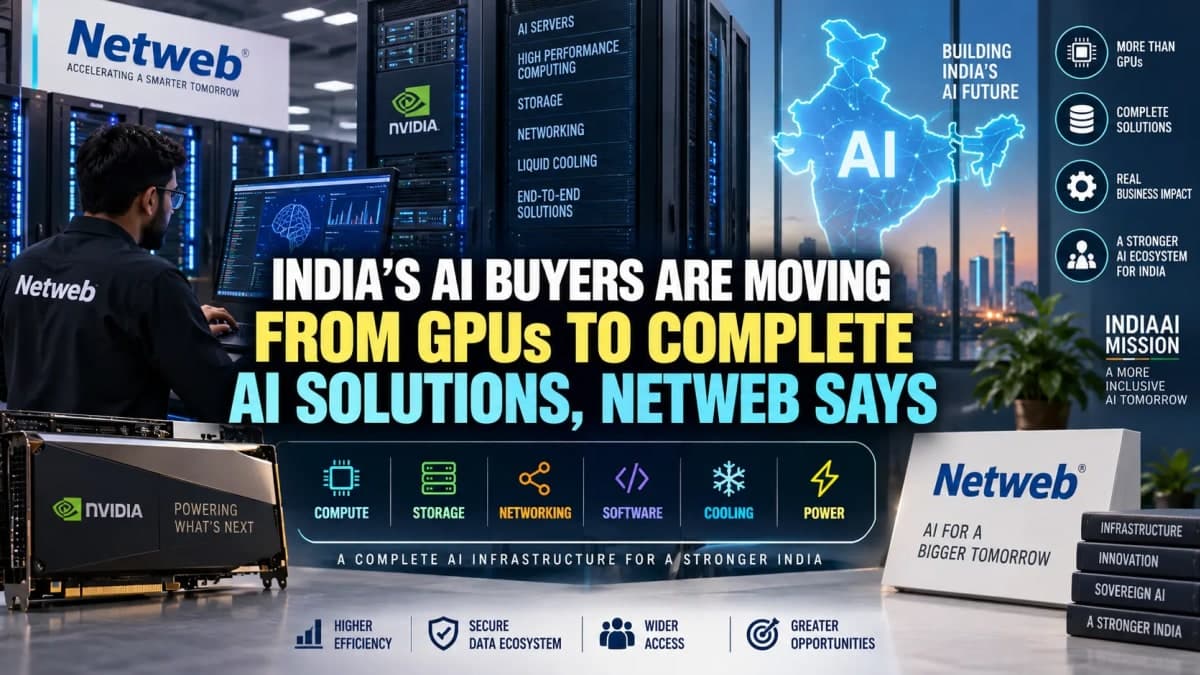
Indian AI customers are asking a different question
The first phase of the artificial intelligence infrastructure boom was dominated by one question: how many GPUs could an organisation secure?
Netweb Technologies says that conversation is beginning to change in India.
Customers are increasingly approaching AI investments as complete projects rather than purchases of individual pieces of computing infrastructure, according to Swastik Chakraborty, Vice-President of Technology at Netweb Technologies.
That means businesses are looking beyond the accelerator itself. They want computing capacity, storage, networking, software and the surrounding data-centre infrastructure to work together and, ultimately, deliver a defined business outcome.
For companies supplying AI infrastructure, the distinction is significant. A powerful GPU cluster has limited value if an organisation cannot efficiently feed it data, manage workloads, cool the equipment or turn the resulting computing capacity into usable applications.
From buying infrastructure to buying outcomes
Chakraborty said the demand for end-to-end AI solutions is growing as customers focus more closely on what they expect their investment to accomplish.
The trend does not mean demand for GPUs is disappearing. Accelerators remain at the centre of training and running many advanced AI models. Instead, Netweb's argument is that buyers increasingly see GPUs as one component of a much larger system.
That shift changes what an AI infrastructure provider is expected to deliver.
Netweb's own approach spans compute, high-performance storage, interconnects, the AI cloud stack and middleware. The company has previously told investors that it does not view itself as simply supplying GPUs, arguing that accelerators cannot operate effectively in isolation.
Its strategy therefore increasingly resembles systems integration around high-performance computing rather than conventional hardware sales.
AI is becoming a bigger part of Netweb's business
The change in customer behaviour comes as AI has become increasingly important to Netweb itself.
During the company's July 2026 earnings call, Managing Director Sanjay Lodha said AI contributed 62% of revenue. He also said Netweb was focusing on large GPU deals but did not intend to pursue what he described as simple "box selling."
Instead, the company is positioning itself around complete hardware and software solutions.
That strategy is consistent with Netweb's broader portfolio. The Faridabad-based company operates across high-performance computing, private cloud and hyper-converged infrastructure, AI systems, enterprise workstations, high-performance storage and data-centre servers.
Its AI services also extend from initial planning and proof-of-concept work through model improvement and production deployment.
India's AI Mission is adding to infrastructure demand
Public investment is another source of demand.
Netweb says it has seen stronger order momentum from companies participating in the roughly ₹10,372 crore IndiaAI Mission, adding to demand for domestic high-performance computing and sovereign AI infrastructure.
The IndiaAI Mission is intended to expand the country's computing capacity while supporting AI development across startups, researchers and other parts of the ecosystem.
For domestic infrastructure suppliers, that creates an opportunity that extends beyond selling processors.
A large AI deployment needs servers, networking and high-speed storage, but it also needs software capable of orchestrating those resources. At larger scales, electricity supply and cooling become fundamental design constraints.
As those installations become denser, the boundaries between IT infrastructure and the physical design of the data centre begin to narrow.
Cooling and electricity are becoming part of the AI equation
The rise of powerful AI accelerators is forcing data-centre operators to reconsider how facilities are designed.
Chakraborty argued that India needs to address power and energy requirements alongside the expansion of computing capacity.
“In AI, every day that is lost is taking a couple of steps behind the world in the development race. If we have to be at the forefront, we need to be focusing on handling power and energy requirements and taking a different approach for data centre architecture,” he said.
That challenge becomes more pressing as operators deploy increasingly dense computing systems.
Netweb has already moved toward liquid-cooled infrastructure. Earlier this year, it announced Make-in-India Tyrone systems built around Nvidia's Grace Blackwell architecture.
Its Tyrone Camarero GB200 configuration is designed to combine 20 systems within a single liquid-cooled rack, incorporating 40 Nvidia Grace CPUs and 80 Blackwell GPUs alongside networking, storage and security infrastructure.
Such configurations illustrate why AI infrastructure can no longer be treated purely as a procurement decision about processors. Power distribution, heat removal and rack architecture can determine how much computing capacity can actually be deployed.
Netweb sees an opportunity in sovereign AI
There is another dimension to India's infrastructure buildout: control over where AI workloads and data reside.
Netweb has been positioning its locally designed and manufactured systems around the idea of sovereign computing, where organisations retain greater control over infrastructure, data and the software environment used for AI.
The company has worked with Nvidia for about 15 years and is an OEM partner of the US chipmaker.
In February, Netweb expanded its locally manufactured AI portfolio with systems based on Nvidia's Grace Blackwell platform. The company said its GB200-based architecture could support AI training and real-time large language model inference for models scaling to as many as 10 trillion parameters.
Those are company claims about the capabilities of its systems, rather than evidence that Indian customers are currently deploying models at that scale.
Still, the product direction shows where infrastructure suppliers expect demand to move: larger systems that combine accelerators with networking, storage, cooling and software rather than treating each layer separately.
India needs to produce AI services, not just consume them
Chakraborty also argues that building computing infrastructure should not become the endpoint of India's AI strategy.
India, he said, needs to become a producer of AI services rather than primarily a consumer of them.
That requires investment further up the technology stack.
Expanding GPU capacity can make training and inference more accessible, but computing resources alone do not create commercially useful AI products. Developers need models, tools, applications, accessible datasets and systems for deploying them at scale.
Netweb has suggested federated data centres as one possible approach to data-access constraints. Such an architecture could allow access to be governed according to the requirements of developers or users without requiring every dataset to be concentrated in the same location.
The next phase of India's AI buildout may be more complicated
The race for GPUs helped define the early infrastructure phase of the generative AI boom. The next stage is likely to involve harder questions.
Companies need to decide what they want their AI systems to accomplish, how much computing capacity those applications actually require and whether the economics justify deploying that infrastructure themselves.
They also have to contend with power availability, cooling, data access and the technical challenge of connecting hardware with production software.
Netweb stands to benefit if customers increasingly choose integrated systems because that is precisely the part of the market the company is targeting. Its assessment of the shift should therefore be viewed in that commercial context.
But the underlying engineering problem is broader than any one supplier.
A GPU may provide the computational engine for modern AI. Turning that processing power into a reliable service requires considerably more around it.
If Indian AI spending continues moving in that direction, the country's infrastructure competition will increasingly be decided not simply by who can supply accelerators, but by who can make the entire stack work.