India’s semiconductor ambitions are entering an important new phase. In the early years, domestic chip startups largely focused on design, prototypes and raising initial capital. Now, some companies are seeking significantly larger funding rounds as they attempt to move beyond research and development toward commercial products and large-scale businesses.
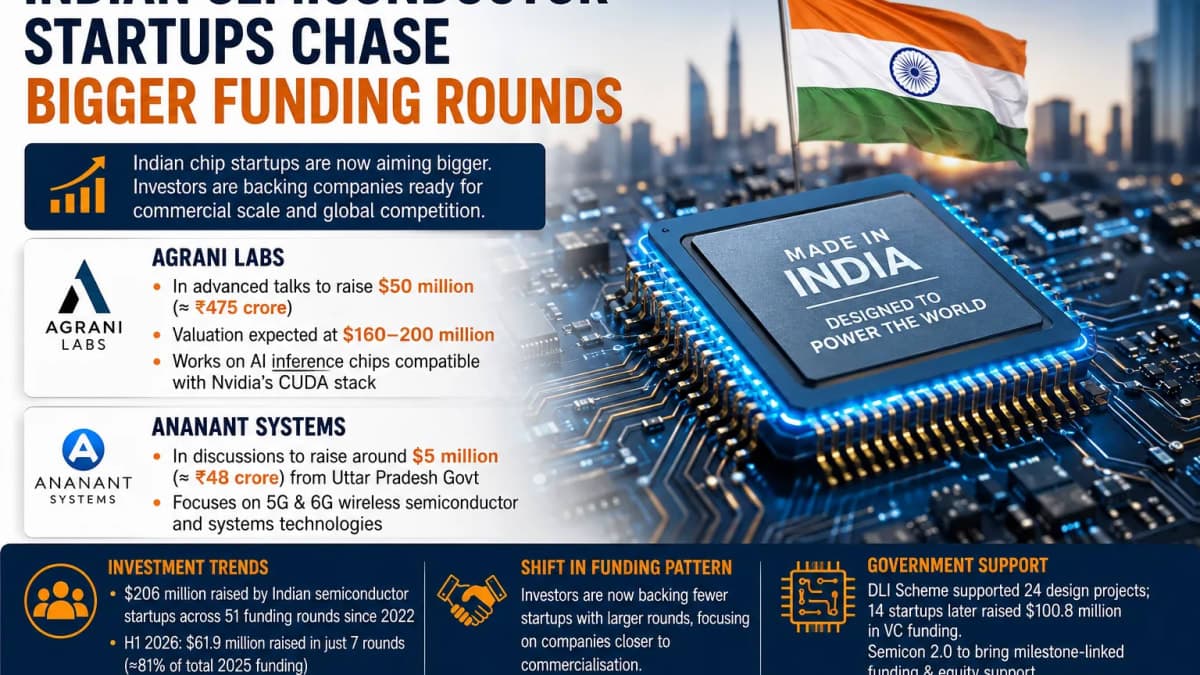
One of the most prominent examples is Bengaluru-based Agrani Labs, which is reportedly in advanced discussions to raise approximately $50 million (around ₹475 crore) in fresh funding.
According to people familiar with the matter, existing investor Peak XV Partners could invest around $15 million in the proposed round, while the remaining capital may come from new investors, potentially including 360 One.
Importantly, these figures relate to ongoing funding discussions and should not be treated as a completed transaction.
Agrani Labs Could Be Valued at $160–200 Million
According to reports, the ongoing discussions could value Agrani Labs at approximately $160 million to $200 million.
That would represent a significant jump from its previous funding level. In June 2025, Agrani Labs raised $8 million in seed funding from Peak XV Partners, when the company was reportedly valued at around $35 million.
Agrani Labs was founded in 2024 by Dheemanth Nagaraj, Ashok Jagannathan, Srikanth Nimmagadda and Rajesh Vivekanandham. Its founders have experience working at global semiconductor companies including Intel and AMD.
The potential new capital is expected to be primarily used for research and development, engineering and business expansion.
Agrani Labs Bets on AI Inference Chips
Agrani Labs’ ambitions extend beyond the Indian market. The company is working on AI inference chips that it aims to make compatible with Nvidia’s CUDA software stack.
If the company successfully brings its products to commercial scale, it could eventually compete with US-based AI semiconductor companies such as SambaNova Systems and Groq.
As artificial intelligence drives rapidly increasing computing requirements, inference processors, data-centre chips and more energy-efficient semiconductor architectures are becoming strategically important areas for investors and technology companies.
Ananant Systems Also Seeks Around $5 Million
Agrani Labs is not the only Indian semiconductor startup looking for fresh capital.
Ananant Systems is reportedly in discussions with the Uttar Pradesh government to raise around $5 million, or approximately ₹48 crore, in new funding.
The company is also planning to explore additional capital through the Research, Development and Innovation (RDI) Fund.
However, reports said that Ananant Systems, the Uttar Pradesh government and the RDI Fund had not responded to related queries. The potential investment should therefore be regarded as a funding plan under discussion rather than a confirmed transaction.
Founded in 2024 by Chitranjan (Chitu) Singh, a former Director of Engineering at Qualcomm, Ananant Systems is working on advanced 5G and 6G wireless semiconductor and systems technologies.
Investors Are Putting More Money Into Fewer Startups
One of the most significant developments in India’s semiconductor startup ecosystem is not simply the growth in overall investment but a shift in the funding pattern.
According to a report by Speciale Invest, Indian semiconductor startups have raised approximately $206 million across 51 funding rounds since 2022.
During the first half of 2026 alone, these companies raised approximately $61.9 million, equivalent to about 81% of the $76.6 million raised during the whole of 2025.
Interestingly, the number of funding rounds has declined rather than increased:
16 funding rounds were recorded in 2024
The number declined to 13 in 2025
Only seven rounds were recorded in H1 2026
Despite fewer transactions, the amount of capital being invested has remained strong.
The trend suggests venture capital investors are moving away from spreading smaller amounts across a large number of experimental early-stage companies. Instead, more capital appears to be flowing toward startups that have progressed further in product development, validation and commercialisation.
Seven recent Series A rounds attracted a combined $73.7 million, accounting for roughly one-third of the total semiconductor startup funding raised since 2022.
Government Support Is Helping Open the Door to Private Capital
A link is also emerging between government support and subsequent private venture capital investment.
Under the Indian government’s Design Linked Incentive (DLI) Programme, 24 semiconductor design projects have been approved for support.
According to Speciale Invest, 14 DLI-supported chip-design startups subsequently secured institutional venture capital, collectively raising $100.8 million through their first and second funding rounds.
One example is Vervesemi Microelectronics.
In February 2026, the government announced that DLI-supported Vervesemi had raised $10 million, or around ₹90 crore, in Series A funding.
The funding round was led by investor Ashish Kacholia and Unicorn India Ventures, with participation from Roots Ventures, Caperize Fina and MAIQ Growth Scheme.
The company said it planned to use the capital for commercialisation, production readiness, expansion of its engineering and applications teams, and next-generation semiconductor research and development.
Moving From Chip Design to Commercial Production Remains the Biggest Challenge
The acceleration in funding is encouraging, but building a semiconductor startup is considerably more capital-intensive and time-consuming than developing a typical software business.
Even after completing a chip design, a startup must navigate several additional stages, including tape-out, fabrication, testing, validation, reliability qualification and customer approval before it can potentially secure large commercial orders.
This means using seed capital to build a successful prototype and transforming that prototype into a commercial product capable of being manufactured in millions of units are two very different financial challenges.
That is likely to become the next major test for India’s semiconductor ecosystem: whether domestic startups can move beyond design and prototypes to secure repeat customers, large orders and sustainable positions in global semiconductor markets.
Semicon 2.0 Could Provide the Next Push
The Indian government is also preparing to give startup financing a larger role in the next phase of the country’s semiconductor strategy.
According to reports, under Semicon 2.0, the government is exploring models that could go beyond conventional one-time grants, including milestone-linked funding and potential equity investment in semiconductor startups.
Such an approach could be important because semiconductor startups often require continuous access to capital over several years before reaching commercial scale.
If government-backed funding can complement private venture capital, it could help reduce early technological risks and provide startups with a longer financial runway to reach commercialisation.
What Does This Mean for India’s Semiconductor Ecosystem?
Agrani Labs’ potential $50 million funding round and growing investment across other semiconductor startups should not be viewed simply as isolated fundraising stories.
The broader shift is that India’s semiconductor startup ecosystem appears to be moving from the question of “Can chips be designed in India?” toward “Can Indian companies sell chips globally at scale?”
Opportunities are also emerging across AI infrastructure, analog and RF chips, power semiconductors, advanced packaging, photonics, semiconductor equipment and materials.
Larger funding rounds, however, do not guarantee success. The real test will come when startups have to turn prototypes into reliable commercial products, win repeat customer orders and establish sustainable positions within the global semiconductor supply chain.
For India, therefore, the funding momentum of 2026 is about more than rising investment. It represents an important test of whether the country’s domestic semiconductor ambitions can successfully move from design and development to commercialisation and global scale.