The Uttar Pradesh government is stepping up its startup ambitions with a ₹1,000 crore financing programme designed to improve access to capital and strengthen the state’s innovation ecosystem.
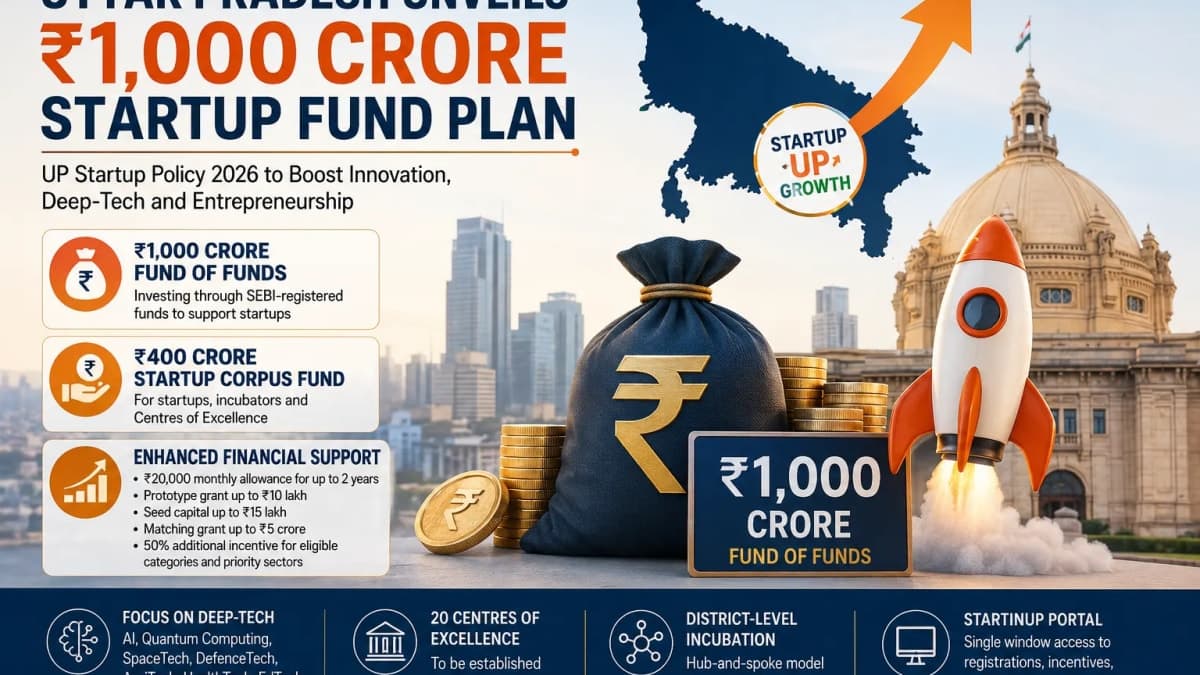
Under the Uttar Pradesh Startup Policy 2026, the state has provided for a ₹1,000 crore UP Startup Fund, structured as a Fund of Funds rather than a vehicle that invests directly in individual companies. The framework is part of a wider strategy covering startup financing, incubation, deep technology, research and entrepreneurship across the state.
The policy was approved by the Uttar Pradesh Cabinet in July 2026 and combines the funding initiative with higher grants for young companies, new Centres of Excellence and a flagship deep-tech incubation hub.
₹1,000 Crore Fund Will Work Through Investment Funds
A key distinction for entrepreneurs is that the ₹1,000 crore programme is not designed as a pool from which the government simply hands money directly to individual startups.
According to Uttar Pradesh's official startup platforms, the UP Startup Fund operates as a Fund of Funds, investing through eligible daughter funds or Alternative Investment Funds, which in turn deploy capital into qualifying startups. Official information also identifies SIDBI's role in the financing structure.
This model is intended to combine government-backed capital with professional investment management and potentially attract additional private capital into Uttar Pradesh-based businesses.
₹400 Crore Corpus Adds Another Layer of Support
The ₹1,000 crore Fund of Funds is only one component of the new framework.
The Startup Policy 2026 also provides for a ₹400 crore startup corpus fund, aimed at supporting startups, incubators and Centres of Excellence.
The policy's financial-support measures include:
A ₹20,000 monthly sustenance allowance for eligible startups for up to two years.
A prototype grant of up to ₹10 lakh.
Seed capital support of up to ₹15 lakh.
A matching grant of up to ₹5 crore for eligible high-growth startups.
An additional 50% incentive on prototype and seed grants for specified categories and priority sectors.
The additional incentives cover categories including women-led, Divyangjan-led, EWS-led and transgender-led startups, as well as eligible ventures in Purvanchal and Bundelkhand and businesses working in areas such as AgriTech, sustainability, renewable energy, waste management and climate-related solutions.
Uttar Pradesh Puts Deep-Tech at Centre of Startup Strategy
Beyond financing, the policy signals that Uttar Pradesh wants to compete more aggressively for technology-intensive businesses.
The government has identified areas including artificial intelligence, quantum computing, blockchain, SpaceTech, DefenceTech, AgriTech, HealthTech and EdTech among the technologies and sectors it wants the ecosystem to support.
A flagship U-Hub, envisioned as a deep-tech incubation centre, is part of the plan. Uttar Pradesh also intends to establish 20 new Centres of Excellence over the next five years, while expanding incubation infrastructure across districts through a hub-and-spoke model.
The approach matters because deep-tech companies typically face different funding requirements from conventional digital startups. Technologies involving advanced research, hardware, aerospace, robotics or other science-intensive fields can require longer development periods and substantially more patient capital before reaching commercial scale.
Startup Support Expands Beyond Noida and Lucknow
Another important element of the policy is its attempt to distribute entrepreneurship beyond the state's established technology centres.
The government plans to expand incubators across districts and encourage innovation connected with local economic strengths, including the state's One District One Product (ODOP) programme. Entrepreneurship Cells in educational institutions, faculty development programmes and innovation centres are also included in the policy framework.
That could prove significant for Uttar Pradesh because a broader district-level network may give founders outside major startup centres easier access to mentors, incubation facilities and investors.
StartInUP Portal to Serve as a Single Window
The state is also seeking to simplify how entrepreneurs access government startup programmes.
Its plans include an integrated StartInUP Portal providing access to registrations, incentives, mentors, investors and other ecosystem participants.
The government's startup mission also lists measures covering free incubation, proof-of-concept opportunities, government procurement support and connections with angels, venture capital firms, high-net-worth individuals and family offices.
Why the ₹1,000 Crore Plan Matters
The size of the headline fund is significant, but the structure of the programme may ultimately matter more than the ₹1,000 crore figure itself.
Because the capital is routed through investment funds rather than allocated directly to every startup, its impact will depend on factors including the participation of investment managers, deployment of capital, startup eligibility and the ability of Uttar Pradesh companies to become investment-ready.
At the same time, the combination of a Fund of Funds, startup grants, district-level incubation and dedicated deep-tech infrastructure gives the policy a broader scope than a standalone funding announcement.
For entrepreneurs, the biggest potential benefit is a more complete financing pathway: assistance at the prototype and seed stages, followed by access to professional investors and larger pools of growth capital as businesses scale.
The Bigger Picture
Uttar Pradesh is positioning startups as part of a wider economic-development strategy rather than treating entrepreneurship solely as a technology-sector initiative.
The Startup Policy 2026 explicitly targets innovation across sectors and regions while giving emerging technologies a prominent role. The state's challenge now shifts from policy design to execution—particularly how quickly its new funding, incubation and investment mechanisms translate into capital and commercial opportunities for startups.
If implementation matches the policy's scale, the ₹1,000 crore Fund of Funds and associated incentives could strengthen Uttar Pradesh's ability to compete for founders and investment while encouraging more companies to emerge outside its traditional startup centres.