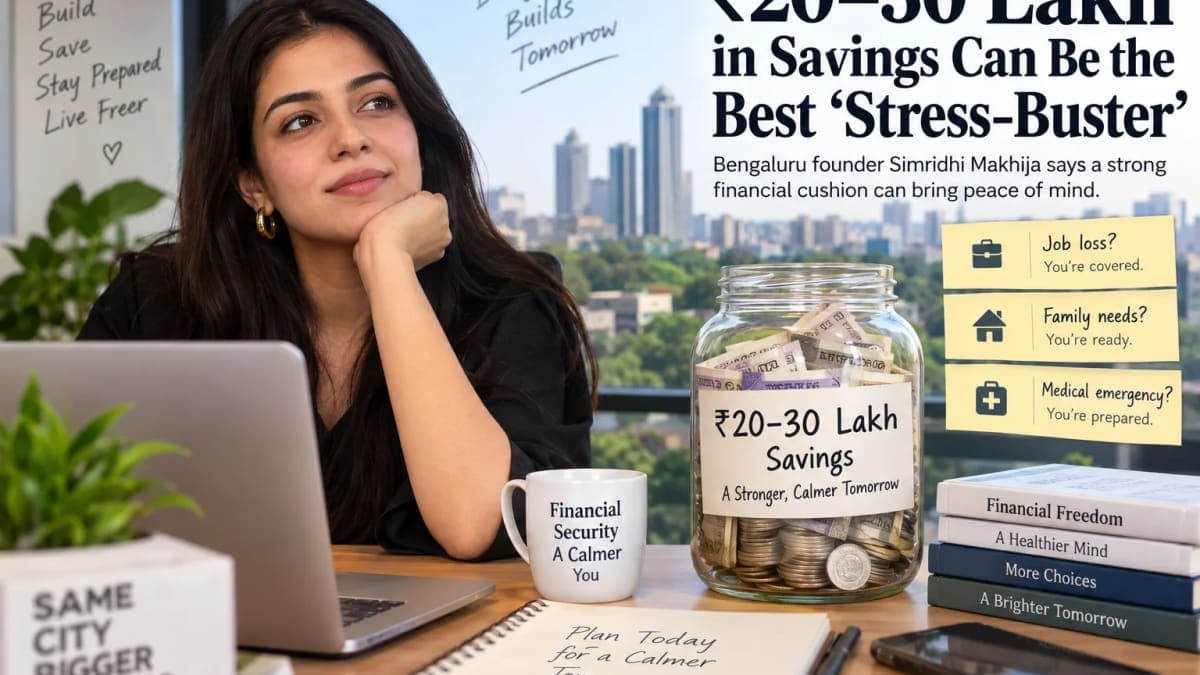
Bengaluru Founder Says ₹20–30 Lakh Savings Can Bring a Different Kind of Peace of Mind
Financial security is often measured in salaries, investments and net worth. Bengaluru entrepreneur Simridhi Makhija has offered a simpler benchmark: enough money in the bank to know that a sudden setback will not immediately upend your life.
Makhija, founder of The Speak Fest, has drawn attention online after arguing that consistent cash flow and savings of about ₹20–30 lakh can provide a powerful sense of security.
“Nothing calms down your nervous system more than having consistent flow of money,” she said in a social-media video.
Her point was not about using those savings to upgrade a lifestyle. She framed the money instead as protection against the kinds of events that can quickly destabilise household finances, from losing a job to helping parents or dealing with a medical emergency.
A Financial Cushion for When Plans Go Wrong
For Makhija, the value of having ₹20–30 lakh available lies in knowing that an unexpected expense does not automatically become a crisis.
“Even if you lose your job, even if your parents need money, there is a healthcare crisis, whatever it is, you are good because you have 20 to 30 lakhs saved in your bank account,” she said.
That figure is Makhija's own benchmark, rather than a standard personal-finance rule. The amount of emergency savings someone needs can vary considerably depending on monthly expenses, debt, dependants, insurance coverage and the stability of their income.
Still, her argument touches on a practical distinction that can get lost when financial success is discussed mainly in terms of earnings. A strong monthly salary does not necessarily provide the same protection as accessible savings if most of that income is already committed to expenses.
Cash reserves, on the other hand, can buy time when income stops or an unforeseen bill arrives.
Why She Links Savings With Confidence
Makhija also argued that building a financial cushion with one's own earnings can change how a person approaches difficult decisions.
“So that's when you will feel like you can move confidently in the world: (A) because you have actually earned that money yourself. (B) that that is your cushion in any situation that comes your way,” she said.
The confidence she describes is less about having money available to spend and more about having options.
Someone with adequate reserves may have more room to search for another job after a layoff, respond to an urgent family expense or reconsider a difficult professional situation without facing the same immediate financial pressure.
That does not mean a particular bank balance guarantees emotional wellbeing. Makhija's ₹20–30 lakh figure reflects her own view of what constitutes a meaningful cushion, not a universally applicable threshold.
Her Comments on Therapy Draw a More Important Distinction
Makhija also discussed therapy, books and other ways people try to manage stress, arguing that they may not resolve anxiety when financial insecurity is one of its underlying causes.
“So therapy is fine, reading books is fine, trying to calm down your nervous system is fine, but unless you actually go to the root of why your nervous system is actually acting up all the time, you are not going to be better,” she said.
Her comments are best read as an argument about financial stress rather than medical advice.
Money problems can be one source of anxiety, and improving financial stability may remove some of that pressure. But savings are not a substitute for mental-health treatment, nor does a certain amount of money guarantee relief from anxiety or other health conditions.
That distinction matters because the phrase “calm your nervous system,” while widely used in wellness conversations, should not turn a personal-finance observation into a clinical claim.
What Makhija Says She Has Seen in Bengaluru's Founder Community
Part of Makhija's perspective comes from her experience around Bengaluru's startup ecosystem.
She said she has observed differences between entrepreneurs struggling to maintain reliable cash flow and founders who have reached greater financial stability.
“I have seen here in Bangalore as to how those founders who do not have consistent cash flow struggle with everything in their life in every sphere, versus those founders who have made it, and now they are happy in every other sphere of their life,” she said.
That comparison is her personal observation rather than evidence that financial success automatically produces happiness. Founders can face pressures ranging from uncertain revenue and payroll obligations to fundraising demands and personal financial exposure, and those circumstances differ widely from one business to another.
What her comments capture more clearly is the pressure created when professional uncertainty and personal finances become difficult to separate.
₹20–30 Lakh Is Not the Real Number for Everyone
The most eye-catching part of Makhija's argument is also the part that requires the most context.
₹20 lakh could represent years of expenses for one person and a much shorter runway for another. A household supporting children or elderly parents, paying a large home loan or facing substantial recurring expenses will have different requirements from someone with few financial obligations.
That makes the underlying principle more useful than the specific figure.
An emergency fund is ultimately about how long someone can continue meeting essential expenses if normal income disappears. Thinking in terms of financial runway rather than chasing a fixed savings target can provide a more realistic measure of security.
There is also a difference between money that exists on paper and money that can be accessed when needed. Investments, property and retirement assets can contribute to overall wealth, but an emergency often requires readily available funds.
The Appeal of Having Room to Choose
Makhija's remarks have gained traction because they put a number on something that is harder to quantify: the comfort of knowing an unexpected event does not have to dictate the next decision.
Financial security cannot eliminate every source of stress, and ₹20–30 lakh is not a magic threshold. For many people, reaching such a figure may itself be a distant goal.
But the broader idea behind her argument is more straightforward. Savings can create room between a setback and the decisions that follow it.
For someone facing a layoff, an emergency at home or an uncertain career move, that room can sometimes matter as much as the balance itself.