Nvidia’s $12.93 Billion Hugging Face Deal Reshapes the Open-AI Ecosystem
Nvidia already supplies much of the computing power behind the artificial-intelligence boom. Its planned purchase of Hugging Face would give it something different: a direct position inside one of the industry's largest communities for building, sharing and deploying AI models.
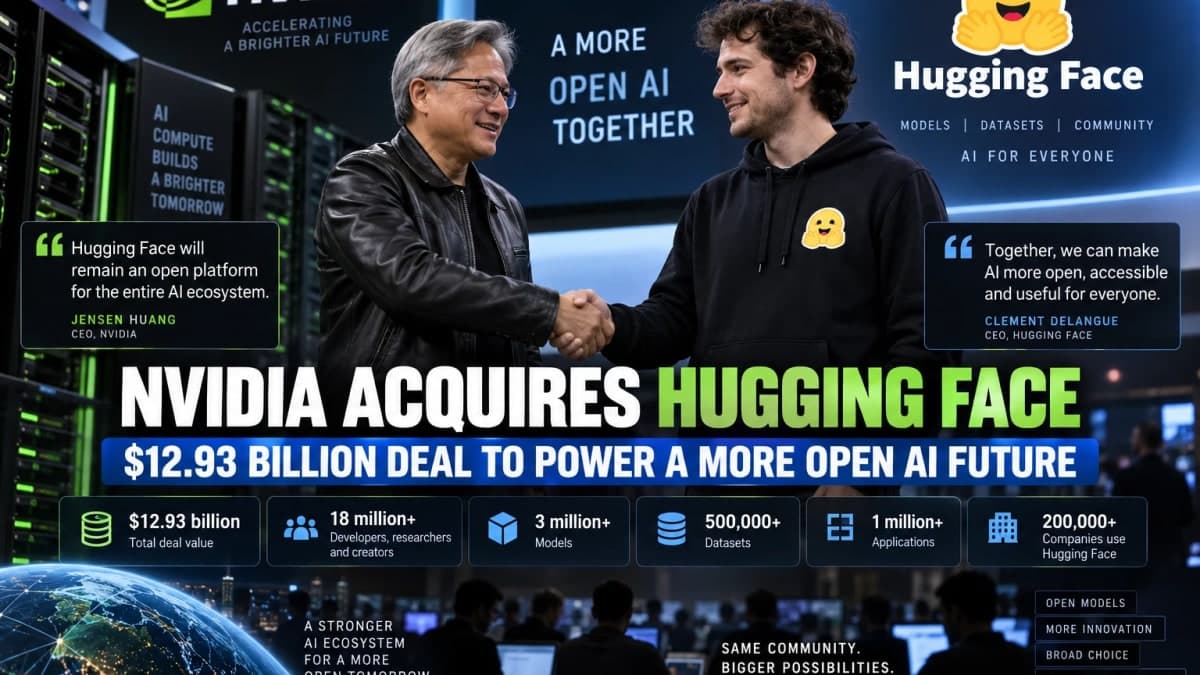
The company announced on September 3 that it had agreed to acquire Hugging Face in a transaction valued at $12.9303 billion. About $11.9 billion is intended for Hugging Face stockholders, subject to adjustments, while an equity-retention programme worth up to roughly $1 billion is designed for employees joining Nvidia.
The transaction has not yet closed. Nvidia expects completion in the first half of 2027, subject to regulatory approvals and customary closing conditions.
What Nvidia is buying extends well beyond another software company. Hugging Face sits between researchers publishing models, developers adapting them and businesses deciding how those models should be deployed. That position has made the platform an important part of the open and open-weight AI economy.
It also creates the central issue surrounding the acquisition: whether Hugging Face can retain the neutrality that helped make it valuable once it belongs to the world's dominant supplier of AI processors.
Hugging Face Gives Nvidia Access to 18 Million Developers
Hugging Face was founded in 2016 and has grown into a major repository and collaboration platform for machine learning.
Nvidia says the service is used by more than 18 million developers, researchers and creators, alongside more than 200,000 companies.
Its repositories contain over 3 million models, 500,000 datasets and 1 million applications.
That reach puts Hugging Face unusually close to the decisions developers make before computing demand ever reaches a data centre. They use the platform to discover models, compare them, customise them and decide how and where to run them.
Nvidia has traditionally captured value later in that chain. Its GPUs provide the computing capacity used to train and operate many AI systems, while CUDA has established a powerful software ecosystem around its hardware.
Hugging Face would move Nvidia closer to the point where developers choose what they want to build in the first place.
The Deal Comes With a Promise of Openness
Nvidia knows that ownership could make some Hugging Face users uneasy.
The platform supports an industry in which Nvidia's customers, partners and hardware competitors often operate alongside one another. Its appeal depends partly on developers being able to choose among different models, frameworks, cloud providers and processors.
Chief executive Jensen Huang sought to address that concern when announcing the acquisition.
“Hugging Face will remain an open platform for the entire AI ecosystem,” Huang said.
Nvidia has also said its own computing hardware will not be required to build or deploy through Hugging Face and that support for other silicon providers will continue.
Those assurances matter because Hugging Face would become less useful if developers began to view it primarily as a route into Nvidia's own products.
The more difficult test will come after ownership changes hands. Developers will be watching not only whether competing hardware remains available, but whether Nvidia's technology receives preferential treatment through optimisation, integration or deployment tools.
Nvidia Is Paying for Position, Not Just Revenue
The $12.93 billion valuation is difficult to understand through Hugging Face's current revenue alone.
The company was valued at $4.5 billion in 2023 and has raised roughly $400 million from investors. Its backers have included Nvidia, Salesforce, Amazon and AMD, alongside venture-capital investors.
Nvidia's agreed price is therefore almost three times Hugging Face's 2023 valuation.
Hugging Face is generating roughly $150 million in annualised revenue, according to Fortune. On that figure, the acquisition price is about 86 times annualised revenue.
The premium reflects scarcity.
There are few independent platforms with Hugging Face's combination of developer adoption, model distribution, datasets and machine-learning tools. Building similar software is one challenge; recreating a community of more than 18 million users is another.
That network is likely to account for a substantial part of what Nvidia believes it is buying.
Open Models Give Nvidia a Broader Route to AI Growth
The transaction also fits Nvidia's position in the debate between proprietary and open AI.
Companies including OpenAI and Anthropic largely provide access to their most advanced systems through controlled services. Open-weight models give developers greater freedom to download, modify and run models on infrastructure they select themselves.
For Nvidia, there is a commercial advantage in supporting both approaches.
The company does not need a single AI model provider to dominate. Its hardware business benefits from an expanding market in which many companies train, customise and deploy models.
A healthy open-model ecosystem can broaden that demand.
Hugging Face provides a distribution layer for exactly that kind of activity. Developers can experiment with models from different organisations rather than committing immediately to one proprietary provider.
As AI spending shifts towards inference, smaller specialised models and autonomous agents, that diversity could become increasingly valuable to the companies selling the infrastructure underneath them.
Nvidia’s Biggest Customers Are Also Building Rival Chips
There is another reason for Nvidia to expand beyond GPUs.
Some of the technology companies spending heavily on Nvidia processors are developing their own AI accelerators. They want greater control over costs, supply and the infrastructure supporting their AI services.
That means several major Nvidia customers are also potential competitors.
Owning Hugging Face would not eliminate that threat. It would, however, give Nvidia another connection to developers even when workloads do not run exclusively on Nvidia processors.
The platform could also provide insight into which types of models, applications and deployment methods are gaining traction.
That information is potentially valuable when Nvidia decides where to focus future hardware and software development.
Neutrality Becomes a Business Requirement
The acquisition creates competing incentives that Nvidia will have to manage carefully.
Nvidia naturally benefits when developers use its hardware. Hugging Face benefits when developers believe they can use the platform without being pushed towards any particular hardware supplier.
Preserving both propositions will require more than keeping rival chips technically compatible.
Developers and competitors are likely to pay attention to performance optimisation, default settings, product placement and integration with Nvidia's expanding portfolio of AI software.
Even relatively small changes could influence perceptions of whether Hugging Face still operates as neutral infrastructure.
Regulators may examine the same issue from a competition perspective. Nvidia's filing makes regulatory approval one of the conditions required before the acquisition can close.
The AI Market Is Moving Beyond Model Training
The timing of the transaction is also important.
The first stage of the generative-AI boom produced extraordinary demand for processors capable of training increasingly large models. That market helped transform Nvidia into the central hardware supplier for the industry.
The next stage is broader.
Companies are putting trained models into products, customising them for particular tasks and deploying AI systems to millions of users. Inference can involve an enormous number of smaller computing jobs rather than a relatively limited number of giant training runs.
Hugging Face is well positioned for that shift because its users are already experimenting with the models and applications that could generate those workloads.
For Nvidia, ownership would provide a direct connection to that activity rather than relying solely on demand flowing through cloud providers and major AI laboratories.
A Nearly $13 Billion Test of Trust
Hugging Face became important partly because developers could use it without committing themselves to a single AI company.
Nvidia's acquisition does not automatically change that. The company has explicitly promised to preserve the platform's openness and support competing infrastructure.
But the ownership structure will change.
If the transaction closes, a company that already occupies a powerful position in AI computing will also control one of the industry's principal marketplaces and collaboration hubs for open models.
That makes Nvidia's nearly $13 billion investment more than an acquisition of software, revenue or intellectual property. It is a bet on where developers will gather as artificial intelligence moves from large-scale model training towards widespread deployment.
The commercial logic is clear: Nvidia wants to participate in more stages of that process.
For Hugging Face, the challenge is different. Its value rests heavily on developers continuing to believe that the platform works for the wider AI ecosystem rather than primarily for its new owner.
How Nvidia handles that relationship after the deal closes will matter as much as the price it has agreed to pay.