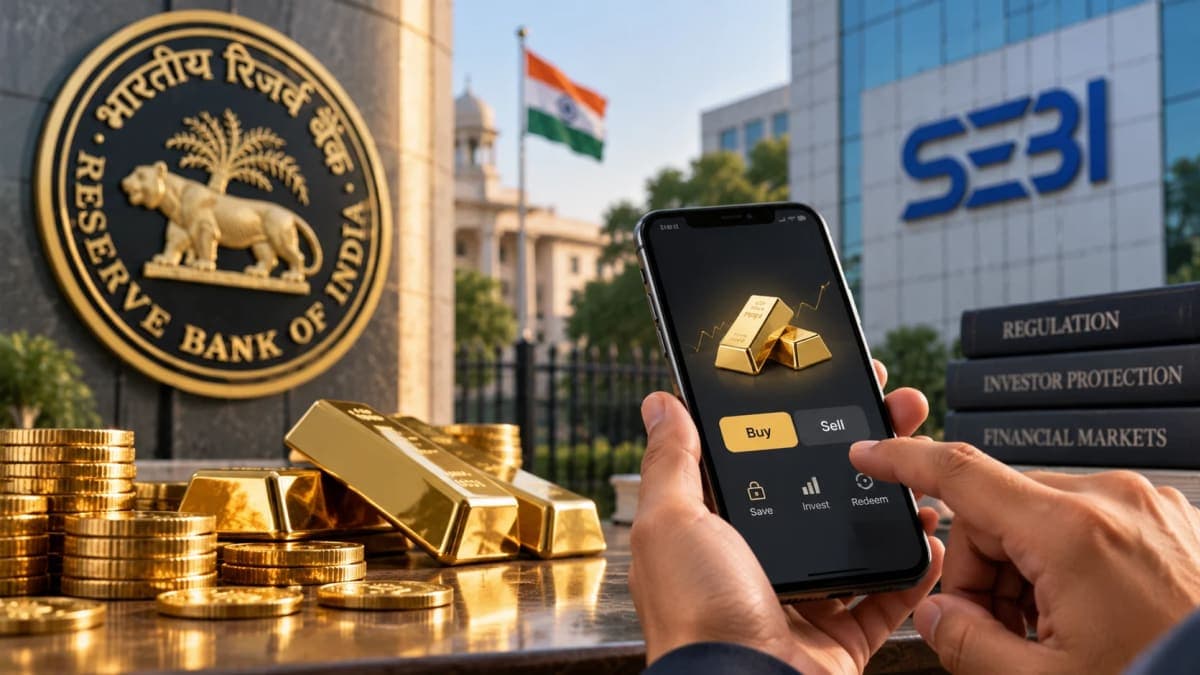
India's fast-growing digital gold market could be heading towards formal regulation, with the government discussing rules that may bring the product under regulatory oversight and require digital holdings to be backed by physical bullion.
The important point for consumers is that no final regulatory framework has been announced yet.
According to a September 18 report by The Economic Times, citing people familiar with the discussions, the Finance Ministry has sought views from regulators, banks and industry participants. One proposal being considered is to recognise digital gold as a security under the Securities Contracts (Regulation) Act, 1956. Joint oversight involving the Reserve Bank of India (RBI) and Securities and Exchange Board of India (SEBI) is also reportedly under discussion.
If adopted, this would mark a significant change for a product that Indians can easily buy in small amounts through apps but which currently sits outside SEBI's securities-market investor-protection framework.
What Is the Government Reportedly Considering?
The discussions appear to revolve around two important changes.
First, every unit of digital gold could be required to have corresponding physical bullion backing. Second, the product could be brought within a formal regulatory structure involving RBI and SEBI.
The Economic Times reported that the Finance Ministry has sought feedback from regulators, banks and other stakeholders, with people involved in the process indicating support for bringing digital gold under regulatory supervision. The report also said recognising it as a security under the Securities Contracts (Regulation) Act is being considered.
This should not be confused with a new rule already in force.
As of September 18, JantaScope could not find a final Finance Ministry notification, RBI regulation or SEBI circular implementing the reported RBI-SEBI framework for ordinary digital gold.
For now, it remains a policy proposal under discussion.
Why Digital Gold Regulation Has Become an Issue
Digital gold makes buying the metal unusually simple.
Consumers can purchase very small amounts online, with the provider typically arranging for corresponding physical gold to be stored on their behalf. The customer can later sell the holding or, depending on the provider's terms, seek physical delivery.
That convenience has helped the category expand.
The Economic Times, citing industry estimates, puts assets managed by India's digital gold sector at around $3 billion, with an average transaction size of about ₹100. These are industry estimates rather than official RBI or SEBI market statistics.
The regulatory problem is that buying something described as “digital gold” can feel like buying a conventional financial investment even though the legal and investor-protection structure is different.
SEBI made that distinction unusually clear last year.
SEBI Warned Investors About Digital Gold in 2025
On November 8, 2025, SEBI issued an official public caution regarding digital gold and e-gold products offered by online platforms.
The regulator said these products are different from SEBI-regulated gold investments because they are neither notified as securities nor regulated as commodity derivatives.
SEBI said digital gold therefore operates outside its regulatory purview and may expose buyers to counterparty and operational risks. It also warned that securities-market investor-protection mechanisms are not available for such investments.
That distinction remains crucial.
SEBI already regulates several ways of getting financial exposure to gold, including Gold Exchange Traded Funds (ETFs), exchange-traded commodity derivatives and Electronic Gold Receipts (EGRs). Digital gold sold through online platforms is not automatically part of those regulated categories.
SEBI Had Earlier Said It Wasn't Looking to Regulate Digital Gold
There is an important piece of context behind the latest report.
Shortly after SEBI's November 2025 warning, chairman Tuhin Kanta Pandey said the regulator was not looking to regulate digital gold, explaining that the product did not fall within SEBI's purview at the time. He pointed consumers towards regulated gold-related products such as ETFs and other tradable gold securities.
The latest discussions therefore should not be read as evidence that SEBI has quietly begun regulating existing digital gold products.
A legal or regulatory change may first be needed to bring the product within an appropriate framework.
The Securities Contracts (Regulation) Act already gives the Central Government a route to declare additional instruments as securities.
There is also a precedent in India's gold market.
Electronic Gold Receipts Show How a Regulated Model Can Work
Electronic Gold Receipts, or EGRs, provide a useful comparison.
In December 2021, the government formally declared EGRs to be securities under the Securities Contracts (Regulation) Act. SEBI subsequently established the framework covering their creation, trading and conversion back into physical gold.
Under that framework, physical gold is deposited with a registered vault manager before an EGR is created.
SEBI's rules explicitly require that an EGR must not be created without the corresponding physical gold being present in the vault. Depositories and vault managers also have reconciliation and inspection responsibilities.
That does not mean digital gold will necessarily be regulated exactly like EGRs.
But it shows that India already has a regulatory architecture connecting physical bullion, electronic ownership records, vaulting and securities-market supervision.
SEBI is still reviewing that ecosystem. On August 11, 2026, it published a consultation paper on reviewing and expanding the scope of the SEBI (Vault Managers) Regulations, 2021.
Industry Has Already Started Building Its Own Standards
Digital gold providers have not waited for a government framework.
Earlier this year, industry participants established the Digital Precious Metals Assurance Council of India (DPMACI), a self-regulatory initiative involving companies including MMTC-PAMP, SafeGold and Augmont, alongside platforms such as PhonePe, BharatPe, MobiKwik, Gullak, Lenden Club and CRED.
The council's framework calls for 1:1 physical-metal backing, periodic independent audits and standards covering vaulting, storage, insurance and disclosure.
It has also proposed segregated customer-fund accounts under independent trustee supervision and a structured grievance-redressal mechanism.
These are industry standards, however. They should not be mistaken for RBI or SEBI regulation.
That difference is exactly why formal oversight could matter.
What 100% Physical Backing Would Mean
Suppose a consumer buys ₹1,000 worth of digital gold.
The key question isn't simply whether an app displays ₹1,000 worth of gold in the customer's account. It is whether the provider's system can demonstrate that the corresponding quantity and quality of physical bullion actually exists, is properly segregated or accounted for, is securely stored and can be reconciled against customer holdings.
A mandatory physical-backing regime could establish common requirements around that process.
It could also potentially bring more standardisation to audits, custody, disclosure and reconciliation.
But the details will determine how much protection consumers actually receive. Regulation would need to address what happens if a platform, bullion provider, vault operator or another intermediary fails.
Simply requiring physical bullion somewhere in a vault would not, by itself, answer every question about legal ownership or customer claims in an insolvency.
Why RBI and SEBI Could Both Be Involved
The reported possibility of joint RBI-SEBI oversight reflects the unusual structure of the product.
Digital gold sits somewhere between a commodity purchase, a stored asset and an app-based investment experience.
SEBI's mandate already covers regulated securities-market gold products, while RBI supervises large parts of India's banking and payment systems.
According to the Economic Times report, one argument for involving both regulators is to reduce regulatory arbitrage and uncertainty around the sector.
The precise division of responsibilities, however, has not been officially announced.
Until the government publishes an actual framework, it would be premature to say which regulator would supervise providers, distributors, payments, vaulting or customer protection.
What Would Change for Digital Gold Buyers?
For consumers, formal regulation could potentially make four areas clearer: who supervises providers, how physical gold backing is verified, what disclosures platforms must make, and where customers can seek redress when something goes wrong.
Today, SEBI's position is explicit: the investor-protection mechanisms available under the securities-market framework do not apply to ordinary digital gold products operating outside its jurisdiction.
That does not mean every digital gold provider is unsafe. Nor does the latest discussion establish that existing holdings are in trouble.
It means consumers need to distinguish between commercial safeguards voluntarily offered by providers and protections required and enforced by a financial regulator.
Those are not the same thing.
JantaScope Analysis: The Biggest Change Could Be Trust, Not Technology
Digital gold succeeded in making gold buying feel almost frictionless. Someone can buy a tiny amount without visiting a jeweller, arranging storage or opening the kind of investment account associated with some regulated market products.
But convenience moved faster than regulation.
Formal oversight could narrow that gap. Physical-backing requirements, independent reconciliation, custody standards and a defined grievance process could make it easier for customers to understand exactly what they own and who is responsible for protecting it.
There could also be costs. Stronger compliance, audits, custody standards and reporting requirements may increase expenses for providers, potentially encouraging consolidation among platforms.
The crucial question now is not whether discussions are happening—they are being reported by multiple people involved in the process—but what the government ultimately puts into law or regulation.
Until an official framework is notified, India's digital gold market remains in the unusual position of having growing consumer adoption and increasingly sophisticated industry safeguards, but without the securities-market protections that SEBI already applies to products such as Gold ETFs and EGRs.


