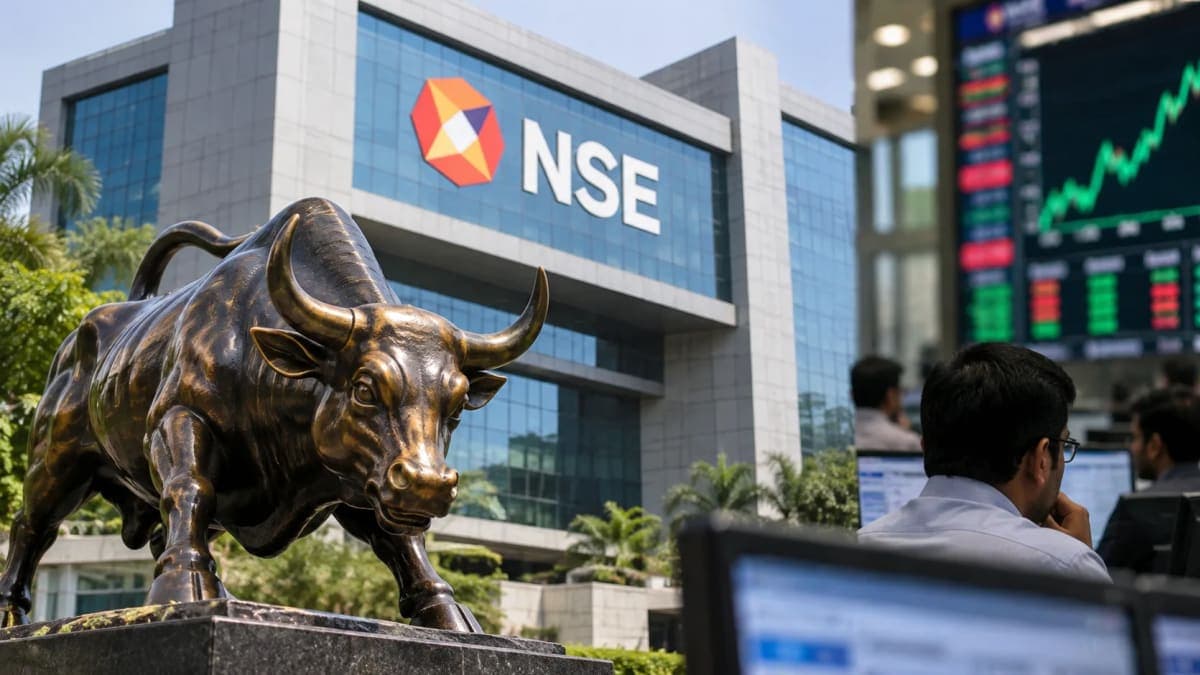
After years of waiting, the National Stock Exchange of India (NSE) has finally opened its IPO for subscription. The issue opened on September 17, 2026, bringing one of India's most closely watched unlisted companies to the public market.
NSE has fixed the IPO price band at ₹1,700 to ₹1,785 per share, with investors required to apply for a minimum of eight shares. At the upper end of the price band, the offer is expected to raise around ₹22,569 crore, putting it among the biggest IPOs India has seen.
Bidding will remain open until September 21.
But the size of the IPO isn't the only reason this issue matters. NSE sits at the heart of India's capital market. A huge share of the country's equity and derivatives trading happens on its platforms every day.
For investors, that makes the IPO quite different from a typical company coming to the market. They aren't simply looking at another financial-services business. They're looking at the exchange infrastructure behind a large part of India's stock market.
At the same time, NSE comes with its own set of risks, particularly around regulation, derivatives trading, competition and technology.
What exactly is NSE offering?
The IPO is a book-built issue involving an offer for sale of up to 126,436,650 equity shares. The shares have a face value of ₹1 each.
With the price band set between ₹1,700 and ₹1,785, a retail investor applying for the minimum lot of eight shares would need ₹14,280 at the upper price.
Eligible NSE employees are being offered a discount of ₹170 per share.
One detail investors shouldn't overlook is that this is an entirely offer-for-sale, or OFS, issue.
That means NSE itself isn't raising fresh money through the IPO. The money raised will go to existing shareholders who are selling their stakes.
So, unlike an IPO where a company raises fresh capital to build factories, expand operations, repay debt or invest in technology, NSE won't receive the ₹22,569 crore for its own business.
The IPO primarily gives existing shareholders a way to monetise part of their holdings while also creating a publicly traded market for NSE shares.
Day One demand was steady, rather than spectacular
Considering the amount of attention surrounding the NSE IPO, the first day's subscription numbers weren't extraordinary.
By around 5:03 pm on September 17, investors had placed bids for roughly 37 million shares against about 88.6 million shares available, translating into an overall subscription of around 42%.
Demand varied considerably across investor categories.
Retail investors had subscribed to roughly 42% of their allocated portion, while non-institutional investors were at around 70%. Qualified institutional buyers had subscribed to approximately 19% of their portion.
Those numbers, however, shouldn't be read in isolation.
Large institutional investors often place their bids during the later stages of an IPO. As a result, first-day subscription figures don't necessarily tell us how strongly an issue will eventually be subscribed.
There's also another important number to consider.
NSE already attracted ₹6,746 crore from anchor investors
A day before public bidding began, NSE allocated shares worth around ₹6,746 crore to anchor investors at ₹1,785 per share — the top end of the IPO price band.
The anchor book attracted major Indian and international institutional investors, including sovereign wealth funds.
That gives a clearer picture of institutional interest than looking only at the first day's QIB subscription.
Still, anchor participation shouldn't be treated as a sign that listing gains are guaranteed. It tells us that large investors were willing to participate at the IPO price. What happens to NSE shares after listing will ultimately depend on valuation, earnings, regulation and market conditions.
Why NSE isn't a normal IPO
The biggest attraction in NSE's business is its sheer scale.
As of June 30, 2026, the exchange had approximately 132.37 million unique registered investors, along with 1,328 trading members and 3,005 listed companies.
The combined market capitalisation of companies listed on NSE was around ₹474.08 trillion.
Those numbers help explain why investors have been waiting for this IPO for so long.
NSE isn't trying to create a new market or win customers from scratch. It already operates one of the largest financial-market ecosystems in the world.
As more Indians invest in stocks, mutual funds, ETFs and derivatives, exchanges can benefit from higher trading activity as well as demand for listings, market data and related services.
That sounds attractive, but NSE's revenue mix also reveals where the risk lies.
NSE's options dominance is a strength — and a vulnerability
Transaction charges remain the biggest contributor to NSE's business.
They accounted for around 78.65% of NSE's FY2025-26 revenue from operations, while equity-options transaction charges alone contributed approximately 60.22%.
That's an important number.
India's derivatives market has grown rapidly, particularly among retail traders. At the same time, regulators have introduced several measures aimed at addressing concerns over excessive speculative activity and losses among individual traders.
Any regulatory change that reduces derivatives volumes can therefore have a noticeable impact on NSE's revenue.
Changes to expiry schedules, contract structures, transaction costs or trading rules may affect how frequently people trade.
NSE also faces competition from BSE, particularly in index derivatives. Recent regulatory changes have altered the competitive landscape, and market share can shift as traders move between products and exchanges.
So while NSE's dominant position is a major advantage, it doesn't make the company immune to regulation or competition.
The numbers behind NSE's business
NSE comes to the market with strong profitability.
For FY26, the exchange reported revenue of approximately ₹16,601 crore and net profit of around ₹10,302 crore. Transaction-charge revenue stood at roughly ₹13,057 crore.
The company also had no debt and maintained a substantial net cash position at the end of March 2026.
Those are strong financial characteristics, but there's another side to the numbers.
Revenue declined by roughly 3% year-on-year in FY26 as transaction-charge income softened.
That decline is useful for investors because it shows that NSE's growth won't necessarily move in a straight line. Even with a growing investor base, changes in trading activity can affect revenue relatively quickly.
Technology matters more for an exchange than most companies
For NSE, technology isn't simply a support function sitting in the background.
It's the business infrastructure itself.
Millions of investors, brokers and institutions depend on the exchange's systems to process orders and trades. Any significant technology outage can disrupt trading and affect confidence in the market.
That means NSE needs to keep investing in cybersecurity, system capacity, redundancy and disaster-recovery infrastructure.
Regulators can also impose consequences when exchanges suffer major technical failures.
Investors therefore shouldn't look at NSE's high profitability and assume technology spending can simply be reduced to improve margins. Reliability is fundamental to the exchange's business.
What are investors really buying?
The most interesting way to look at NSE may be to separate its long-term opportunity from short-term market activity.
The long-term story is straightforward.
India's participation in financial markets has expanded dramatically. NSE had more than 132 million unique registered investors by June 2026, and the broader shift towards formal financial assets could continue creating opportunities for exchanges.
But trading activity is cyclical.
Market volatility, taxes, regulation and changes in investor behaviour can all affect transaction volumes, particularly in derivatives.
That creates an unusual combination.
NSE gives investors exposure to India's long-term financialisation story, but that doesn't mean its earnings will automatically rise every year alongside the number of investors or demat accounts.
Regulators may deliberately introduce measures that reduce activity in areas that generate significant revenue for the exchange.
What should investors watch after the IPO?
The subscription numbers will dominate attention until the issue closes, but they won't be the most important numbers over the longer term.
After NSE lists, investors are likely to pay close attention to its share of the equity-options market, transaction-charge revenue and whether the company can grow businesses that are less dependent on trading volumes.
Regulatory developments will be equally important.
Technology spending, system reliability and the continuing expansion of India's investor base will also help determine how the business develops.
And the OFS structure is worth remembering. NSE isn't receiving fresh capital from this IPO. Existing shareholders are selling shares and receiving the proceeds.
What the IPO does create, however, is something the market hasn't had before: a publicly traded valuation for the company operating India's largest stock-exchange ecosystem.
That's what makes the NSE IPO particularly interesting.
It's not simply a bet on whether Indians will keep buying stocks. It's also a bet on the infrastructure behind India's growing capital markets — a highly profitable business with powerful scale advantages, but one whose future will continue to be shaped by regulation, competition and trading behaviour.