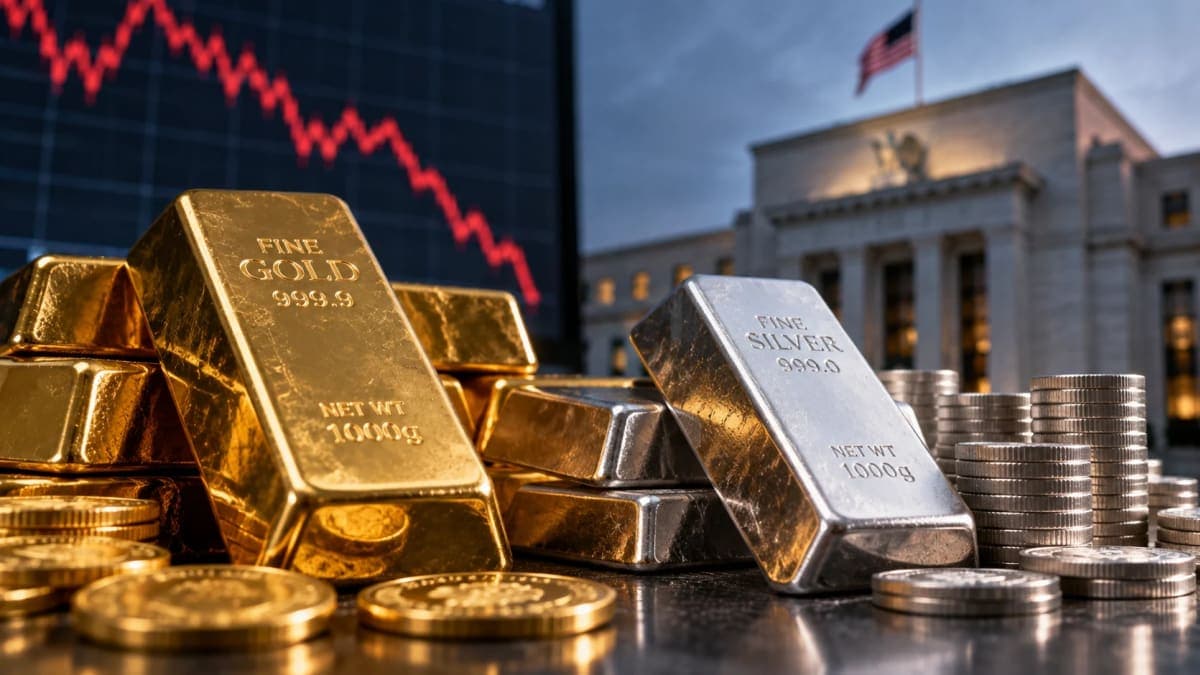
Gold and Silver Price Today, September 17, 2026: Gold Slips Below ₹1.52 Lakh, Silver Falls After Fed Rate Hike
Gold and silver prices opened lower in India on Thursday, September 17, as investors assessed the US Federal Reserve's first interest-rate increase in more than three years.
The India Bullion and Jewellers Association's indicative retail selling rates for Thursday morning put fine gold (999 purity) at ₹15,123 per gram, while 22-karat gold stood at ₹14,760 per gram. Silver was quoted at ₹2,28,475 per kilogram. The benchmark rates exclude 3% GST and making charges.
For fine gold, that works out to about ₹1,51,230 per 10 grams before GST and other retail costs.
Prices were lower than IBJA's Wednesday evening rates. Fine gold had been quoted at ₹15,236 per gram, while silver stood at ₹2,31,337 per kg.
On that basis, gold fell by about ₹1,130 per 10 grams, while silver dropped ₹2,862 per kilogram between Wednesday's PM benchmark and Thursday's AM indicative retail rate.
The decline followed the Federal Reserve's decision to raise US interest rates by 25 basis points. International bullion, however, later recovered as the dollar and US Treasury yields eased.
Gold Price Today: September 17, 2026
According to IBJA's indicative retail selling rates for Thursday morning, fine gold (999 purity) was priced at ₹15,123 per gram. 22K gold stood at ₹14,760 per gram, while 20K gold was quoted at ₹13,460 per gram. The rate for 18K gold was ₹12,250 per gram, while 14K gold stood at ₹9,755 per gram.
These rates do not include 3% GST or making charges, so jewellery buyers will generally pay more than the quoted benchmark.
The final price of a 22K ornament, for instance, will depend on its weight, making charges and other applicable costs charged by the jeweller.
Silver Falls ₹2,862 Per Kg
Silver also started Thursday on a weaker footing.
IBJA's indicative morning rate was ₹2,28,475 per kg, against ₹2,31,337 per kg on Wednesday evening. That's a decline of ₹2,862 per kg, or roughly 1.24%.
Silver often sees sharper swings than gold because its price is shaped by both investment demand and industrial consumption. It is widely used in sectors including electronics and solar energy, leaving it exposed not only to interest rates and currency movements but also to changes in manufacturing and global economic expectations.
Gold prices fell across different purity levels as well.
Fine gold moved from ₹15,236 to ₹15,123 per gram between Wednesday evening and Thursday morning, a decline of ₹113 per gram.
The 22K rate dropped from ₹14,871 to ₹14,760 per gram, while 18K gold declined from ₹12,341 to ₹12,250.
These comparisons are between IBJA's Wednesday PM and Thursday AM benchmark sessions. They do not necessarily represent the exact change a consumer will see at every jewellery store.
Why Gold and Silver Prices Fell
The Federal Reserve's September policy decision was the main global event influencing precious metals.
The Fed raised its benchmark interest rate by 25 basis points to a target range of 3.75%-4.00%, its first increase in more than three years. The decision was unanimous.
According to Reuters, 16 of the 18 policymakers who submitted rate projections indicated at least one additional quarter-point increase by the end of 2026.
That possibility matters for gold because the metal does not pay interest. Higher interest rates and bond yields can make interest-bearing assets such as government debt more attractive by comparison.
Higher US rates can also support the dollar, which can put additional pressure on precious metals priced in the US currency.
But the reaction in international markets wasn't straightforward.
International Gold Rebounds as Dollar and Yields Ease
After initially coming under pressure following the Fed decision, international gold prices recovered sharply on Thursday.
According to Reuters, spot gold was up 2.4% at $4,364.29 an ounce at 9:11 a.m. EDT, while spot silver rose 3.9% to $65.44 an ounce.
The recovery came as two major influences on bullion moved in its favour.
The US dollar eased from a seven-week high, while the benchmark 10-year US Treasury yield also declined.
A weaker dollar can make dollar-denominated gold cheaper for buyers using other currencies. Lower bond yields, meanwhile, reduce some of the opportunity cost of holding an asset such as gold that does not generate interest.
Oil prices also fell sharply.
Energy prices can feed into inflation expectations, which in turn influence expectations for central-bank policy. Lower oil prices can therefore change the market's view of how aggressively interest rates may need to rise.
This produced an unusual-looking market picture on Thursday: India's morning bullion benchmarks were lower, even as international gold subsequently staged a strong recovery.
The difference largely reflects timing. Domestic benchmark rates capture prices at a particular point, while global precious-metal markets continue moving through the day.
What Are Gold Prices in Mumbai?
Retail gold prices can differ from IBJA's national benchmark.
One market-price tracker put 24K gold in Mumbai at around ₹1,51,453 per 10 grams at 10 a.m. on September 17, down approximately ₹1,041 from the previous day's comparable rate.
Its 22K Mumbai rate was around ₹1,38,731 per 10 grams.
Other retail trackers may show different numbers. The variation can come from the timing of an update, local market conditions and whether the quoted figure represents a bullion benchmark, jewellery rate or another retail measure.
For consistency, the national prices used as the main reference in this article are IBJA's published benchmark rates.
Anyone planning to buy jewellery should still check the live selling rate with the jeweller before completing the purchase.
Why the Benchmark Gold Rate Isn't Your Final Jewellery Bill
A gold rate of roughly ₹1.51 lakh per 10 grams doesn't mean a 10-gram piece of jewellery will cost exactly that amount.
IBJA states that its published rates exclude 3% GST and making charges.
The actual jewellery bill can also vary according to purity, weight, design and the jeweller's making-charge structure.
For consumers comparing prices, it is useful to separate the underlying value of the gold from making charges and other costs. Checking the hallmark and stated purity is equally important when making a jewellery purchase.
What Is Driving the Volatility?
Thursday's price action shows why gold can react differently even within the same trading session.
Higher US interest rates are generally a headwind for the metal, particularly if they push up bond yields and strengthen the dollar.
But gold is also influenced by geopolitical uncertainty, government-debt concerns, currency movements and demand for defensive assets. The international rebound on Thursday showed how quickly the market can change when the dollar and Treasury yields reverse direction.
Silver has an added complication. Its substantial industrial use means expectations for manufacturing, electronics, solar energy and the global economy can affect its price alongside the monetary factors that also influence gold.
What Indian Buyers and Investors Should Watch Now
For Indian gold buyers, international bullion prices tell only part of the story.
The rupee-dollar exchange rate also plays an important role in determining domestic prices. Gold can rise overseas without producing an identical percentage increase in India, depending on how the rupee moves against the dollar. The reverse can also happen.
Attention will now remain on whether Thursday's rebound in international bullion can hold.
The Fed's policy signal remains relatively hawkish. According to Reuters, another US rate increase this year remains possible, keeping Treasury yields and the dollar firmly in focus for precious-metals markets.
At the same time, Thursday's trading showed how quickly gold can recover when those pressures ease.
For jewellery buyers, that volatility makes it difficult to identify the exact bottom of the market. Investors, meanwhile, may find it more useful to separate short-term price moves from changes in the underlying forces driving bullion.
For now, those forces are pulling in different directions: higher interest rates are creating pressure, while movements in the dollar, bond yields, energy prices and geopolitical uncertainty continue to influence demand.