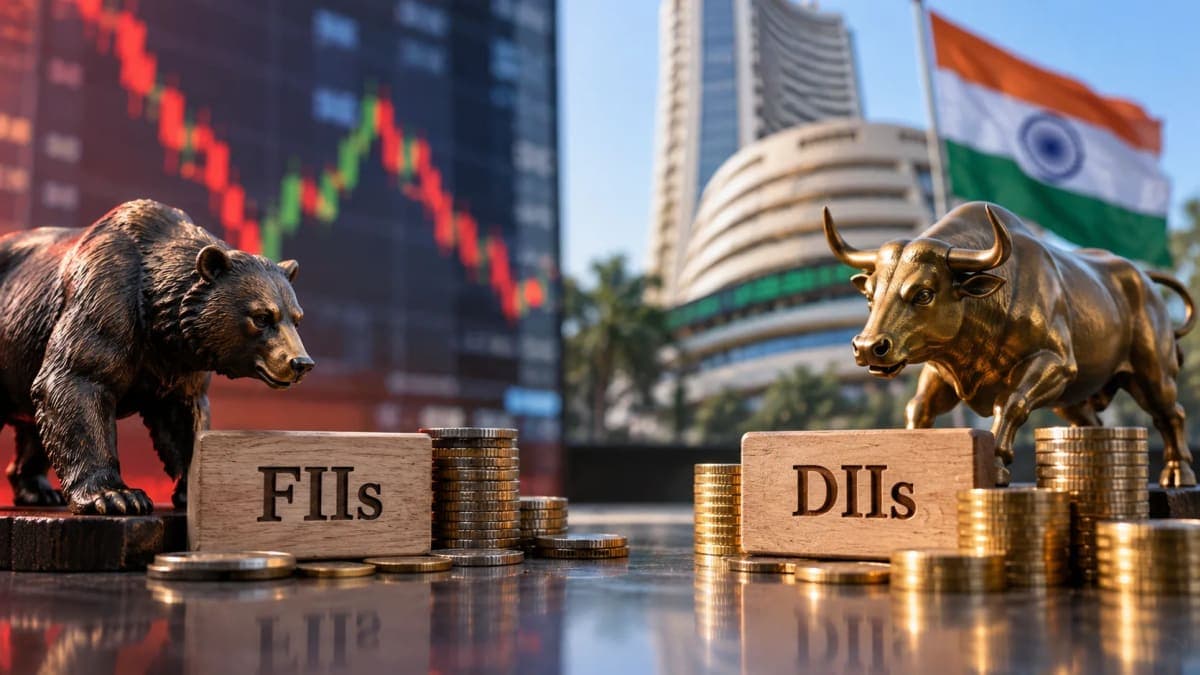
Foreign investors continued to pull money out of Indian equities on September 17, but domestic institutions stepped in with enough buying to more than offset the selling.
Provisional exchange data showed foreign institutional investors (FIIs/FPIs) sold a net ₹3,208.76 crore of shares in the cash market on Thursday, while domestic institutional investors (DIIs) bought a net ₹3,617.75 crore.
The headline numbers tell a simple story: foreign money was leaving while domestic money was coming in. But the market underneath was more complicated.
The Nifty 50 still managed to gain 53 points, or 0.23%, to close around 23,271, while the Sensex slipped 22 points, or 0.03%, to 74,314.6. Mid- and small-cap indices performed better, with the Nifty Midcap 100 gaining 0.92% and the Smallcap 100 rising 0.76%.
That resilience came despite an uncomfortable global backdrop: the US Federal Reserve had just raised interest rates, crude oil remained above $100 a barrel and the rupee briefly weakened past 96 against the dollar.
So why didn't ₹3,209 crore of foreign selling push the market sharply lower?
The answer lies partly in the strength of domestic institutional money.
What FIIs and DIIs Actually Did on September 17
The gross numbers provide more context than the net figures alone.
FIIs purchased ₹8,761.71 crore worth of shares but sold ₹11,970.47 crore, leaving them as net sellers of ₹3,208.76 crore.
DIIs moved in the opposite direction. They purchased ₹14,105.01 crore of equities and sold ₹10,487.26 crore, resulting in net buying of ₹3,617.75 crore.
That means domestic institutional buying exceeded foreign net selling by roughly ₹409 crore.
There is an important technical detail for investors to understand, however.
These figures are provisional trading data, not final settled foreign-investment flows. NSE says its FII/FPI numbers are compiled from the day's activity using PAN information supplied by NSDL and may change because of custodial confirmation, modifications and other adjustments. Final FPI data is available separately through depositories such as NSDL and CDSL.
In other words, ₹3,208.76 crore is the correct provisional cash-market number for September 17, but it should not be confused with final depository-confirmed FPI investment data.
That distinction often gets lost in daily market coverage.
Foreign Selling Is Not Just a One-Day Story
Thursday's withdrawal was part of a wider pattern.
After the September 17 session, FIIs had sold a net ₹7,640.48 crore of Indian shares during September so far, according to the provisional exchange figures cited by Moneycontrol.
DIIs, meanwhile, had invested a much larger ₹35,198.99 crore during the month.
The contrast is striking.
Domestic institutional purchases in September were more than four times the reported net foreign selling through September 17. That does not mean the two flows can simply be matched rupee-for-rupee or that DII buying will always prevent a correction. Different investors buy different stocks, at different prices and for different reasons.
But it does help explain why Indian equities can sometimes remain relatively stable even during sustained periods of foreign selling.
India's market has a much deeper domestic institutional base than it did years ago. Mutual funds, insurers and other local institutions can provide significant demand when overseas investors reduce exposure.
September 17 offered another example of that cushioning effect.
Why Are Foreign Investors Cautious?
There is unlikely to be one single explanation for every FII transaction, and exchange data itself does not reveal investors' motives.
But the global environment has clearly become less comfortable for emerging-market equities.
The Federal Reserve raised its target range by 25 basis points on September 16 to 3.75%-4.00%. The decision was unanimous, with the Fed saying inflation remained elevated.
Perhaps more important for markets, Fed officials' latest projections showed a median federal funds rate of 4.1% at the end of 2026, up from the 3.8% projection made in June.
Higher US interest rates can make dollar assets relatively more attractive and raise the hurdle for investors taking risk in emerging markets.
India also has another problem: oil.
Brent crude was around $104.8 a barrel on September 17, even after falling about 1% during the session.
For an oil-importing economy such as India, sustained high crude prices can put pressure on inflation, the current account and the currency. All three matter to foreign investors assessing returns from Indian assets.
The Rupee Adds Another Layer
Foreign investors do not earn returns on Indian equities in isolation. Currency movements matter too.
The rupee briefly weakened beyond 96 per US dollar on September 17 before recovering to close at 95.93, compared with 95.9550 in the previous session.
Reuters reported that probable RBI intervention and portfolio inflows linked to a global equity-index rebalancing helped the currency recover. Most Asian currencies fell after the Fed decision.
The reported RBI intervention has not been officially confirmed and should therefore be treated as traders' assessment rather than an established central-bank action.
For an overseas investor, however, the underlying currency issue is straightforward.
Even when an Indian stock generates a positive rupee return, depreciation of the rupee can reduce that return when converted back into dollars. A stronger dollar combined with high US yields can therefore make the risk-reward calculation for foreign investors less attractive.
This does not prove that currency weakness caused Thursday's FII selling. The daily flow data cannot establish that.
It does show why the rupee has become an important part of the broader foreign-flow story.
Yet the Market Didn't Look Like a Broad Sell-Off
The behaviour of the indices is particularly interesting.
Reuters reported that 12 of India's 16 major sectoral indices advanced during Thursday's session. The auto index gained about 1%, while the mid-cap and small-cap indices also outperformed the benchmarks.
That is not what a straightforward market-wide risk-off session normally looks like.
The Nifty has now risen for two consecutive sessions after losing roughly 6% over the previous five weeks. Reuters reported traders attributing some of the rebound to short covering in oversold areas of the market.
This provides a useful reminder about institutional-flow numbers.
A negative FII figure does not automatically mean the Nifty must fall that day. Markets are influenced by domestic institutions, retail investors, derivatives positioning, sector rotation, corporate developments and the prices at which buyers are willing to absorb supply.
Daily FII/DII data is therefore better viewed as one piece of the market puzzle rather than a standalone trading signal.
Why DII Buying Has Become So Important
The September numbers reveal something more structural about India's equity market.
Through September 17, DIIs had invested almost ₹35,199 crore even as FIIs remained net sellers.
A large domestic pool of institutional capital can reduce the market's immediate dependence on foreign money. When FIIs sell, domestic institutions can potentially absorb some of the shares being offered rather than allowing prices to adjust entirely through weaker demand.
But there is an important caveat.
Strong DII buying should not be interpreted as a guarantee against market declines. If foreign selling becomes substantially larger, domestic inflows weaken, earnings disappoint or valuations adjust, markets can still fall sharply.
Nor does aggregate DII buying reveal exactly where that money is going.
The more useful question is whether the divergence between foreign selling and domestic buying persists over several weeks and how markets behave while it does.
What Investors Should Watch Next
September 17's ₹3,209 crore FII selling number matters more when placed alongside three other variables: US interest rates, crude oil and the rupee.
The Fed has restarted tightening and its latest projections imply that policy could remain restrictive. Oil remains expensive, while the rupee is testing historically weak levels. Together, those factors make the external environment challenging for Indian equities.
Against that, domestic institutions continue to provide substantial buying support.
That tug-of-war is arguably more informative than either day's number by itself.
If FIIs continue selling but DIIs keep absorbing supply, Indian benchmarks may remain more resilient than foreign-flow data alone would suggest. If domestic buying begins to weaken while foreign selling accelerates, the balance could change quickly.
For now, September 17 delivered a clear snapshot of the divide: overseas institutions reduced exposure, domestic institutions bought aggressively, and the broader market still managed to hold its ground.
The next question is not whether FIIs sold ₹3,209 crore on one day. It is how long foreign and domestic investors continue moving in opposite directions—and which side eventually changes course.


