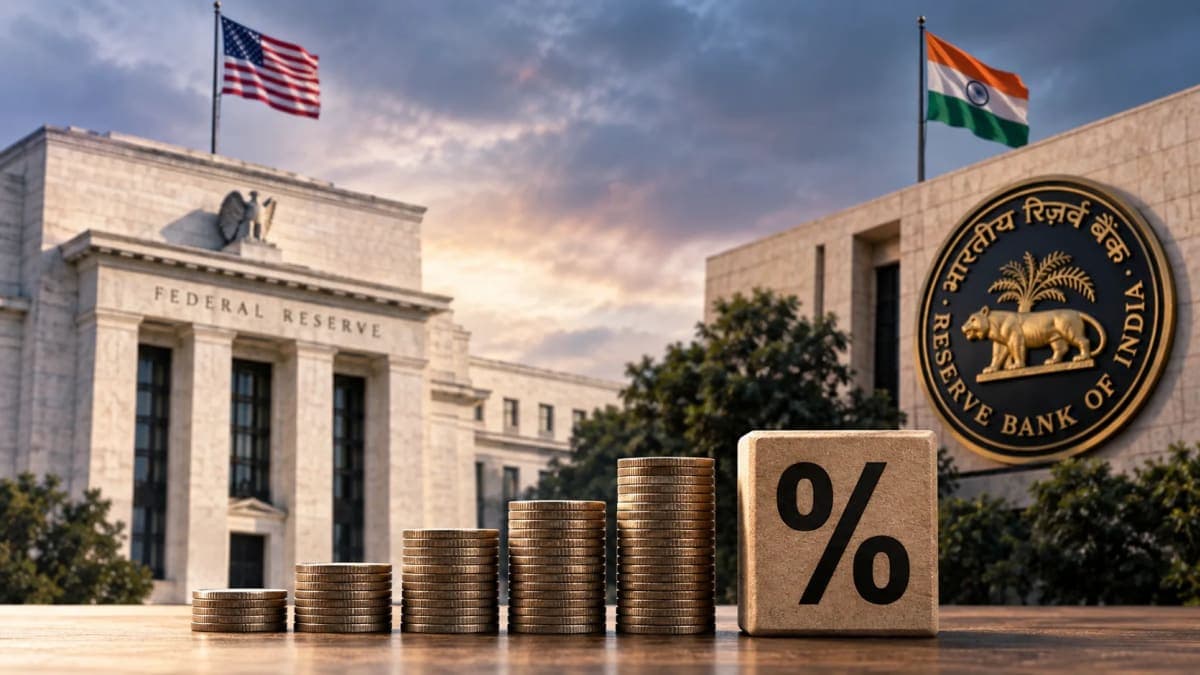
Fed Rate Hike Raises Pressure on RBI Ahead of October Policy Decision
The US Federal Reserve has raised interest rates again, making the Reserve Bank of India’s upcoming policy decision a little more complicated. The RBI was already dealing with rising inflation, expensive crude oil, pressure on the rupee and a large amount of excess liquidity in the banking system. Now it also has a more hawkish Fed to consider.
On September 16, the Federal Open Market Committee raised the federal funds target range by 25 basis points to 3.75%-4.00%. The decision was unanimous. The Fed said inflation remained elevated and indicated that tighter monetary policy was needed to bring it back towards the central bank’s 2% goal.
What caught the attention of global markets, however, was not just the rate increase.
The Fed’s latest projections showed policymakers expecting the federal funds rate to be around 4.1% at the end of 2026. In June, the median projection had been 3.8%. In other words, the latest increase may not necessarily be a one-off move, and another rate hike this year remains possible.
For India, the timing is important. The RBI is heading towards its next monetary policy review just as inflation at home has started picking up again.
RBI Was Already Facing a Tough Decision
At its August 3-5 meeting, the RBI’s Monetary Policy Committee unanimously decided to keep the repo rate unchanged at 5.25%.
Policymakers were looking for more evidence on whether higher energy and input costs were beginning to spread across the wider economy. Since that meeting, however, the inflation numbers have become less reassuring.
India’s Consumer Price Index inflation rose to 4.82% year-on-year in August, up from 4.45% in July, according to official data. Food inflation also increased, climbing to 5.95% from 5.52%.
The pressure was stronger in rural India, where headline inflation reached 5.23%, compared with 4.31% in urban areas.
Inflation is still within the RBI’s official tolerance range of 2%-6%, but it is now clearly above the central bank’s medium-term target of 4%.
There are also signs that the problem may be spreading beyond the categories that usually see sharp price swings. Reuters reported estimates showing core inflation — which excludes food and fuel — at around 4.2% in August, up from 3.86% in July.
That matters for the RBI.
If inflation rises mainly because of vegetables or another volatile food item, policymakers may be more willing to wait and see whether prices settle down. But when price increases become broader, the risk is that higher costs start feeding through to more goods and services. Businesses may eventually pass those costs on to consumers, making inflation harder to bring down.
Why a US Rate Hike Matters to India
The RBI does not simply follow the Federal Reserve. India’s Monetary Policy Committee has its own inflation mandate, and its decisions are primarily based on conditions in the Indian economy.
Still, what happens in the US cannot be ignored.
Higher American interest rates can make dollar-denominated assets more attractive to global investors. For emerging markets such as India, that can put pressure on foreign investment flows, currencies and bond markets.
Some of that pressure is already visible.
The rupee briefly weakened past 96 against the US dollar on September 17, touching 96.08 before recovering.
Reuters, citing traders, reported that state-run banks were seen selling dollars, probably on behalf of the RBI. The rupee eventually ended around 95.93 per dollar, with suspected RBI intervention and portfolio inflows helping limit the impact of the Fed decision.
The RBI itself has not officially confirmed that intervention. It should therefore be viewed as a market assessment rather than a confirmed central-bank action.
The Fed’s rate increase creates another issue for the RBI. If US interest rates rise while Indian rates remain unchanged, the interest-rate gap between the two countries becomes smaller.
That does not mean money will automatically leave India, nor does it mean the RBI has to match the Fed with its own hike. But when a narrowing rate gap comes alongside a weaker rupee and expensive crude oil, keeping rates unchanged can become a more difficult choice.
Oil Could Be an Even Bigger Problem
The Fed may be getting most of the attention, but crude oil could ultimately matter even more for the RBI’s October decision.
Brent crude was trading above $100 a barrel ahead of the Fed meeting as concerns over Middle East supplies supported prices. On September 17, Brent was around $104.8 a barrel after falling roughly 1%, according to Reuters.
For India, expensive oil creates problems on several fronts.
The country imports a large share of the crude oil it consumes, so higher global prices can increase the import bill and add pressure on the rupee. They can also raise operating costs for transport companies, airlines and energy-intensive industries.
If oil stays expensive for long enough, some of those higher costs can eventually find their way into consumer prices.
August inflation data may already be showing early signs of that pressure. Transport inflation increased to 4.60% from 4.43% in July, even though state-controlled fuel retailers had not recently changed retail petrol and diesel prices, Reuters reported.
For the RBI, therefore, it may not be enough to simply look at where oil prices are today. How long they remain elevated could be just as important.
RBI Is Also Tackling Excess Liquidity
The repo rate is only one part of the RBI’s monetary policy toolkit.
The amount of surplus money sitting in the banking system also matters because it affects how effectively changes in interest rates reach borrowers, depositors and financial markets.
India has recently been dealing with a sizeable liquidity surplus.
According to Reuters, banking-system surplus liquidity reached roughly ₹11.6 trillion on September 6. It later fell to around ₹7.4 trillion following tax outflows and foreign-exchange operations by the central bank.
The RBI has now started taking some of that excess liquidity out of the system.
On September 17, the central bank sold ₹500 billion worth of government securities through an auction-based open-market operation. It was the first net auction-based OMO sale since November 2017.
Two more sales of ₹250 billion each are scheduled, taking the announced programme to ₹1 trillion.
Why does this matter?
When banks have large amounts of surplus cash, an increase in the repo rate may not pass through the financial system as strongly as policymakers want. Removing some of that liquidity can make monetary tightening more effective.
That does not mean the RBI has already decided to raise rates in October. Liquidity management can serve several purposes and should not be treated as confirmation of the MPC’s next move.
But investors may need to pay closer attention to what the RBI is doing with liquidity rather than focusing only on the repo rate.
Is an October RBI Rate Hike Coming?
Expectations in the bond market have clearly shifted.
Reuters reported on September 17 that bond traders widely expected the RBI to raise the repo rate by 25 basis points at its October policy review.
Not every economist agrees on the timing.
ICRA chief economist Aditi Nayar said her base case was for a rate increase in December, while adding that persistently high crude oil prices could bring the move forward to October.
That difference of opinion gets to the heart of the RBI’s dilemma.
The issue is not simply that inflation is above 4%. Policymakers have to judge whether the recent rise in prices is likely to last and whether it is spreading widely enough across the economy to justify higher borrowing costs now.
Waiting would give the RBI more data. Raising rates sooner could help contain inflation expectations and reduce the risk of price pressures becoming more entrenched.
The Fed’s latest move makes waiting slightly less comfortable, but what happens inside India will still carry more weight.
What Matters Before the October Meeting
There are now four areas worth watching closely: crude oil, the rupee, banking-system liquidity and signs that inflation is spreading beyond food and fuel.
One complication is that policymakers may not have September’s inflation number before making their decision.
The government has scheduled the release of September CPI data for October 12. If the RBI meeting takes place before then, the MPC will have to rely on August inflation figures along with more recent information from commodity markets, the currency, banking liquidity and economic activity.
That leaves the RBI with a difficult balancing act.
The Fed’s September hike, together with projections suggesting US rates could stay higher, has made the global environment less forgiving. But that does not mean the RBI has to follow Washington with a rate increase of its own.
The decision will come down to what policymakers see happening in India.
If inflation continues to broaden, crude remains expensive and the rupee stays under pressure, the argument for tighter policy becomes stronger. If those pressures ease, the RBI may have more room to wait for additional data.
For borrowers, businesses and bond investors, that is the real question heading into October. The Fed has added another layer of pressure, but the RBI’s next move will ultimately depend on whether India’s own inflation problem is becoming persistent enough to require a response.