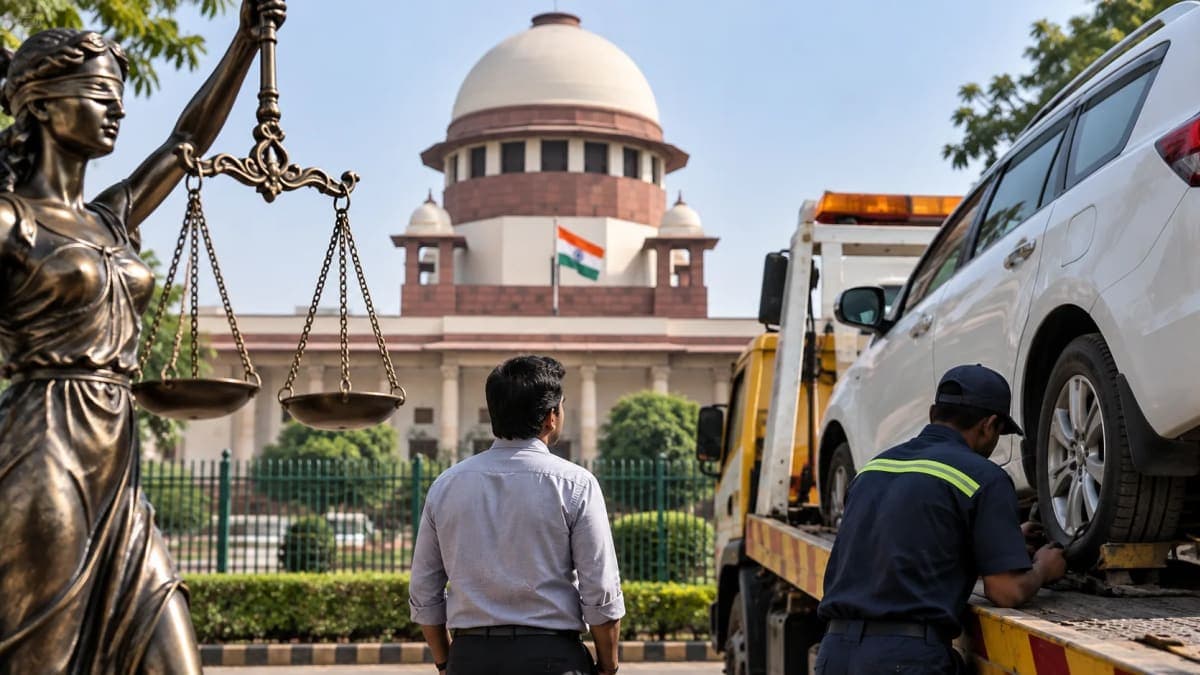
Supreme Court Says Banks, NBFCs Cannot Forcibly Seize Vehicles After Loan Default: What Borrowers Need to Know
Missing a vehicle-loan EMI does not give a bank or finance company a free hand to send recovery agents and simply take the vehicle away by force.
The Supreme Court has made that clear in an important ruling on vehicle-loan recovery. Banks and non-banking financial companies (NBFCs) may have the right to repossess a financed vehicle after a default, but they must do so according to the law, the terms of the loan agreement and Reserve Bank of India (RBI) guidelines.
The September 16, 2026 judgment in Hari Dutta Sharma v. State of U.P. & Ors. involved a commercial truck financed by Cholamandalam Investment and Finance Company Limited. The Court found that the truck had been repossessed without the seven-day notice required under the agreement and that the process followed was neither peaceful nor consistent with due process.
There is, however, an important distinction here. The Supreme Court has not said that banks and NBFCs can never repossess a vehicle after a borrower defaults. It recognised that a valid loan agreement may give the lender that right. What lenders cannot do is use force or ignore the safeguards that are supposed to govern repossession.
How the dispute began
Hari Dutta Sharma took a commercial vehicle loan on March 25, 2019 to purchase a Tata SFC 407 truck.
The sanctioned loan was ₹10,40,080.75, of which ₹9.36 lakh was disbursed. It was to be repaid over 75 monthly instalments, with the truck hypothecated as security. Sharma later received a supplementary loan of ₹1,04,080.75 in June 2021.
He subsequently fell behind on repayments.
This was not the first time the lender had acted over the default. The truck had earlier been repossessed and was released after Sharma paid ₹86,726 and agreed to regularise his loan account. More defaults followed, and notices were issued on July 7 and December 22, 2022.
The dispute before the Supreme Court largely turned on what happened after that.
Sharma told the Court that on April 9, 2023, his truck was parked after delivering goods at a godown in Ayodhya. According to his version, four unidentified people broke the steering lock at around 1 a.m. and drove the truck away.
He claimed that he had received no repossession notice before the vehicle was taken. A lost-article report and an e-FIR were filed on the same day.
The finance company presented a different account. It pointed to Sharma's repeated repayment defaults and maintained that pre-seizure intimation, an inventory, post-seizure intimation and a pre-sale notice had been provided to the relevant parties.
But one detail proved particularly important: the Supreme Court found that the seven-day notice contemplated under the loan agreement had not been issued before this repossession. The Court also noted that Sharma's signature was missing from the possession memorandum.
Default doesn't mean a lender can use any recovery method
This is probably the most important takeaway for anyone with a car, two-wheeler or commercial vehicle loan.
The Supreme Court did not remove a lender's right to repossess a financed vehicle.
It accepted that this right can arise from the loan agreement itself. Such security arrangements are also an important part of vehicle financing, particularly for borrowers such as small transport operators who may not have other assets to offer as collateral.
But having a repossession clause in an agreement is not the same as having unlimited authority to seize a vehicle.
The Court said repossession must happen through lawful means. Banks and financial institutions cannot use musclemen to forcibly take possession of vehicles. Recovery agents are expected to follow applicable RBI guidelines, while repossession clauses must also comply with the Indian Contract Act, 1872.
That makes the ruling more specific than headlines suggesting that banks have simply been barred from seizing vehicles.
A lender can still have a legal and contractual right to repossess. What it cannot assume is that a missed payment allows it to use whatever recovery method it wants.
RBI rules already place limits on recovery practices
Many of these protections existed even before this Supreme Court judgment.
RBI's framework has long discouraged lenders from using harassment or intimidation to recover loans. That includes repeatedly contacting borrowers at unreasonable hours and using muscle power.
There are more specific safeguards when it comes to vehicle financing by NBFCs.
An RBI clarification issued in April 2009 said that a legally enforceable repossession clause should be included in the loan agreement. To keep the process transparent, the agreement should spell out important details such as the notice period before repossession, situations where notice may be waived, the procedure for taking possession, the borrower's final opportunity to repay before a sale or auction, how the vehicle can be restored to the borrower and the procedure for selling or auctioning it.
The Supreme Court's ruling brings these protections back into focus. It also emphasises that recovery agents have to comply with applicable guidelines and that complaints about abusive recovery practices cannot simply be brushed aside.
In other words, whether money is owed is only one part of the issue. How a lender goes about recovering its secured asset matters too.
The loan agreement itself came under scrutiny
Another notable part of the case was the Court's examination of the actual loan agreement.
Article 11 provided for seven days' notice before repossession. At the same time, other provisions allowed the company to waive that notice in certain circumstances at its own discretion.
The Supreme Court found this problematic because it effectively gave the financier too much unilateral control over a safeguard meant to protect the borrower.
The Court also raised concerns about provisions that allowed recovery agents to enter places while searching for the financed asset, as well as the lack of sufficiently clear procedures governing possession and the eventual sale of the vehicle.
In Sharma's case, the required seven-day notice had not been issued. As a result, the Court held that the company's contractual right to repossess the vehicle had not arisen in the manner it claimed.
Sharma gets ₹10 lakh compensation
By the time the legal battle reached its conclusion, returning the truck was no longer a practical option because the vehicle had already been sold.
The finance company sold it for ₹4.5 lakh on August 31, 2023.
The Supreme Court did not reverse the completed sale. Instead, it ordered the company to close both of Sharma's loan accounts and refund the ₹4.5 lakh sale proceeds, along with interest at 6% per annum from the date of sale until payment.
Sharma was also awarded ₹10 lakh as compensation for the mental agony and loss of livelihood he suffered for a considerable period. The Court imposed another ₹50,000 in costs.
The livelihood issue was particularly significant because Sharma depended on the truck to earn a living. The Court held that the arbitrary deprivation of that livelihood violated Articles 14 and 21 of the Constitution.
Supreme Court puts the RBI on notice over compliance
The judgment isn't limited to what happened between one borrower and one finance company.
The Supreme Court noted that RBI guidelines, master circulars and clarifications covering banks and NBFCs have existed for years, yet implementation has not always matched what the rules require.
It therefore directed the RBI to take effective steps to ensure “genuine compliance” by NBFCs and scheduled commercial banks. The Court's Registry was also directed to forward a copy of the judgment to the RBI.
That part of the ruling could have wider consequences for the lending industry.
Rules against coercive recovery practices are useful only when lenders, recovery agencies and the people working on the ground actually follow them. The Court's direction puts fresh attention on that gap between written policy and real-world recovery practices.
What should vehicle-loan borrowers take from the ruling?
First, the judgment does not wipe out a borrower's repayment obligations.
If EMIs are unpaid, lenders can still pursue legitimate remedies available under the loan agreement and the law. Borrowers should therefore not interpret the judgment as permission to stop making repayments or ignore default notices.
At the same time, falling behind on a loan does not mean a borrower gives up all procedural protections.
If a vehicle is being repossessed, several questions can become important. Does the loan agreement contain a legally valid repossession clause? Was the required notice actually served? Was the borrower given the opportunity required under the agreement to clear the default? Was possession obtained peacefully and lawfully? And if the vehicle was later sold, was the prescribed sale or auction procedure followed?
These aren't minor technicalities. They can determine whether a repossession that might otherwise have been permitted becomes legally vulnerable.
For banks and NBFCs, the judgment also makes documentation and recovery-agent conduct harder to treat as routine formalities. Using force, bypassing notice requirements or failing to properly record the repossession can expose a lender to legal consequences.
Why this ruling matters beyond this particular case
There are two competing concerns at the heart of vehicle financing.
Banks and NBFCs need a practical way to enforce security when borrowers default. Without that protection, vehicle loans—particularly loans to borrowers without substantial collateral—could become more difficult or expensive to offer.
But the other side of the equation matters just as much. If lenders or their agents are allowed to take possession however they choose, a contractual recovery right can quickly turn into coercion.
The Supreme Court's ruling tries to draw the line between the two.
It isn't a ban on repossession. It is a reminder that repossession has to be lawful.
For vehicle-loan borrowers, that's an important difference. Missing payments can lead to recovery action and even the loss of a financed vehicle, but being in default does not put a borrower outside the protection of the law.