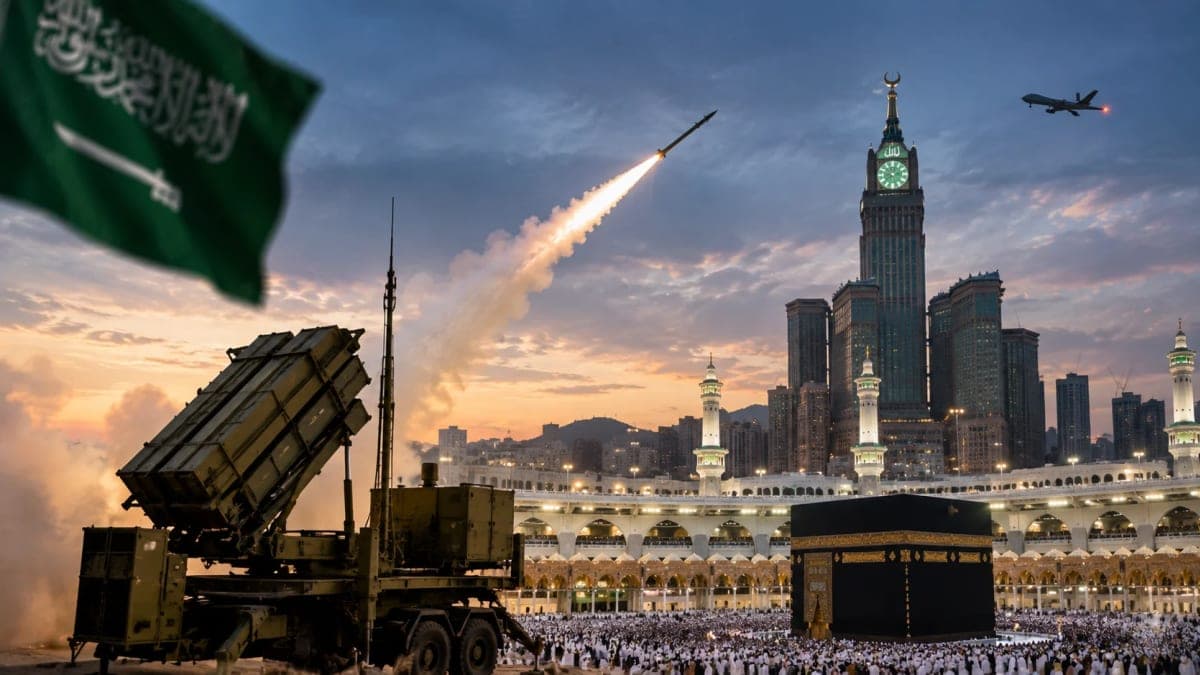
A rapidly escalating confrontation between Saudi Arabia and Yemen's Houthis has reached the vicinity of Islam's holiest city, with Saudi authorities saying air defences intercepted and destroyed a drone south of Mecca before it could enter the city's restricted airspace.
The incident followed a rare security warning in Mecca, as well as alerts in Jeddah and Taif, amid a renewed wave of missile and drone attacks on Saudi territory.
Saudi Arabia blamed the Houthis for the drone and described the security of Mecca, the Two Holy Mosques and pilgrims as a “red line”.
The Houthis dispute that account.
A Houthi military source denied that Yemen posed any threat to Mecca or other Islamic holy sites, while another Houthi official publicly rejected Saudi allegations that the group was targeting the city.
At the same time, the United States has updated its travel advisory for Saudi Arabia to Level 3 — Reconsider Travel, citing armed conflict, terrorism and the risk of Iranian drone and missile attacks on American interests.
Together, the developments mark a significant escalation in a conflict that had remained substantially quieter along the Saudi-Yemen frontier after the 2022 UN-mediated truce.
What Saudi Arabia says happened near Mecca
The Saudi-led coalition issued its official account on September 16.
According to a statement carried by the Saudi Press Agency, Royal Saudi Air Defence Forces intercepted and destroyed what the coalition described as a hostile drone attempting to enter Mecca's airspace.
Coalition spokesman Major General Turki Al-Malki said the interception occurred south of Mecca.
The Saudi statement characterised the incident as the second attempt to target Mecca, referring to an earlier ballistic-missile episode.
Saudi authorities have presented the latest incident as a direct threat to civilians, worshippers and the security of the holy city.
That is Saudi Arabia's official account. Independent reporting confirms that Saudi authorities announced the interception, but publicly available evidence does not independently establish every element of the drone's intended target.
Houthis deny targeting Mecca
The Houthi side rejects Saudi Arabia's characterisation.
A Houthi military source, speaking through Yemen's Houthi-run SABA news agency, categorically denied that there was a threat from Yemen directed toward Mecca or other Islamic holy sites.
Houthi political bureau member Hazem al-Assad separately rejected the accusation on X.
The distinction is important.
The Houthis have acknowledged responsibility for other recent attacks against Saudi targets, but they deny that Mecca itself was their intended target in this incident.
Therefore, “Houthis attack Mecca” should not be presented as an independently established fact.
The more accurate formulation is:
Saudi Arabia says it intercepted a Houthi drone approaching Mecca's restricted airspace; the Houthis deny targeting Mecca or Islamic holy sites.
What happened to the Mecca security alert?
Before the drone interception became public, Saudi Civil Defense issued warnings of “potential danger” covering Mecca, Jeddah and Taif.
Residents were advised to remain indoors and stay away from windows and open areas.
The alerts were brief and were subsequently lifted.
AFP reported that the warning in Mecca was the first such alert there since the current Middle East war began.
Some coverage has described it as Mecca's “first-ever” missile or aerial-threat alert. That wording is not sufficiently supported by the authoritative material reviewed for this article and should be avoided.
Saudi Arabia itself says Mecca faced an earlier attempted attack involving a ballistic missile.
Why an alert near Mecca is exceptionally sensitive
The geographical location changes the significance of this incident.
Mecca contains the Grand Mosque and the Kaaba, the holiest site in Islam.
Muslims around the world face the Kaaba during their daily prayers, while millions travel to the city for Hajj and Umrah.
That means even an intercepted weapon approaching the city's restricted airspace carries religious, diplomatic and security implications far beyond an ordinary military incident.
Saudi Arabia has accordingly framed the protection of the holy sites and pilgrims as an absolute security priority.
The Organisation of Islamic Cooperation also condemned the Houthi attacks affecting the Makkah and Madinah regions and expressed solidarity with Saudi Arabia.
This did not begin with the Mecca incident
The drone episode comes after several days of escalating attacks.
Saudi authorities say Houthi ballistic missiles and drones struck or threatened multiple locations in the kingdom.
The Saudi-led coalition reported that attacks affecting Khamis Mushait, Abha and Taif injured 13 civilians and damaged homes and vehicles.
Saudi Arabia subsequently warned that it would respond “firmly”.
The Houthis, meanwhile, have linked their recent military operations to Saudi actions in Yemen.
This represents a serious deterioration from the relative calm that followed the UN-mediated truce in April 2022.
Although that truce formally expired later in 2022, large-scale cross-border attacks between Saudi Arabia and the Houthis remained substantially reduced for years afterward.
The current exchange therefore represents a renewed phase of direct confrontation.
Why the Saudi-Houthi conflict matters beyond Yemen
The implications extend beyond the Saudi-Yemen border.
The Houthis control Sanaa and substantial territory in northern and western Yemen, including areas near the Red Sea.
Their missile, drone and maritime capabilities have increasingly given the movement the ability to affect security far beyond Yemeni territory.
That matters particularly because Yemen sits beside the Bab el-Mandeb Strait, one of the world's strategically important maritime chokepoints connecting the Red Sea with the Gulf of Aden.
Escalation involving Saudi Arabia therefore has potential consequences for shipping, energy markets and regional military calculations.
It also comes during a broader period of heightened confrontation involving Iran and its regional allies and partners.
The Houthis are aligned with Iran, although describing every Houthi military decision as directly ordered by Tehran would require evidence that is not publicly available for each individual operation.
US raises Saudi Arabia travel warning to Level 3
The security deterioration is now reflected in official American travel guidance.
The U.S. State Department's Saudi Arabia advisory, issued September 15, lists the country at:
Level 3 — Reconsider Travel.
The State Department cites several risks, including:
armed conflict;
terrorism;
potential Iranian drone and missile targeting of American interests;
exit bans; and
Saudi laws relating to social-media activity.
The United States separately says travellers should not travel to the Yemen border because of terrorism risks.
This is broader than a Mecca-specific warning.
The advisory does not state that Americans are prohibited from travelling to Saudi Arabia, nor does Level 3 mean the same thing as the State Department's highest Level 4 — Do Not Travel classification.
Travellers should therefore distinguish between a recommendation to reconsider travel to Saudi Arabia generally and the more severe warning applying to particular areas.
Is Mecca closed to pilgrims?
There is no authoritative announcement reviewed for this article saying that Mecca has been closed because of the latest incident.
Likewise, no official suspension of Umrah because of the drone interception had been announced at the time of publication.
The security warning was lifted after being activated briefly.
That could change if the conflict escalates, but claims that pilgrimage has already been suspended would be premature without an announcement from Saudi authorities.
Travellers and pilgrims should rely on Saudi government instructions and official airline and consular information rather than viral social-media posts.
Saudi Arabia calls the security of the holy sites a “red line”
Saudi officials have used unusually strong language following the incident.
The coalition says the security of Mecca, the Two Holy Mosques, worshippers and pilgrims represents a “red line”.
That language indicates Riyadh considers any weapon approaching the holy city's airspace qualitatively different from attacks on conventional military or infrastructure targets.
Saudi Arabia has also warned of deterrent measures in response to continued Houthi attacks.
What those measures will involve remains uncertain.
Any claims about a specific Saudi military retaliation should therefore be treated cautiously until Riyadh officially announces an operation or independently verifiable evidence emerges.
JantaScope Analysis: Three separate facts should not be merged into one headline
The speed of this story has produced a potentially misleading simplification online:
“Houthis fired a missile at Mecca, triggering Mecca's first-ever missile alarm.”
The evidence currently supports a more nuanced account.
First, Saudi Arabia says it intercepted a drone, not simply a missile, south of Mecca before it entered restricted airspace.
Second, the Houthis deny that Mecca or another Islamic holy site was their intended target.
Third, a rare emergency warning was indeed activated in Mecca, but describing it as the city's first-ever missile alert goes beyond what authoritative sources currently establish.
Those distinctions do not make the incident insignificant.
Quite the opposite.
A hostile drone approaching restricted airspace around Mecca during an escalating Saudi-Houthi confrontation is itself an extraordinary security development.
But separating what Saudi Arabia alleges, what the Houthis deny and what has been independently established makes the story stronger rather than less dramatic.
What to watch next
Three developments now matter most.
The first is whether Saudi Arabia launches a broader military response against Houthi-controlled areas of Yemen after promising a firm reaction.
The second is whether missile and drone alerts spread deeper into western Saudi Arabia or repeatedly affect Mecca, Jeddah and Taif.
The third is whether the deterioration begins affecting Umrah operations, commercial aviation or Red Sea shipping.
At publication time, the available evidence confirms a serious escalation — but not the closure of Mecca, suspension of pilgrimage or an independently established Houthi decision to deliberately strike the Grand Mosque or Kaaba.