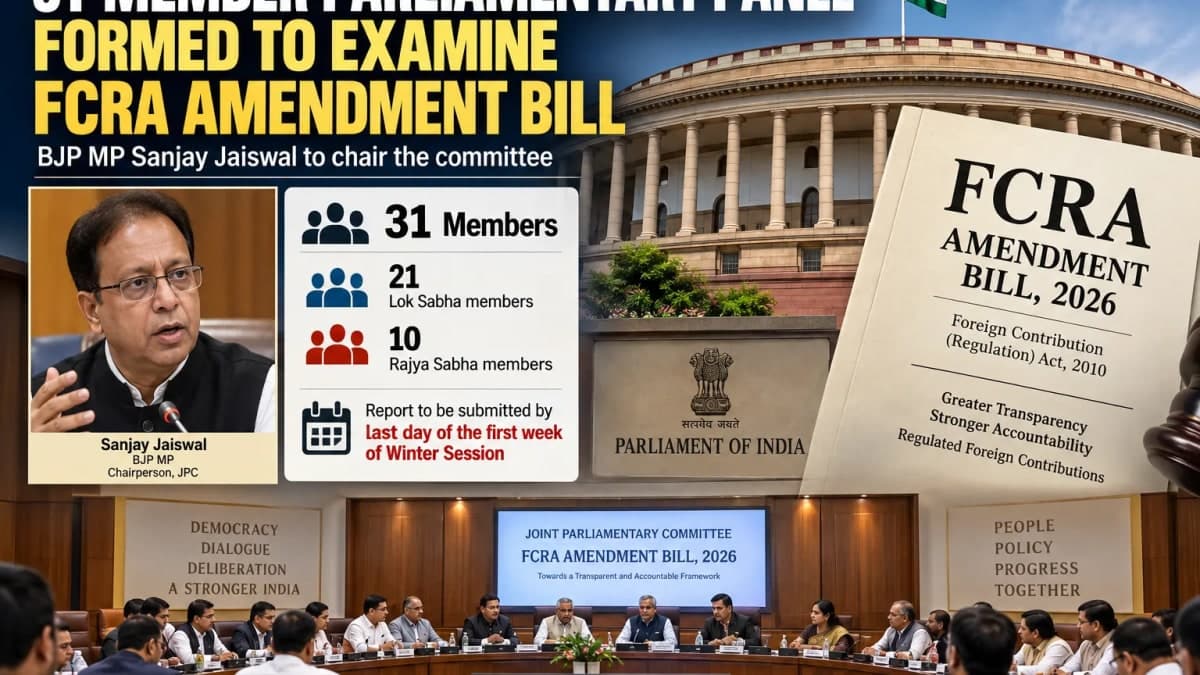
A 31-member Joint Parliamentary Committee (JPC) has been constituted to examine the Foreign Contribution (Regulation) Amendment Bill, 2026, moving the proposed legislation into a detailed stage of parliamentary scrutiny after weeks of political debate over its provisions.
Lok Sabha Speaker Om Birla constituted the committee, with BJP MP Sanjay Jaiswal appointed as its chairperson. The panel brings together 21 members of the Lok Sabha and 10 members of the Rajya Sabha.
The committee will examine proposed changes to the law governing foreign contributions in India at a time when the government and Opposition have offered sharply different assessments of the Bill.
Who Is on the 31-Member Committee?
The committee reflects representation from several political parties.
Of its 31 members, 14 are from the BJP and five from the Congress. The JD(U), Trinamool Congress and DMK have two members each, while the Samajwadi Party, Indian Union Muslim League, Shiv Sena, NCP (SP), NCP and TDP have one member each.
Among the prominent Lok Sabha members on the committee are Sanjay Jaiswal, Bhartruhari Mahtab, Tejasvi Surya, Nishikant Dubey, A. Raja and Supriya Sule.
The Rajya Sabha representatives include Harsh Vardhan Shringla, Sanjay Kumar Jha, Praful Patel and Menaka Guruswamy.
Key Lok Sabha Members
Apart from chairperson Sanjay Jaiswal, BJP representatives from the Lok Sabha include Bhartruhari Mahtab, Tejasvi Surya, Kamlesh Jangde, Mukeshkumar Chandrakaant Dalal, Nishikant Dubey, Vishnu Dayal Ram, Ananta Nayak and Arvind Dharmapuri.
Congress members from the Lok Sabha include Anto Antony, Captain Viriato Fernandes, Muhammed Hamdullah Sayeed and Kali Charan Munda.
Other members include Zia Ur Rehman of the Samajwadi Party, Kalyan Banerjee of the TMC, A. Raja of the DMK, Lavu Sri Krishna Devarayalu of the TDP, Naresh Ganpat Mhaske of Shiv Sena, Kaushalendra Kumar of the JD(U), Supriya Sule of the NCP (SP) and E. T. Mohammed Basheer of the IUML.
Rajya Sabha Representation
The BJP's representatives from the Rajya Sabha include C. Sadanandan Master, Harsh Vardhan Shringla, Ujjwal Deorao Nikam, Alka Gurjar and Sat Paul Sharma.
Other Rajya Sabha members on the panel are Praful Patel of the NCP, Sanjay Kumar Jha of the JD(U), Christopher Manickam of the Congress, Menaka Guruswamy of the TMC and P. Wilson of the DMK.
Why Was the FCRA Amendment Bill Sent to a JPC?
Both Houses of Parliament approved referring the Foreign Contribution (Regulation) Amendment Bill, 2026, to a Joint Parliamentary Committee on August 12.
The Bill seeks to further amend the Foreign Contribution (Regulation) Act, 2010, which provides the legal framework governing the acceptance and utilisation of foreign contributions.
The stated objective of the proposed legislation is to strengthen transparency and accountability in the use of foreign contributions.
Its referral to a parliamentary committee came amid objections from Opposition parties, which alleged that the proposed changes could adversely affect minorities and non-governmental organisations.
The government has rejected those allegations and maintained that the legislation is not religion-specific. It has argued that the proposed framework is aimed at regulating foreign contributions rather than discriminating against any particular community.
Those competing positions are important because claims about the Bill targeting minorities remain political allegations rather than established findings.
What Does the Amendment Bill Propose?
One significant element reported in connection with the Bill concerns the handling of assets when an organisation loses its FCRA registration.
The proposed legislation seeks to establish a designated authority to manage and dispose of assets in cases where an organisation's FCRA licence is cancelled, withdrawn or otherwise ceases to remain valid under the applicable provisions.
This has emerged as one of the areas attracting scrutiny.
Critics have expressed concern about the potential impact of stronger executive control over the assets of affected organisations, including NGOs and institutions receiving foreign contributions.
The government, however, has defended the broader amendments as measures intended to improve oversight, transparency and accountability surrounding foreign funding.
The JPC process provides Parliament with an opportunity to examine such competing arguments in greater detail before the legislation proceeds further.
Committee Faces Winter Session Deadline
The newly constituted panel has been asked to submit its report to the Lok Sabha by the last day of the first week of Parliament's Winter Session.
That timetable makes the committee's review an important next stage in the Bill's legislative journey.
A parliamentary committee can examine provisions in greater detail than is generally possible during floor debate. Its scrutiny may involve analysing individual clauses, considering concerns surrounding implementation and evaluating submissions or views relevant to the proposed legislation.
The committee can then present its findings and recommendations to Parliament.
Its recommendations will therefore be closely watched, although the committee's report itself will not automatically determine the final wording of the law.
Why the FCRA Debate Matters
The Foreign Contribution (Regulation) framework sits at the intersection of two significant policy concerns.
On one side is the government's responsibility to ensure that money entering India from foreign sources is properly accounted for and used in accordance with the law.
On the other is the ability of legitimate organisations—including NGOs, educational institutions and social-welfare organisations—to receive foreign support for permitted activities.
Changes to the regulatory framework can consequently have implications beyond administrative compliance.
This explains why the 2026 amendment has generated debate not only in Parliament but also among organisations and political leaders concerned about how tighter rules could operate in practice.
What Happens Next?
With the JPC now constituted, attention shifts from the political battle over whether the Bill should receive further scrutiny to the substance of that scrutiny.
The committee will examine the proposed amendments before submitting its report to the Lok Sabha.
Its conclusions will be important because they could identify provisions requiring clarification, modification or reconsideration before Parliament takes the legislation forward.
The formation of the 31-member committee therefore does not settle the debate over the FCRA Amendment Bill. Instead, it begins a more detailed parliamentary examination of one of the key regulatory proposals concerning foreign contributions in India.