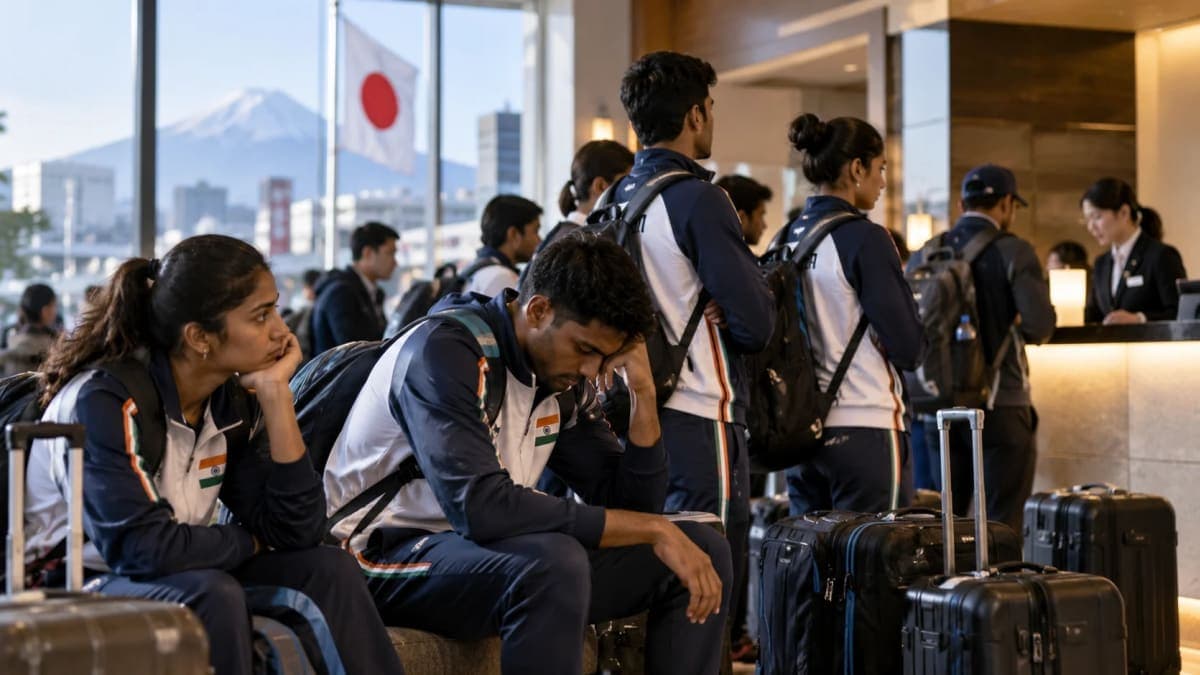
A Difficult Start to India’s Final Asian Games Preparations
India’s track-and-field athletes travelled to Japan expecting their final days before the 2026 Asian Games to be about training and acclimatisation.
Instead, their arrival has been followed by reports of a prolonged hotel check-in, missing breakfast, transport trouble and inconvenient meal arrangements.
According to a Times of India report published on September 16, India’s athletics contingent reached its hotel at around 10 am local time on Sunday but had to wait more than four hours before completing check-in. The men's team, women's team and coaches were reportedly placed across three separate hotels, each more than four kilometres from the squad's training facility in Tsukuba.
The problems reportedly continued the following morning.
Sources quoted by the newspaper said the men’s athletics squad did not receive breakfast at the hotel on Monday because hotel staff said they had not been notified that breakfast was required for the athletes. Some athletes reportedly went without breakfast, while others went outside to find food.
These details have subsequently been reported by Gulf News as well, but its account attributes the core claims to the original Times of India reporting.
That sourcing distinction is important: at the time of publication, JantaScope could not independently locate an official AFI, IOA or Aichi-Nagoya organising committee statement confirming the breakfast incident.
A Four-Hour Wait Was Only the Beginning, Report Says
The reported breakfast problem was not the only disruption.
According to the same sources, a designated bus that was supposed to collect the men's contingent for a training session failed to arrive on Monday evening.
The athletes were in Tsukuba for their final preparations at the University of Tsukuba ground, according to the report.
The men's and women's teams and coaches were reportedly staying in three separate hotels more than four kilometres from that training location. They also had to travel roughly four kilometres for lunch and dinner.
For an athletics squad in the final preparation phase before a major championship, those details matter because accommodation, meals, recovery and transport all have to fit around carefully scheduled training.
There is no evidence at this stage, however, that the reported disruptions have affected any athlete's competitive performance.
What Was Reported About the Athletes’ Food?
The food issue requires some nuance.
The reporting does not establish that Indian athletes were continuously left without meals in Japan.
Rather, the specific allegation is that the men's contingent was not booked for breakfast at its hotel on Monday morning.
Sources also told the Times of India that the regular breakfast available at the Japanese hotel consisted of rice and soybeans, while meals at an Indian restaurant included rice, roti and chicken. They further alleged that there was no special diet and no regular provision of fruit.
Gulf News subsequently reported the same details.
Claims that the entire Indian contingent was being denied adequate food would therefore go beyond what the available evidence supports.
The more precise issue is a reported breakdown in meal booking and logistics for the men's athletics team, combined with concerns attributed to sources about the food arrangements available during the pre-Games camp.
Why Is India’s Athletics Team in Tsukuba?
The Asian Games themselves are being staged in Aichi-Nagoya, but India's athletics contingent travelled to Tsukuba for final preparations before competition.
The 20th Asian Games are scheduled to take place in Japan from September 19 to October 4, 2026, with athletes representing 45 countries and regions.
That means the reported problems occurred only days before the Games formally begin.
This timing is significant. The final period before a major competition is typically used for acclimatisation, training, recovery and preparation rather than heavy workloads.
The logistical issues therefore arrived at an inconvenient moment, even though there is currently no verified evidence showing that they have materially compromised India's competition preparations.
The Bigger Story: Asian Games Accommodation Was Already Under Pressure
The Indian athletics episode has emerged against a broader backdrop of accommodation pressure surrounding the Aichi-Nagoya Games.
This is not merely speculation.
The Aichi-Nagoya Asian Games Organising Committee (AINAGOC) has publicly acknowledged that the expected number of delegation members exceeded the accommodation capacity originally planned for the Games.
According to an official organising committee statement, accommodation preparations had initially been made for approximately 15,000 delegation members.
When the expected number exceeded that capacity, AINAGOC and the Olympic Council of Asia decided that certain team officials would arrange accommodation through their respective National Olympic Committees instead of using accommodation supplied by the organisers. The OCA notified NOCs of the arrangement on August 24, and an online briefing followed on August 26.
The organisers stressed that these measures were not intended to reduce participation and said preparations were being made in coordination with the OCA and individual NOCs.
This does not establish that the broader accommodation-capacity problem caused India's reported difficulties in Tsukuba.
But it provides important context: accommodation logistics for delegations had already required adjustments before the Games began.
India Is Not the Only Delegation Raising Accommodation Concerns
Concerns about Games accommodation have also emerged from other national delegations.
South Korean officials publicly criticised accommodation arrangements ahead of the Games, describing some conditions as the country's worst Asian Games experience. Concerns reported by AFP included rooms and beds considered unsuitable for some taller athletes.
That does not prove a direct connection with India's reported hotel or meal problems.
It does, however, show that the Indian athletics story has emerged amid wider scrutiny of how thousands of athletes and officials are being housed during the event.
Why Logistics Matter More in Athletics Than They May Appear
A missed breakfast or delayed bus can sound relatively minor compared with competition itself.
In elite sport, however, the timing makes logistical consistency important.
Track-and-field athletes frequently organise training, meals, hydration, treatment and sleep around competition schedules. A transport delay can disrupt a planned training window; irregular meals can interfere with routines athletes have followed during preparation.
That does not mean one missed meal or delayed training session will automatically affect results.
There is currently no verified evidence that the incidents reported in Tsukuba have harmed the performance or health of any Indian athlete.
The relevant question is therefore not whether the episode has already cost India medals. There is no basis for such a conclusion.
The issue is whether avoidable logistical problems are being minimised during the narrow preparation window immediately before a major continental competition.
Where Responsibility Remains Unclear
One aspect of the story needs particular care.
The Times of India quoted unnamed sources who described the breakfast episode as exposing inadequate planning by officials deputed by the Athletics Federation of India.
That is an attributed assessment from the newspaper's sources, not an independently established finding.
JantaScope has not found publicly available evidence establishing exactly who was responsible for booking the breakfast, arranging the relevant hotel services or coordinating the bus that reportedly failed to arrive.
Nor did the material reviewed for this article establish whether responsibility lay with AFI officials, another Indian delegation body, local contractors, the hotels, transport providers, Games organisers or a combination of parties.
Until an official explanation establishes the chain of responsibility, attributing the failure definitively to one organisation would be premature.
JantaScope Analysis: There Are Actually Two Stories Here
The immediate story is straightforward: Indian athletes reportedly encountered a series of avoidable logistical problems soon after arriving in Japan.
The broader story is more complicated.
The official organising committee has already acknowledged that delegation numbers exceeded its original accommodation planning capacity and that alternative arrangements had to be introduced for some officials.
At the same time, South Korea has publicly raised separate concerns about accommodation conditions.
India's reported difficulties therefore deserve examination in the context of a Games operation managing a very large international delegation footprint.
But that context should not be used to assign responsibility for India's specific problems without evidence.
For the Indian contingent, the most important development now will be whether the meal, transport and accommodation arrangements stabilise before competition begins.
Asian Games Begin September 19
The 2026 Asian Games officially run from September 19 to October 4 in Aichi-Nagoya, Japan.
India arrives at the Games after its record performance at Hangzhou 2022, where the country crossed the 100-medal mark for the first time at an Asian Games.
The immediate priority for the athletics contingent will therefore be moving beyond the reported arrival problems and completing its final preparation before competition.
Whether the logistical episode remains an isolated pre-Games disruption or becomes part of a wider pattern will depend on what happens over the coming days.