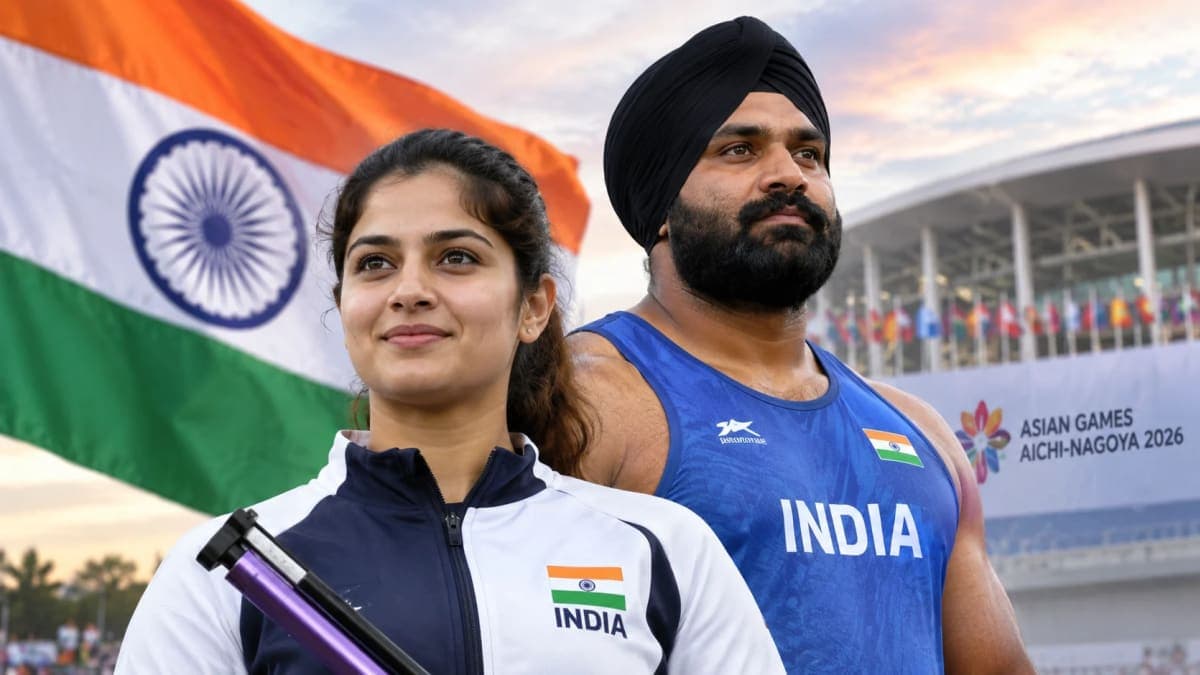
India will have two familiar sporting faces leading its contingent at the Asian Games opening ceremony in Japan. Double Olympic medallist Manu Bhaker and two-time Asian Games shot put champion Tajinderpal Singh Toor have been named the country’s flag-bearers for the Aichi-Nagoya 2026 opening ceremony on September 19.
India’s Chef de Mission Sahdev Yadav confirmed Bhaker’s selection on Friday, September 18, saying, “Manu Bhaker will be one of the flag-bearers.” The Athletics Federation of India later confirmed Toor as the second flag-bearer.
It is a pairing that brings together two very different success stories in Indian sport. Bhaker heads to Japan after becoming one of the standout performers of India’s Paris 2024 Olympic campaign. Toor, meanwhile, has already won the Asian Games shot put title twice and will be trying to make it three in a row.
Their selection also comes at an important time for Indian sport. After a record-breaking Asian Games in Hangzhou, expectations are naturally higher this time. India is no longer heading into the event simply hoping to improve on its previous medal tally. The challenge now is to show that the success of 2023 can be sustained.
Manu Bhaker returns as a double Olympic medallist
Bhaker’s place at the front of the Indian contingent comes two years after the biggest moment of her career.
At the Paris Olympics, she won bronze in the women’s 10m air pistol to become the first Indian woman to win an Olympic medal in shooting. She then teamed up with Sarabjot Singh in the 10m air pistol mixed team event, where the Indian pair defeated South Korea 16-10 in the bronze-medal match.
That second medal put Bhaker in a special place in Indian Olympic history. She became the first athlete from independent India to win two medals at a single edition of the Olympic Games.
What made the achievement even more remarkable was what had happened three years earlier.
Bhaker arrived at the Tokyo Olympics in 2021 as one of India’s biggest shooting hopes but left without a medal. Paris turned out very differently. Instead of returning empty-handed, she came home with two bronze medals and became one of the most recognisable faces of India’s campaign.
She now arrives in Aichi-Nagoya at 24 with a very different status. She is no longer just a talented shooter carrying expectations into a major competition. She is a proven Olympic medallist who has already experienced both disappointment and success on sport’s biggest stage.
Being asked to carry the national flag is another significant moment in that journey.
Tajinderpal Singh Toor has unfinished business in Japan
Tajinderpal Singh Toor’s Asian Games story is built around consistency.
The Indian shot putter first won gold at the 2018 Asian Games in Jakarta, producing a throw of 20.75 metres. China’s Liu Yang finished second with 19.52m, leaving Toor comfortably clear of the rest of the field.
Five years later, at the delayed Hangzhou Asian Games, he did it again.
Toor successfully defended his title with a best throw of 20.36m. Saudi Arabia’s Mohamed Daouda Tolo pushed him hard with 20.18m, while Liu Yang took bronze with 19.97m.
That means Toor heads into the 2026 Games with the chance to win a third consecutive Asian Games shot put gold.
Few athletes get the opportunity to dominate an event across three editions of a continental championship, particularly over an eight-year period. That gives Toor’s appearance in Japan an extra edge.
The Olympic Council of Asia has also listed him among India’s returning individual Asian Games champions, alongside established names such as Neeraj Chopra, Avinash Sable, Parul Chaudhary and Annu Rani.
His selection as flag-bearer therefore feels closely connected to what he has already achieved at this competition. While Bhaker arrives with fresh Olympic success behind her, Toor returns to an event where he has been the man to beat for two editions.
Shooting and athletics were crucial to India's Hangzhou success
There is another reason the Bhaker-Toor pairing stands out.
They represent shooting and athletics, the two sports that contributed heavily to India’s record medal haul at the previous Asian Games.
India finished Hangzhou with 107 medals — 28 gold, 38 silver and 41 bronze. It was the first time the country crossed the 100-medal mark at an Asian Games.
Athletics alone delivered 29 medals, while shooting contributed another 22. Together, the two sports accounted for 51 medals, nearly half of India's total.
That makes the choice of Bhaker and Toor particularly relevant.
Indian shooting now has considerable depth across pistol, rifle and shotgun events, while athletics has grown into a much broader source of medals than it was in earlier Asian Games cycles.
The challenge is whether those sports can deliver at a similar level in Japan.
Hangzhou set a new benchmark, and once a country has crossed 100 medals, comparisons with that performance become unavoidable. But matching a previous total is never straightforward. Form changes, athletes change, events evolve and rivals improve.
India heads to Aichi-Nagoya with 503 athletes
India’s final contingent for the 20th Asian Games stands at 503 athletes.
Sports Minister Mansukh Mandaviya was joined by Indian Olympic Association president P.T. Usha, Sports Secretary Hari Ranjan Rao and Chef de Mission Sahdev Yadav at the official send-off for the contingent in New Delhi earlier this month.
There has been some confusion over the size of the Indian squad because an earlier figure of 492 athletes was officially announced in August.
That initial list included 265 men and 227 women, with athletics forming India's biggest group at 73 athletes. Subsequent additions took the final contingent to 503.
India will still have fewer athletes than it did at Hangzhou, where 655 competitors represented the country.
The difference makes direct medal-table comparisons less straightforward. India’s 107 medals in Hangzhou came from its largest-ever Asian Games contingent. This time, the squad is smaller, but it still includes established champions and medal contenders across a wide range of disciplines.
Asian Games return to Japan after 32 years
The 20th Asian Games officially run from September 19 to October 4, although competition in some events began before the opening ceremony.
More than 11,000 athletes and roughly 6,000 officials from 45 countries and regions are expected to be involved. The programme includes 43 sports and 469 medal events, with the Games carrying the official motto “Imagine One Asia.”
Japan is hosting the Asian Games for the third time.
Tokyo staged the competition in 1958 and Hiroshima hosted it in 1994. Aichi-Nagoya therefore brings the Asian Games back to Japan after a gap of 32 years.
This edition also looks different behind the scenes.
Instead of relying on a conventional central athletes’ village, organisers are using a mix of hotels, temporary accommodation and a cruise ship to house athletes and officials. The Olympic Council of Asia has defended the approach, arguing that it helps control costs and avoids creating expensive infrastructure that may have little use once the Games are over.
Once the opening ceremony is finished, however, those organisational issues are likely to take a back seat as attention turns to competition.
Why Bhaker and Toor are fitting choices
Carrying the flag has no effect on what happens in competition, but the choice of Bhaker and Toor says something about the athletes India is taking into these Games.
Bhaker represents one of Indian sport’s biggest recent Olympic success stories. Her journey from a difficult Tokyo campaign to two medals in Paris showed how quickly an athlete’s fortunes can change at the highest level.
Toor’s story is different. His reputation has been built on repeatedly delivering at the Asian Games. Gold in Jakarta was followed by gold in Hangzhou, and Japan now offers him the chance to complete a hat-trick.
Together, they also represent two sports that were at the heart of India's breakthrough in Hangzhou.
That 107-medal performance changed expectations. India showed it could compete for medals across a much wider group of sports rather than relying on a handful of disciplines or individual stars.
The question now is whether that depth can be maintained.
The answer will come over the next two weeks, across hundreds of events and performances. But before the medals are decided, Bhaker and Toor will have one of the most visible roles of the opening night — walking into the ceremony carrying the Indian flag.
For Bhaker, it is another milestone after her breakthrough in Paris. For Toor, it comes as he prepares to defend a title he has held since 2018.
And for India, the two flag-bearers offer a fitting link between the country's recent sporting progress and the expectations it carries into Aichi-Nagoya.